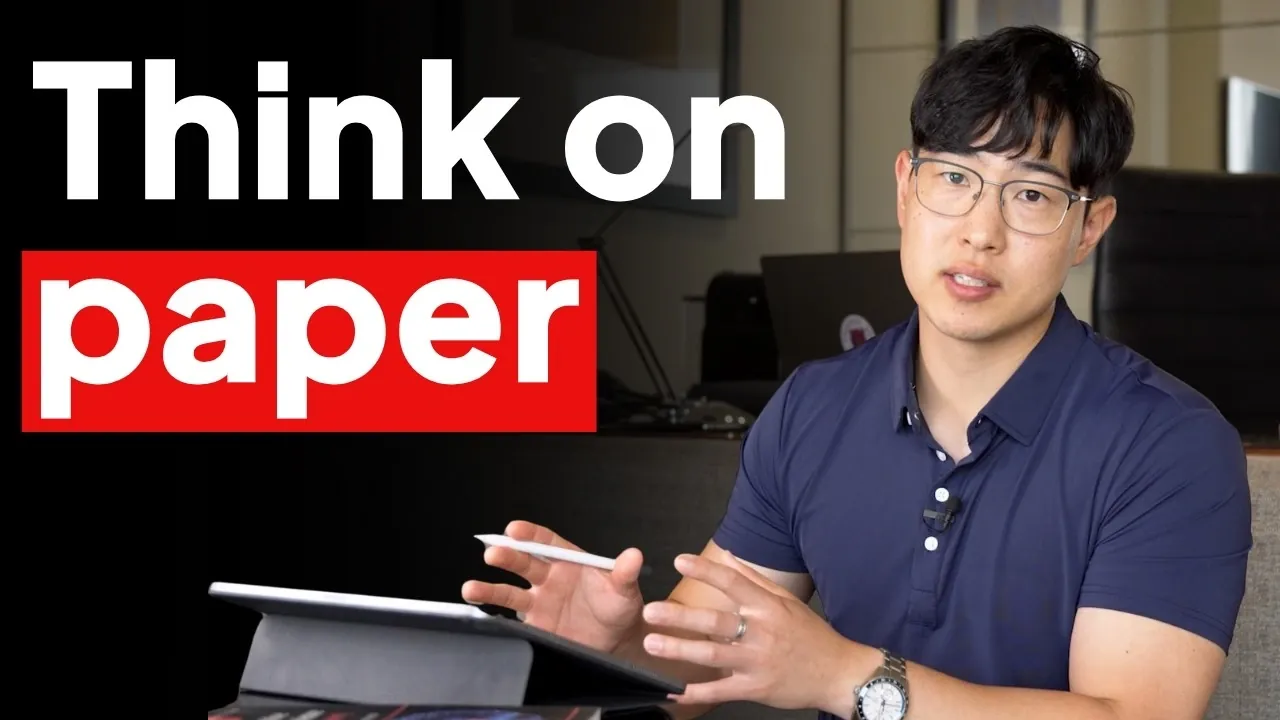
Thinking on paper is a structured approach to learning that emphasizes externalizing your thoughts to reduce mental overload and improve understanding. As explained by Justin Sung, this method involves three key principles: “Make it Wrong,” “Make it Shorter,” and “Make it Again.” By starting with unfiltered ideas, condensing them into concise summaries, and revisiting them iteratively, you create a visual framework that fosters clarity and retention. Unlike passive note-taking, this process actively engages your mind, helping you break down complex topics and uncover meaningful connections.
In this tutorial, you will discover how to apply these principles to enhance your ability to learn and solve problems. You’ll explore how capturing raw ideas without worrying about accuracy can lead to unexpected insights, why condensing information helps you focus on key concepts, and how revisiting your notes reinforces memory and understanding. Whether you’re tackling a challenging subject or organizing your thoughts for a project, this method offers a practical way to approach learning with confidence and efficiency.
What is Thinking on Paper?
TL;DR Key Takeaways :
- Thinking on paper is a structured learning technique that externalizes thoughts, reduces mental overload, and enhances clarity, retention, and application of complex topics.
- The method is built on three core principles: “Make it Wrong” (capture raw ideas), “Make it Shorter” (condense key points), and “Make it Again” (refine and reorganize iteratively).
- It addresses the limitations of mental organization by creating a visual framework that promotes critical thinking, pattern recognition, and deeper understanding.
- Practical applications include studying, problem-solving, organizing meetings, and personal development, making it a versatile tool for various scenarios.
- Key benefits include faster problem-solving, improved memory retention, deeper comprehension, and the ability to uncover patterns and connections effectively.
Thinking on paper is a deliberate method of transferring your thoughts, ideas, and insights from your mind onto paper. This process reduces cognitive strain, allowing you to focus on identifying patterns, connections, and gaps in your understanding. Unlike passive note-taking, which often involves copying information without deeper engagement, thinking on paper encourages you to actively process and refine your ideas. By externalizing your thoughts, you create a visual framework that enhances clarity and promotes critical thinking.
Why Relying on Mental Organization Falls Short
Attempting to organize and retain information solely in your mind can quickly become overwhelming. The human brain has limited capacity for juggling multiple ideas simultaneously, and relying on memory alone often leads to confusion, missed connections, and incomplete understanding. Similarly, unstructured or overly detailed notes can clutter your thinking, making it harder to extract key insights. Thinking on paper addresses these challenges by offering a clear, systematic approach to breaking down and organizing information. This method not only reduces mental overload but also ensures that your learning process remains focused and efficient.
Method for Faster Learning & Better Memory

Browse through more resources below from our in-depth content covering more areas on productivity.
- Best Productivity Apps for ADHD: Stay Focused and Organized
- How to Turn Your iPhone Into a Productivity Machine in 2025
- The Ultimate iOS 18 Productivity Setup (iPhone 16)
- Unlocking the iPad mini’s TRUE Potential for Productivity
- Apple Watch for Students: Top Features to Boost Productivity
- Best AI Apps for Maximum Productivity & Faster Results Daily
- How to Use the iPhones Built In Productivity Apps
- New Apple Notes iOS 26 Features to Boost Your Productivity
- Awesome iPad Productivity Tips & Tricks
- Apple’s 3 App Productivity System: A Guide to Simplify Your Day
The Three Core Principles of Thinking on Paper
To fully harness the benefits of this technique, follow these three foundational principles:
- Make it Wrong: Start by writing down your thoughts, ideas, or concepts without worrying about accuracy or structure. This step is about capturing raw information and exploring possibilities. Mistakes are not only acceptable but can also lead to unexpected insights and creative breakthroughs.
- Make it Shorter: Once you have your initial notes, condense them into concise keywords or phrases. This forces you to distill the essence of the material, making it easier to identify the most important points and underlying patterns.
- Make it Again: Revisit and reorganize your notes as you gain new insights or encounter additional information. This iterative process helps refine your understanding, correct errors, and reinforce your memory.
Why Thinking on Paper Works
This method capitalizes on the brain’s natural preference for visual and organized information. By externalizing your thoughts, you create a tangible representation of your ideas, making it easier to identify gaps, connections, and solutions. The process also encourages active engagement, which is essential for deep learning and long-term retention. Unlike passive methods, thinking on paper transforms your learning experience into an interactive and dynamic process, making sure that you not only understand the material but can also apply it effectively.
Benefits of Thinking on Paper
Adopting this technique can significantly enhance your ability to learn, solve problems, and make decisions. Some of the key advantages include:
- Faster Problem-Solving: Visualizing your thoughts helps clarify complex issues, allowing you to identify solutions more quickly and effectively.
- Improved Memory Retention: The process of reorganizing and refining your notes strengthens your ability to recall information over time.
- Deeper Understanding: Summarizing and connecting ideas fosters a more comprehensive grasp of intricate topics, allowing you to see the bigger picture.
- Pattern Recognition: The visual organization of information helps you uncover relationships, trends, and insights that might otherwise go unnoticed.
How to Apply Thinking on Paper
This versatile technique can be adapted to a wide range of scenarios, making it a valuable tool for both personal and professional development. Here are some practical applications:
- Studying: Break down complex subjects into manageable parts, making it easier to understand and retain material. Use diagrams, charts, or mind maps to visualize key concepts.
- Meetings: Organize key points, action items, and follow-ups visually to ensure clarity and focus during discussions. This approach can also help you communicate your ideas more effectively.
- Problem-Solving: Map out potential solutions, their implications, and possible outcomes to make informed decisions. This structured approach reduces uncertainty and enhances decision-making.
- Personal Development: Reflect on your goals, challenges, and progress by externalizing your thoughts. This can help you identify areas for improvement and track your growth over time.
Tips for Success
To maximize the effectiveness of thinking on paper, consider these practical tips:
- Avoid Perfectionism: Focus on organizing your thoughts rather than creating flawless notes. The goal is to achieve clarity and understanding, not perfection.
- Prioritize Simplicity: Use concise language and straightforward visuals to make your notes easy to understand and review. Avoid overcomplicating your diagrams or summaries.
- Refine Regularly: Revisit and update your notes as your understanding deepens or new information becomes available. This iterative process ensures that your notes remain relevant and accurate.
Unlock Your Potential with Thinking on Paper
Thinking on paper is more than just a note-taking strategy, it is a powerful tool for enhancing cognitive processing, memory retention, and decision-making. By externalizing your thoughts, you can navigate complex topics with greater confidence and efficiency. Whether you’re studying for an exam, solving a challenging problem, or reflecting on personal goals, this method equips you with the clarity and structure needed to succeed in any field. Embrace the practice of thinking on paper and unlock new levels of understanding and productivity.
Media Credit: Justin Sung
Disclosure: Some of our articles include affiliate links. If you buy something through one of these links, Geeky Gadgets may earn an affiliate commission. Learn about our Disclosure Policy.
