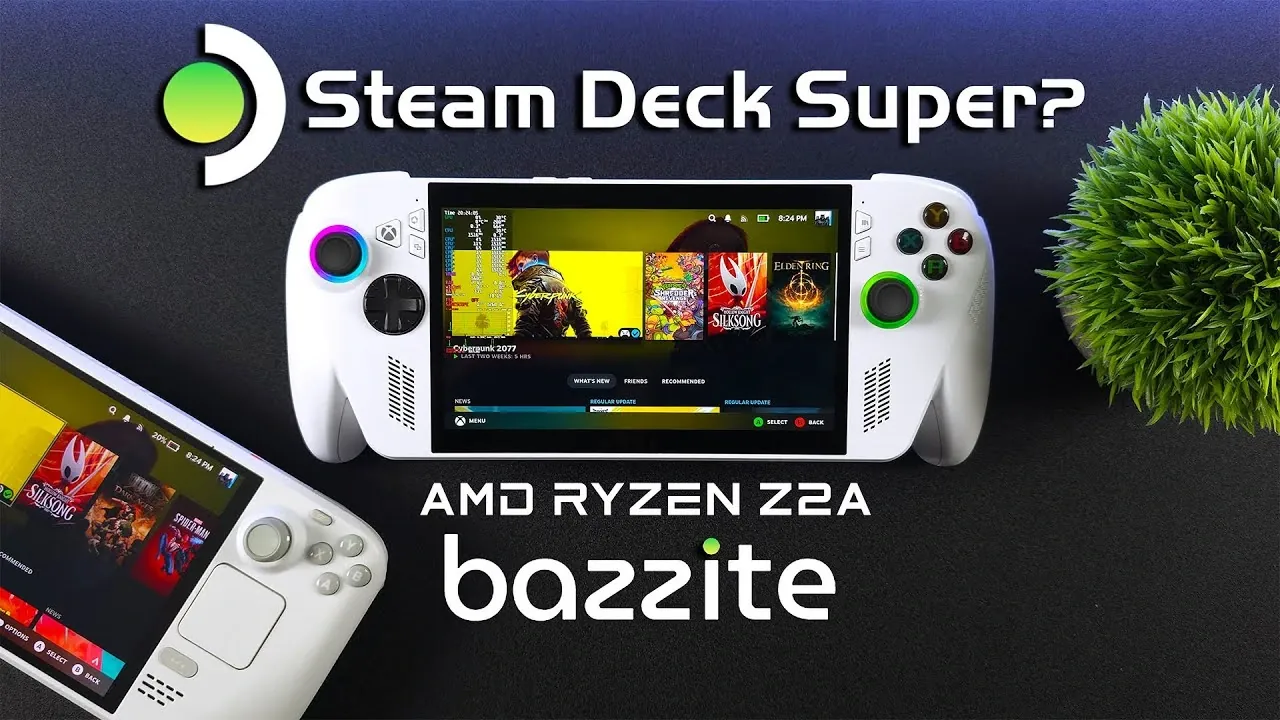
What if the Steam Deck wasn’t the only handheld gaming device redefining portable play? Enter the ROG Xbox Ally, a sleek contender that dares to challenge Valve’s beloved console, particularly for Linux enthusiasts. With its 1080p variable refresh rate display, AMD Ryzen Z2A APU, and RDNA 2 GPU, the Ally promises sharper visuals and a touch more power under the hood. But is it truly the “Steam Deck Super,” or just another incremental upgrade in an increasingly crowded market? For gamers who crave customization and performance, the Ally’s Linux compatibility might be a dream come true, or a frustrating compromise. Let’s explore whether this device has what it takes to dethrone the reigning champion of handheld gaming.
In this piece, ETA Prime uncovers the ROG Xbox Ally’s key strengths and surprising limitations, from its hardware specs to its Linux integration. You’ll discover how it stacks up against the Steam Deck in terms of performance, battery life, and usability, as well as what it means for gamers who prioritize flexibility and control. Whether you’re a Linux tinkerer or a casual gamer curious about the next big thing in portable gaming, the Ally offers plenty to dissect. But does it deliver enough to justify its place as a true alternative? Let’s see how far this challenger can push the boundaries of handheld gaming.
ROG Xbox Ally Overview
TL;DR Key Takeaways :
- The ROG Xbox Ally features an AMD Ryzen Z2A APU and RDNA 2 GPU, offering modest performance improvements over the Steam Deck, with slightly higher CPU and GPU clock speeds.
- Its 1080p variable refresh rate display provides sharper visuals compared to the Steam Deck’s 800p screen, enhancing the gaming experience for modern titles.
- Battery life varies significantly based on usage, with up to 9 hours for light gaming at 6W TDP but only 2-2.5 hours for demanding AAA games at higher TDP settings.
- Linux compatibility via Bazzite OS offers advanced customization options, but the lack of official Steam OS support and non-functional RGB lighting under Linux are notable drawbacks.
- While the device delivers incremental upgrades and solid build quality, its limitations, such as battery life and minor performance gains, may not justify an upgrade for all users.
Key Hardware Features
The ROG Xbox Ally is built around the AMD Ryzen Z2A APU, a Zen 2-based processor featuring 4 cores and 8 threads. Its integrated RDNA 2 GPU, clocked at 1,800 MHz, slightly outpaces the Steam Deck’s GPU, which operates at 1,600 MHz. With 16 GB of RAM, including 8 GB dedicated to the iGPU, the device ensures smooth multitasking and gaming performance.
One of its standout features is the 1080p variable refresh rate display, which offers sharper visuals compared to the Steam Deck’s 800p screen. This higher resolution enhances the gaming experience, particularly for modern titles that benefit from detailed graphics. The display is complemented by a compact and ergonomic design, making it suitable for extended gaming sessions.
Performance Overview
The ROG Xbox Ally delivers slightly better performance than the Steam Deck, thanks to its higher CPU and GPU clock speeds. It supports TDP (Thermal Design Power) adjustments up to 20W, allowing users to fine-tune performance for demanding games or prioritize battery life for less intensive tasks.
Gaming benchmarks reveal minor FPS (frames per second) improvements in certain titles, but overall performance remains comparable to the Steam Deck when running games at similar settings. This positions the ROG Xbox Ally as a device for users seeking incremental upgrades rather than a innovative leap in performance. While it may not redefine handheld gaming, it offers a reliable and customizable experience for enthusiasts.
ROG Xbox Ally With Linux OS Installed
Here is a selection of other guides from our extensive library of content you may find of interest on ROG Xbox Ally.
- Xbox ROG Ally X vs ROG Xbox Ally: A In-Depth Comparison Oct
- ASUS ROG Xbox Ally Windows Gaming Handheld : Features
- ROG Xbox Ally X vs ROG Ally X: Detailed Comparison
- ROG XBOX Ally Hands-On Review: Features, Performance & Price
- How the ROG Xbox Ally Combines Portability with PC-Level Power
- ROG Xbox Ally Series: Microsoft and ASUS Redefine Gaming
- ROG Xbox Ally Review: Pros, Cons & Everything You Need to Know
- ROG Xbox Ally X Hands On Review : The Future of Portable Gaming
- Everything We Know About the ASUS ROG Ally 2 Handheld
- Xbox App Update: Manage All Your PC Games in One Place
Gaming Benchmarks
The ROG Xbox Ally has been tested with a variety of games, including popular titles such as Cyberpunk 2077, The Witcher 3, Elden Ring, Mortal Kombat 1, and Doom: The Dark Ages. At 720p and 900p resolutions with optimized settings, the device achieves playable frame rates, with some games nearing 60 FPS.
However, performance varies depending on the game. More demanding AAA titles often require lower graphical settings to maintain smooth gameplay, particularly at higher resolutions. While the device handles indie and older games with ease, its limitations become apparent when running resource-intensive modern titles.
Battery Life and Power Efficiency
Equipped with a 60Wh battery, the ROG Xbox Ally offers varying runtimes based on usage and TDP settings. For less demanding indie and 2D games, the device can last up to 9 hours at a 6W TDP. However, AAA games significantly reduce battery life, with runtimes of approximately 2.5 hours at 15W TDP and just 2 hours at 20W TDP.
Power consumption ranges from 6.8W to around 30W, depending on the game and settings. This makes battery optimization essential for extended gaming sessions, particularly for users who prioritize portability. While the battery life is adequate for casual gaming, it may fall short for those seeking uninterrupted gameplay during long trips.
Linux Compatibility and Features
The ROG Xbox Ally runs Linux via the Bazzite OS, offering a smooth experience with functional Wi-Fi, Bluetooth, and TDP controls. Advanced features such as fan curve adjustments, GPU frequency settings, and battery charge limits provide users with a high degree of customization. These features cater to Linux enthusiasts who value control over their device’s performance and efficiency.
However, the lack of official Steam OS support is a notable drawback. Users must rely on beta updates to optimize functionality, which may deter those seeking a seamless Linux gaming experience. Additionally, while the device is compatible with a wide range of Linux games, some users may encounter challenges when configuring certain titles or features.
Display and Build Quality
The ROG Xbox Ally features a 1080p variable refresh rate display, which is a significant improvement in resolution compared to the Steam Deck. This upgrade enhances visual clarity, making it ideal for games with detailed environments and textures. However, the display lacks the vibrancy of the Steam Deck OLED, which may be a consideration for users who prioritize color accuracy and contrast.
The device’s build quality is solid, with a compact and ergonomic design that ensures comfort during extended use. Additional buttons improve usability, offering quick access to menus in both Windows and Linux environments. However, the RGB lighting, a feature many gamers appreciate, is non-functional under Linux, which could disappoint users seeking a fully customizable aesthetic.
Limitations to Consider
While the ROG Xbox Ally offers several advantages, it also comes with notable limitations that may affect its appeal:
- The absence of official Steam OS support, requiring reliance on beta updates for Linux functionality.
- Non-functional RGB lighting under Linux, reducing its aesthetic appeal for some users.
- Performance gains that, while present, may not justify an upgrade for all users.
- Battery life that may not meet the expectations of users seeking extended gaming sessions on the go.
These factors highlight the device’s incremental nature, making it less appealing to those seeking a fully optimized and feature-rich gaming experience.
The ROG Xbox Ally positions itself as a capable alternative to the Steam Deck, particularly for Linux enthusiasts who value customization and control. Its AMD Ryzen Z2A APU and RDNA 2 GPU deliver modest performance improvements, while the 1080p display enhances visual quality for modern games.
However, its incremental upgrades, lack of official Steam OS support, and minor limitations suggest it is best suited for users seeking a slightly enhanced handheld gaming experience. For those willing to navigate its quirks, the ROG Xbox Ally offers a solid, albeit not new, option in the portable gaming market.
Media Credit: ETA PRIME
Disclosure: Some of our articles include affiliate links. If you buy something through one of these links, Geeky Gadgets may earn an affiliate commission. Learn about our Disclosure Policy.
