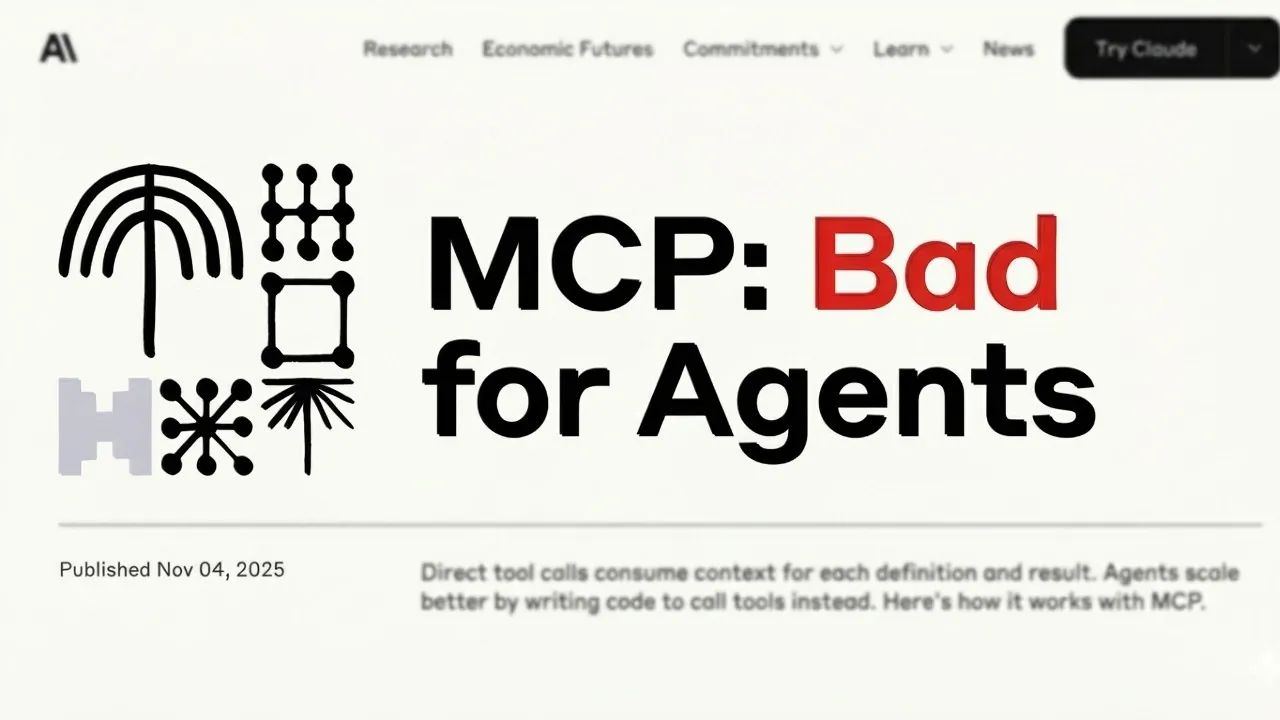
Is the Model Context Protocol (MCP) on the verge of obsolescence? For years, MCP has been a cornerstone in AI agent design, offering a standardized way to integrate tools and manage interactions. But as AI systems grow more complex and resource-intensive, cracks in this once-reliable framework are becoming impossible to ignore. From bloated context windows to excessive token usage, MCP’s inefficiencies are no longer just minor inconveniences, they’re roadblocks to scalability. Meanwhile, a new contender, code agents, is gaining traction, promising to transform how AI agents interact with tools. Could this signal the end of MCP as we know it?
In this breakdown, Prompt Engineering explains marabout the forces driving this seismic shift in AI frameworks. You’ll uncover why MCP’s traditional architecture is struggling to keep pace with modern demands and how code agents are stepping in with solutions like progressive disclosure and externalized code execution. But is MCP truly obsolete, or does it still have a role to play in the evolving AI landscape? By the end, you’ll have a deeper understanding of this pivotal moment in AI development, and why it matters for the future of intelligent systems. The answers might surprise you.
MCP vs Code Agents
TL;DR Key Takeaways :
- MCP’s inefficiencies, including “context rot” and excessive token usage, hinder its scalability and effectiveness in modern AI systems.
- Code agents are emerging as a superior alternative, offering selective tool retrieval, reduced context noise, and progressive disclosure for optimized resource usage.
- Code agents enhance scalability and privacy, supporting complex workflows and incorporating robust data anonymization and access controls.
- MCP retains value as a standardized integration framework, potentially complementing code agents by making sure compatibility and structural consistency.
- Security challenges, such as unauthorized tool usage and system vulnerabilities, require robust measures like controlled access, data anonymization, and regular audits to ensure safe AI operations.
What’s Wrong with MCP?
MCP was designed to provide a uniform interface for AI agents to interact with tools, making sure consistency and compatibility. However, its architecture introduces several inefficiencies that hinder its effectiveness in modern applications. Key issues include:
- Overloading the context window with redundant or irrelevant information, leading to a phenomenon known as “context rot.”
- Excessive token usage, which prematurely exhausts computational resources, leaving less capacity for meaningful tasks.
- Challenges in managing multiple tools or executing chained operations, which exacerbate inefficiencies and reduce scalability.
These limitations not only degrade the performance of AI agents but also restrict their ability to scale effectively. As AI systems increasingly demand agility and resource efficiency, MCP’s traditional approach struggles to meet these evolving requirements.
Emerging Alternatives: The Rise of Code Agents
To address MCP’s shortcomings, organizations such as Enthropic and Cloudflare are pioneering code agents as a more efficient alternative. Unlike MCP, which embeds tool definitions and results directly into the context, code agents interact with tools through APIs. This shift introduces several critical improvements:
- Tools are organized as a directory, allowing selective retrieval and execution based on specific needs.
- Code execution occurs outside the primary context, reducing noise and preserving computational resources.
- Progressive disclosure ensures tools are loaded only when required, minimizing unnecessary context pollution.
By decoupling tool execution from the AI agent’s main context, code agents optimize resource usage and enhance the system’s ability to handle complex workflows. This approach not only improves efficiency but also aligns better with the demands of modern AI systems.

Take a look at other insightful guides from our broad collection that might capture your interest in Code Agents.
- Boost Code Efficiency with Claude Code’s New AI Sub-Agents
- How to Use Sub-Agents in Claude Code for Better Coding Results
- Build AI Agents Easily with LangSmith’s No-Code Platform
- How to Build Custom AI Agents with Claude Code SDK
- How to Combine AI Code Agents to Build Apps Faster in 2025
- Claude Hive : Boost Your Coding Efficiency with Sub-Agents
- Claude Code Agents : The Feature That Changes Everything
- How to Use ChatGPT’s Agent Builder for Automating Tasks Without
- How to Build an AI Agent Using No-Code Tools
- New Claude Code 2.0 Agentic AI Coding Agent : The Secret
Why Code Agents Are a Better Fit
The adoption of code agents offers several distinct advantages over MCP’s traditional framework. One of the most significant benefits is progressive disclosure, which ensures that tools are only activated when necessary. This reduces the risk of overloading the context and enhances overall system efficiency.
Code agents also excel in privacy-preserving operations, incorporating data anonymization techniques and strict access controls to safeguard sensitive information. Furthermore, their design supports scalability, allowing seamless management of complex tool chains and multiple concurrent operations. These features make code agents a more practical and adaptable choice for modern AI systems that require flexibility, efficiency, and robust data handling.
Does MCP Still Have a Role?
Despite its limitations, MCP retains value as a standardized framework for AI agent operations. Its uniform API interface simplifies connectivity and authorization, making it a useful tool for making sure compatibility across diverse systems. However, its role may need to evolve to remain relevant.
Rather than directly managing tool execution, MCP could serve as a foundational layer for integration and standardization. In this scenario, code agents would handle the dynamic aspects of tool interaction and execution, using MCP’s framework for compatibility while addressing its operational inefficiencies. This complementary relationship could allow developers to harness the strengths of both approaches.
Security Challenges and Solutions
As AI systems become more interconnected, the security challenges associated with MCP and similar frameworks must be addressed. Vulnerabilities such as cross-server tool invocation and system-level access pose significant risks. To mitigate these threats, robust security measures are essential, including:
- Implementing controlled access protocols to prevent unauthorized tool usage.
- Using data anonymization techniques to protect sensitive information during operations.
- Conducting regular audits to identify and resolve potential vulnerabilities in the system.
By prioritizing security, developers can ensure the safe and reliable operation of AI agents, regardless of whether MCP, code agents, or a hybrid approach is used.
A Balanced Future for AI Frameworks
The decline of MCP as a direct operational framework for AI agents is driven by its inefficiencies in context management and token usage. However, its value as a standardized integration layer remains significant. Code agents, with their ability to optimize resource usage and enhance scalability, represent a promising alternative for modern AI systems.
Rather than viewing MCP and code agents as competing solutions, they can be seen as complementary. MCP can provide the structural foundation for integration and compatibility, while code agents address the dynamic demands of tool interaction and execution. By combining the strengths of both approaches, developers can build AI systems that are not only efficient and scalable but also secure and adaptable to future challenges.
Media Credit: Prompt Engineering
Disclosure: Some of our articles include affiliate links. If you buy something through one of these links, Geeky Gadgets may earn an affiliate commission. Learn about our Disclosure Policy.
