
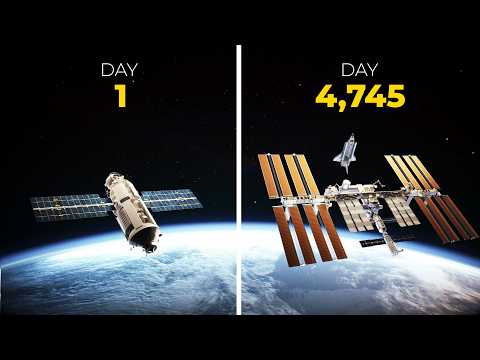
What does it take to build a home in the most unforgiving environment known to humanity, space? The International Space Station (ISS), a marvel of modern engineering, answers this question with its very existence. Orbiting 400 kilometers above Earth, this floating laboratory was pieced together module by module over two decades, defying gravity and geopolitical divides alike. Its construction demanded not only innovative technology but also unprecedented levels of international cooperation. The ISS isn’t just a feat of engineering; it’s a testament to what humanity can achieve when united by a shared vision. Boldly pushing the boundaries of science and diplomacy, the station’s story is as much about human ingenuity as it is about resilience.
In this overview, Real Engineering uncover how the ISS came to life, from its earliest conceptual blueprints to the final assembly of its intricate modular design. You’ll discover the new technologies, like robotic systems and gyroscopic stabilizers, that made building in microgravity possible. We’ll also explore the human stories behind the station, from astronauts braving spacewalks to engineers solving problems no one had ever faced before. Whether you’re fascinated by space exploration or curious about the power of collaboration, the ISS’s journey offers lessons that extend far beyond the stars. Its legacy, as we’ll see, is not just about where we’ve been but where we’re headed.
Legacy of the ISS
TL;DR Key Takeaways :
- The International Space Station (ISS) is a monumental achievement in international collaboration and engineering, built over two decades as a hub for scientific research and technological innovation.
- The ISS’s modular design allowed for incremental construction, using advanced technologies like robotic systems (e.g., Canadarm2) and precision docking mechanisms to overcome the challenges of assembling in microgravity.
- Key engineering advancements, such as solar arrays, ammonia-based cooling systems, and gyroscopic stability systems, ensured the station’s functionality and pushed the boundaries of space technology.
- The ISS represents a global partnership involving 15 nations, with contributions ranging from scientific modules to reliable crew and cargo transport, fostering unprecedented international cooperation.
- As the ISS nears the end of its operational life, its legacy of innovation, collaboration, and scientific discovery will guide future space exploration missions to the Moon, Mars, and beyond.
From Concept to Reality: The ISS’s Early Years
The ISS began as a vision of global partnership, transforming into reality with the launch of its first two modules in 1998. The Russian-built Zarya module provided essential power and propulsion, while the American-built Unity module served as a connecting node for future components. These initial modules were joined in orbit using advanced docking systems, including the androgynous peripheral attach system (APAS) and the common berthing mechanism (CBM). These technologies ensured precise alignment and secure connections, forming the foundation of the station’s modular design.
The station’s construction required meticulous planning and coordination. Each module, truss segment, and solar array was launched aboard space shuttles or Russian rockets and carefully integrated into the growing structure. Robotic systems, such as the Canadarm2, played a pivotal role in maneuvering and attaching components, reducing the need for astronauts to perform risky extravehicular activities (EVAs). This modular approach allowed the ISS to grow incrementally, adapting to new scientific and technological needs over time.
Overcoming Engineering Challenges in Space
Building the ISS in the microgravity environment of low Earth orbit presented unique engineering challenges. Precision docking was critical, as even minor misalignments could compromise the station’s structural integrity. Astronauts and ground teams worked tirelessly to address these risks, including the constant threat posed by space debris, which could damage vital systems.
To ensure the station’s functionality, engineers developed innovative solutions to meet its operational needs:
- Solar arrays provided a reliable and renewable source of power, converting sunlight into electricity.
- Ammonia-based cooling systems and rotating radiators dissipated heat generated by onboard equipment, maintaining optimal temperatures.
- Gyroscopic stability systems maintained the station’s orientation, making sure efficient solar panel operation and uninterrupted communication with Earth.
These advancements not only enabled the ISS to function effectively but also pushed the boundaries of what was possible in space engineering, setting the stage for future missions.
Two Decades in Orbit, the People, Tech & Risks
Check out more relevant guides from our extensive collection on International Space Station (ISS) that you might find useful.
- NASA Releases 4K Footage Of Life On International Space Station
- On Friday, Space Station Assembly Is Complete
- Astro Pi Replay simulation tool launched for Mission Space Lab
- Raspberry Pi Astro Pi 2024 Summer Update
- Space 360 Release First Panoramic View Of Earth From ISS In 4K
- Why is it so hard to build computers for space exploration?
- 4K Ultra HD Footage Of Earth From ISS Released By NASA (video
- 360 Degree View Of Space Shuttle Discovery’s Flight Deck
- Life Movie Lands On Digital Download June 2nd (video)
- How Microgravity is Transforming Drug Development in Space
Technological Breakthroughs
The construction and operation of the ISS required new technological innovations, many of which have had lasting impacts on space exploration. Robotic systems, such as the Canadarm2, were instrumental in assembling the station and conducting maintenance tasks. Operated by astronauts aboard the ISS and ground controllers on Earth, these robotic arms demonstrated the potential of automation in space.
Other key technological advancements included:
- Gyroscopes that stabilized the station without relying on fuel, reducing the need for resupply missions.
- Advanced cooling systems that protected sensitive equipment from extreme temperature fluctuations in space.
- Modular designs that allowed for incremental expansion, allowing the station to evolve and accommodate new scientific objectives.
These innovations not only supported the ISS’s operations but also laid the groundwork for future missions to the Moon, Mars, and beyond.
Global Cooperation: A Unified Effort
The ISS is a testament to the power of international collaboration, involving contributions from 15 nations, including the United States, Russia, Japan, Canada, and members of the European Space Agency. Each partner played a critical role in its construction and operation:
- The United States provided key modules, such as Destiny, a hub for scientific research.
- Europe contributed the Columbus laboratory, allowing advanced experiments in microgravity.
- Russia’s Soyuz spacecraft ensured reliable crew and cargo transport, serving as a lifeline for the station.
The station’s orbit was carefully adjusted to accommodate the launch capabilities of its international partners, reflecting the logistical complexity of the project. Beyond construction, this collaboration extended to scientific research, astronaut training, and mission planning, fostering partnerships that transcended geopolitical boundaries. The ISS has become a symbol of what humanity can achieve when nations work together toward a common goal.
Astronauts: Builders and Innovators
Astronauts played a central role in the construction and maintenance of the ISS. Spacewalks, or extravehicular activities (EVAs), were essential for assembling modules, installing upgrades, and repairing equipment. These tasks required extensive preparation, as working in microgravity demanded a deep understanding of how mass and inertia behave differently than on Earth.
To prepare for these challenges, astronauts underwent rigorous training programs. Simulations, underwater exercises, and virtual reality tools allowed them to practice tasks in environments that mimicked the conditions of space. Their efforts not only ensured the success of the ISS but also provided valuable insights into human adaptation to long-term spaceflight, paving the way for future exploration missions.
Milestones in ISS Development
Over the years, the ISS has grown into a sophisticated research platform, with key modules and systems enhancing its capabilities. Notable milestones in its development include:
- Destiny, a U.S.-built science module that became the station’s primary research hub.
- Quest, an airlock designed to support spacewalks and other extravehicular activities.
- Truss segments that formed the station’s structural backbone, supporting solar arrays and radiators.
The ISS has also become a platform for new scientific research. Its microgravity environment has enabled experiments in fields such as biology, materials science, and medicine, advancing knowledge in ways that would be impossible on Earth. These discoveries have had far-reaching implications, from improving medical treatments to developing new materials for use in space and on Earth.
The ISS’s Legacy and Future
As the ISS approaches the end of its operational life, plans are underway for its controlled re-entry into Earth’s atmosphere. This process will ensure the safe disposal of its components, minimizing risks to people and property on the ground. However, the legacy of the ISS extends far beyond its physical structure.
The ISS has demonstrated the power of international collaboration, advanced space technologies, and inspired a new generation of scientists, engineers, and explorers. The lessons learned from its construction and operation will guide humanity’s future exploration efforts, from establishing a sustainable presence on the Moon to sending humans to Mars and beyond. As a symbol of what humanity can achieve together, the ISS will continue to shape the future of space exploration for decades to come.
Media Credit: Real Engineering
Disclosure: Some of our articles include affiliate links. If you buy something through one of these links, Geeky Gadgets may earn an affiliate commission. Learn about our Disclosure Policy.
