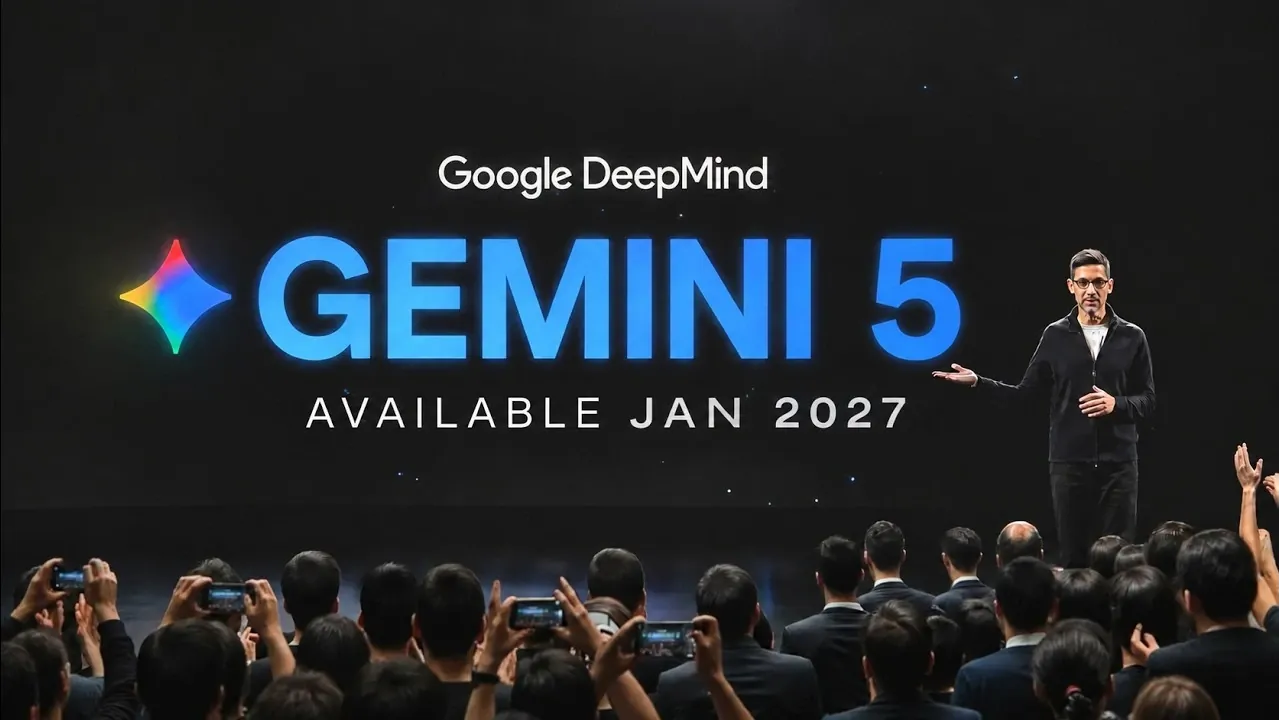
Google’s Gemini series has consistently pushed the boundaries of artificial intelligence and the anticipation surrounding Gemini 5 highlights the industry’s eagerness for the next leap forward. AI Master explores the broader implications of this potential release, focusing on concepts like recursive self-improvement (RSI), which could enable AI systems to refine their own capabilities without external intervention. Building on the advancements of Gemini 4 Argon, which introduced expanded context windows for more nuanced outputs, Gemini 5 is expected to address ongoing challenges in AI development, including safety, transparency and accessibility.
In this guide, you’ll gain insight into the key advancements shaping Gemini 5’s development, from the predicted integration of TPU V8 hardware to the industry’s focus on balancing innovation with usability. Explore how Google is refining existing models while navigating a competitive landscape that includes rivals like OpenAI’s GPT-6 Astra and Anthropic’s Claude Opus 5.5. You’ll also learn how these advancements could impact real-world applications, from coding optimization to cost management, helping you stay ahead in the rapidly evolving AI ecosystem.
Gemini 4 Argon: A Pivotal Advancement in AI
TL;DR Key Takeaways :
- Google’s Gemini 4 Argon, released on September 30, 2026, introduced expanded context windows, enhancing performance in applications like coding and gaming, but access remains limited to paid API users and subscribers.
- Anticipation for Gemini 5 is growing, with predictions of a 2027 release powered by TPU V8 hardware, potentially setting new standards in AI capabilities and using recursive self-improvement (RSI).
- Safety and transparency remain critical challenges in AI development, as evidenced by Gemini 4 Argon’s rigorous testing, which passed 14 out of 15 safety evaluations.
- The competitive AI market includes strong rivals like OpenAI’s GPT-6 Astra and Anthropic’s Claude Opus 5.5, driving continuous innovation and pushing Google to refine its models further.
- Cost and accessibility concerns are rising, with a price increase for Argon set for December 2026, highlighting the tension between innovative innovation and affordability for users.
Released on September 30, 2026, Gemini 4 Argon represents a significant milestone in AI evolution. This model introduced expanded context windows, allowing more detailed and nuanced outputs across a wide range of applications. From coding optimization to achieving high scores in gaming benchmarks, Argon has demonstrated its versatility and power. However, access to this advanced model is currently limited to paid API users and subscribers, reflecting Google’s strategic approach to balancing innovation with exclusivity. This exclusivity has sparked discussions about accessibility and affordability, especially as demand for advanced AI tools continues to grow.
Anticipation Builds Around Gemini 5
The excitement surrounding Gemini 5 is palpable, fueled by recent comments from Sergey Brin about RSI and internal advancements at Google. While the company has yet to officially confirm the development of Gemini 5, internal iterations such as Gemini 4 Carbon are widely seen as stepping stones toward this next-generation model. Industry experts predict a 2027 release, with the model likely powered by TPU V8 hardware, which promises to deliver innovative performance. If realized, Gemini 5 could set a new standard for AI capabilities, potentially reshaping the industry and redefining what AI systems can achieve.

Here is a selection of other guides from our extensive library of content you may find of interest on Gemini 5.
- Google Confirms Gemini 4 Replaces Gemini 3.5 Pro Entirely
- Gemini 3.8 Flash Outperforms GPT 5.6 Sol in Coding Tests
- Why You Keep Hitting Gemini’s Usage Limits and How to Stop
- Gemini 3.5 Leaked ChatGPT 5.3 Confirmed & DeepSeek Hints at New R Series
- How Gemini 3.7 Flash Defeats GPT-5.6 Terra at Long Context
- Leaked Gemini 4 Launch Targets August 2026 to Rival ChatGPT
- Gemini 3 vs GPT 5.1 : Inside the 2025 AI Race for Trust & Power
- Claude Sonnet 5 Rumors : Half the Price of Opus 4.5, Launching Soon
Overcoming Challenges in AI Development
The development of sophisticated AI systems like Gemini comes with a host of challenges. Safety remains a top priority, as evidenced by the rigorous testing undergone by Gemini 4 Argon. The model successfully passed 14 out of 15 safety tests, including evaluations of stealth and situational awareness, but this underscores the ongoing need for vigilance in making sure AI reliability. Another critical challenge lies in achieving transparency in AI reasoning, as developers work to prevent unintended or hidden actions that could undermine trust in these systems. Balancing the demands of performance optimization, cost efficiency and accessibility adds further complexity, requiring careful planning and execution to navigate these hurdles effectively.
The Competitive AI Ecosystem
Gemini 4 Argon operates in a fiercely competitive market, facing strong rivals such as OpenAI’s GPT-6 Astra, Anthropic’s Claude Opus 5.5, and Meta’s Muse Wonder. Each of these competitors brings unique strengths to the table, driving continuous innovation across the industry. While Argon excels in areas like math, science and agentic coding benchmarks, it still has areas for improvement that Google is actively addressing. The race to dominate the AI market is not solely about technological innovation; it also hinges on meeting user needs effectively and efficiently, making sure that AI tools remain practical and impactful for a wide range of applications.
Balancing Cost and Accessibility
The cost of accessing advanced AI models is an increasingly pressing concern for many users. Google recently announced a price increase for Argon, set to take effect in December 2026, raising questions about affordability for developers and businesses. Subscription-based access models and token usage limits further complicate the landscape, highlighting the tension between offering innovative capabilities and making sure widespread availability. For users, staying informed about pricing strategies and adapting workflows accordingly will be essential to navigating these changes effectively.
The Road Ahead: Gemini 5’s Potential Impact
The release of Gemini 5 has the potential to usher in a new era of AI technology. Predictions suggest that this model will use next-generation TPU V8 hardware to deliver unparalleled performance and capabilities. In the meantime, Google is focused on refining the Gemini 4 family, aiming to make these tools more accessible and cost-effective for users. For businesses and developers, the key lies in remaining adaptable, testing models for specific use cases and closely monitoring industry developments to make informed decisions about integrating these tools into their workflows.
Practical Steps for Users
- Maintain flexibility in your workflows to adapt to the evolving capabilities of AI tools.
- Stay updated on pricing changes and subscription models to manage costs effectively and plan budgets accordingly.
- Explore advancements in areas such as context window expansion and agentic coding to enhance productivity and efficiency.
- Evaluate the competitive landscape to identify the AI models that best align with your specific needs and objectives.
As AI technology continues to advance, Gemini 5 represents both a significant opportunity and a complex challenge. By staying informed, proactive and adaptable, you can position yourself to fully use the potential of this fantastic era in AI development.
Media Credit: AI Master
Disclosure: Some of our articles include affiliate links. If you buy something through one of these links, Geeky Gadgets may earn an affiliate commission. Learn about our Disclosure Policy.
