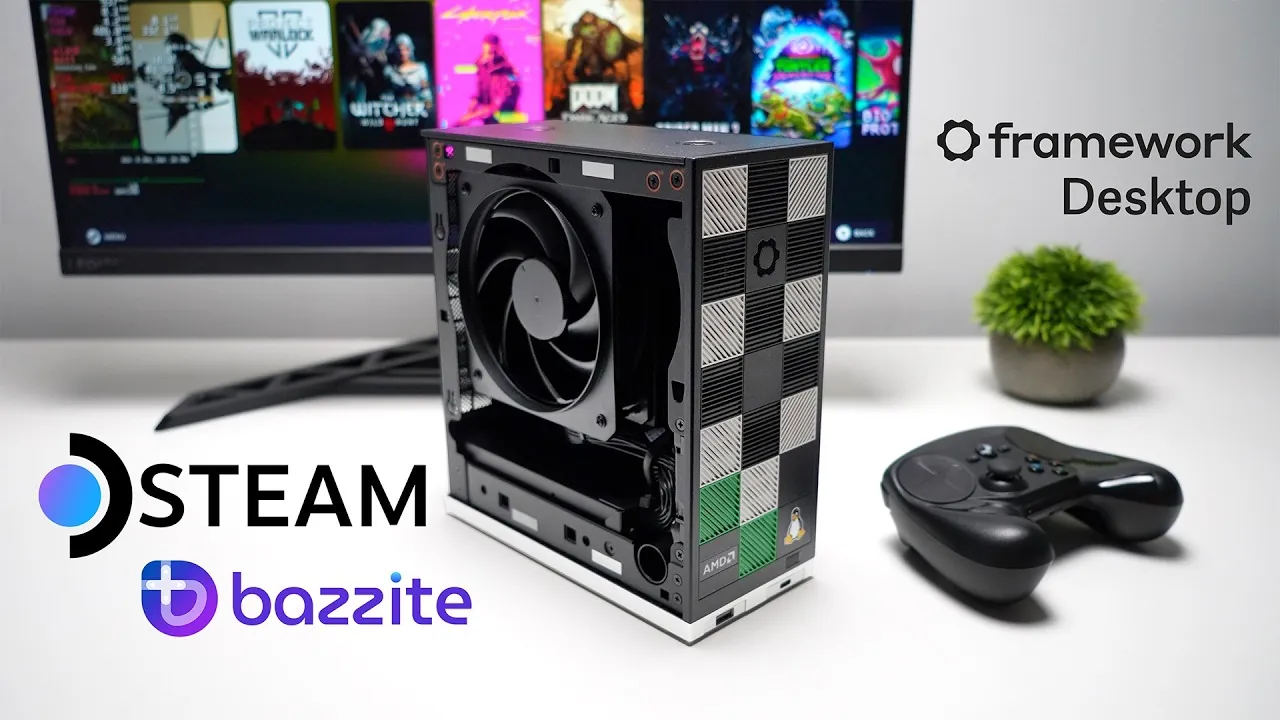
What if your gaming PC could combine the power of a high-performance desktop with the ease and simplicity of a console? Enter the Framework Desktop—a modular PC that’s turning heads for its ability to deliver console-like gaming experiences while maintaining the flexibility and upgradeability of a traditional computer. But here’s the twist: some enthusiasts have taken this innovation a step further, transforming it into a stationary alternative to the Steam Deck, blending the best of both worlds. It’s a bold reimagining of what a gaming system can be, and it’s sparking conversations about the future of modular computing.
In this feature, ETA Prime explore how the Framework Desktop’s customizable design, dual-mode functionality, and high-resolution gaming capabilities make it a standout in the compact PC market. You’ll discover how its Linux-based operating system, powerful AMD Ryzen APU, and Radeon GPU enable smooth performance for demanding titles like Cyberpunk 2077. We’ll also dive into the unique ways users are adapting this system to emulate the Steam Deck’s console-like experience, pushing the boundaries of what modular PCs can achieve. Could this be the perfect blend of performance, flexibility, and simplicity? Let’s find out.
New Framework Desktop Modular Gaming PC Overview
TL;DR Key Takeaways :
- The Framework Desktop combines the modularity of a PC with the simplicity of a console, offering high-resolution gaming, quiet operation, and extensive customization options in a compact form factor.
- Powered by the AMD Ryzen AI Max Plus 395 APU and Radeon 860S GPU, it delivers smooth 1440p gaming performance with support for up to 96 GB of RAM and a 2 TB M.2 SSD for fast storage.
- It runs on BasiOS, a Linux-based operating system with dual modes: Gaming Mode for a streamlined experience and Desktop Mode for productivity, along with support for FidelityFX Super Resolution (FSR) for enhanced visuals.
- The system features a modular design, allowing users to upgrade or replace components like the SSD and cooling system, and includes a customizable front panel for personalization.
- While it lacks advanced tuning options like TDP control and manual GPU clock adjustments, its quiet operation, energy efficiency, and versatility make it a strong choice for stationary setups and tech enthusiasts.
High-Performance Hardware for Demanding Games
At the heart of the Framework Desktop lies the AMD Ryzen AI Max Plus 395 APU, a 16-core, 32-thread processor capable of reaching clock speeds of up to 5.1 GHz. This is complemented by the Radeon 860S integrated GPU, built on the advanced RDNA 3.5 architecture. With 40 compute units and support for up to 96 GB of RAM allocated to graphics, the system ensures smooth gameplay at 1440p resolution with high settings, even for demanding modern titles. Key hardware features include:
- A 2 TB M.2 SSD for lightning-fast storage and reduced load times.
- Integrated Wi-Fi and Bluetooth for seamless connectivity.
- A 400-watt power supply to maintain consistent performance under heavy loads.
The modular design of the Framework Desktop allows users to assemble, upgrade, or replace components such as the SSD and cooling system, making sure flexibility for future enhancements. Despite its compact, console-like form factor, the system is engineered to handle both intensive gaming and multitasking with ease, making it a versatile choice for a wide range of users.
Linux-Based Operating System for Gaming and Productivity
The Framework Desktop runs on BasiOS, a Linux-based operating system specifically tailored for gaming and productivity. This OS offers a dual-mode interface designed to meet the needs of both casual gamers and advanced users:
- Gaming Mode: A streamlined, console-like interface that simplifies navigation and enhances the gaming experience.
- Desktop Mode: Full access to Linux applications, allowing productivity tasks and general computing.
Through the Bazaar platform, users can access a wide range of open source tools, emulators, and software to expand the system’s capabilities. While some games may require additional optimization for Linux, the system supports FidelityFX Super Resolution (FSR), which enhances performance and image quality in graphically demanding titles such as Cyberpunk 2077 and Horizon Zero Dawn. This dual-mode functionality ensures that the Framework Desktop is not only a gaming powerhouse but also a practical tool for everyday productivity.
Steam Gaming PC Built Using New Framework Desktop

Uncover more insights about Framework modular systems in previous articles we have written.
- Framework Laptop repairable modular laptop
- Write better ChatGPT AI prompts Using the CRAFT framework
- Framework Laptop 13 barebones modular laptop B-stock from $499
- Framework modular Laptop 16 pre-orders open from $1,399
- RISC-V Mainboard for Framework Laptop 13: Features & Benefits
- Framework opens new warehouse in the Netherlands
- Apple’s Container Framework vs Docker : Full macOS Comparison
- Harnessing the Power of the RICE Framework for Perfect ChatGPT
- Framework modular laptop CEO Nirav Patel interview
- Framework Desktop Review: A Modular PC Built for the Future
Quiet and Efficient Gaming Performance
The Framework Desktop excels in delivering high-resolution gaming at 1440p, maintaining smooth and consistent performance even during resource-intensive tasks. Its advanced cooling system ensures that the hardware remains cool and operates quietly, making it an ideal choice for living room setups or shared spaces. With a thermal design power (TDP) of up to 120 watts, the system strikes a balance between performance and energy efficiency, making sure reliable operation without excessive power consumption.
While it performs admirably in most scenarios, the Framework Desktop does have some limitations compared to Windows-based systems. For instance, the absence of TDP control and manual GPU clock adjustments—features available on devices like the Steam Deck—may deter advanced users seeking fine-tuned performance. However, the performance gap is minimal, and the system’s overall efficiency and quiet operation make it a strong contender for those prioritizing a seamless gaming experience.
Customizable Design for Personalization
One of the standout features of the Framework Desktop is its customizable front panel, which uses a tile-based system to allow users to personalize the device’s appearance. This feature enables the system to blend seamlessly with various living room aesthetics or gaming setups. Its compact design ensures that it integrates effortlessly with other entertainment devices, making it a versatile addition to any home.
The system’s dual-mode functionality ensures that it adapts to a variety of needs, whether you’re gaming, streaming, or tackling productivity tasks. Additionally, the modular design makes it easy to upgrade or replace components, extending the device’s lifespan and making sure that it remains relevant as technology evolves. This focus on customization and adaptability highlights the Framework Desktop’s commitment to providing a user-centric experience.
Limitations to Consider
While the Framework Desktop offers an impressive array of features, there are some limitations to keep in mind:
- The lack of TDP control and manual GPU clock adjustments may limit advanced performance tuning for experienced users.
- Some games may require additional configuration or optimization to run smoothly on the Linux-based BasiOS.
Despite these drawbacks, the system’s strengths—such as its modularity, high-resolution gaming support, and quiet operation—make it a compelling choice for those seeking a compact and versatile PC.
Is the Framework Desktop Right for You?
The Framework Desktop is an excellent option for users seeking a modular, compact PC that combines powerful integrated graphics with extensive customization options. Its AMD Ryzen APU, Radeon GPU, and Linux-based operating system make it a versatile solution for both gaming and productivity. While it may not replace portable gaming devices like the Steam Deck, it offers a unique alternative for those who prioritize stationary setups, performance, and flexibility.
Whether you’re a gamer, a tech enthusiast, or someone looking for a flexible computing solution, the Framework Desktop provides a well-rounded package that balances performance, efficiency, and personalization. Its modular design and dual-mode functionality ensure that it remains a relevant and adaptable choice for years to come.
Media Credit: ETA PRIME
Disclosure: Some of our articles include affiliate links. If you buy something through one of these links, Geeky Gadgets may earn an affiliate commission. Learn about our Disclosure Policy.
