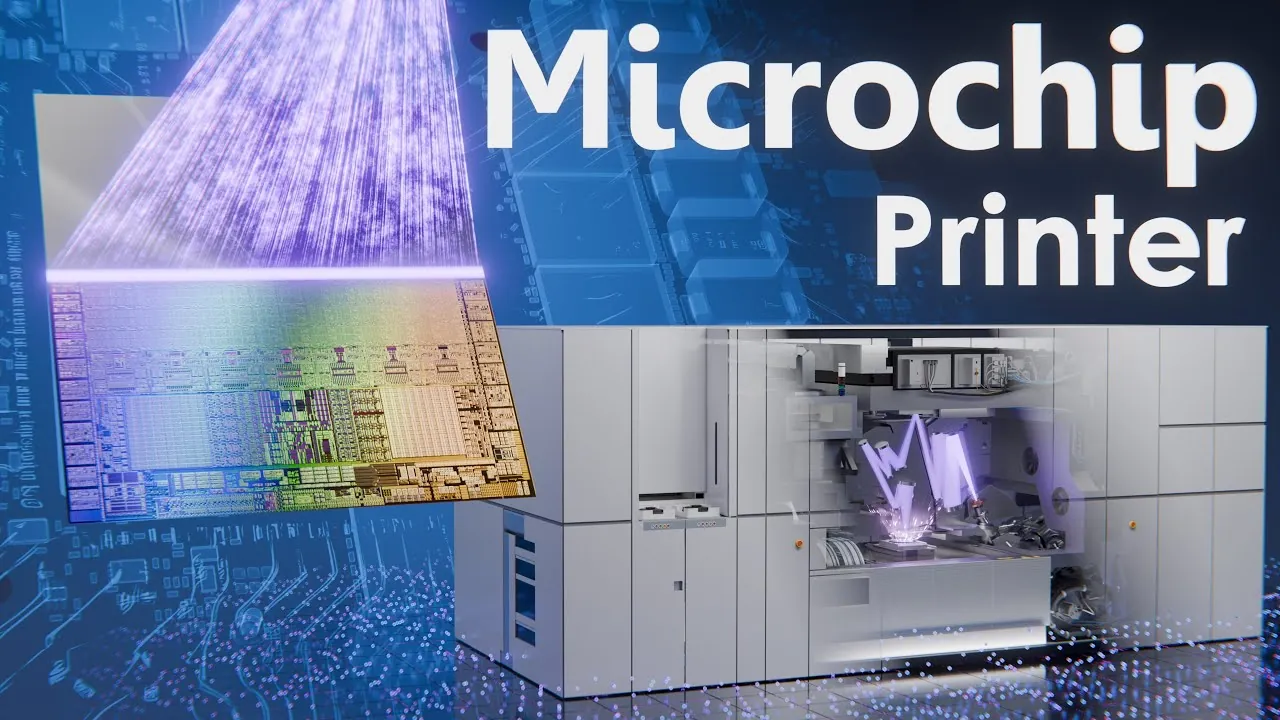
Imagine a machine so advanced it operates with light invisible to the human eye, etching circuits onto silicon wafers at scales smaller than a virus. This is the world of EUV lithography, a technological marvel that powers the production of the microchips at the heart of your smartphone, laptop, and even AI systems. With its ability to manipulate 13-nanometer wavelength light and achieve precision measured in nanometers, EUV lithography represents not just a leap forward in engineering but a cornerstone of modern innovation. Yet, behind its sleek exterior lies a labyrinth of lasers, mirrors, and magnetic levitation systems working in perfect harmony, an achievement that’s as awe-inspiring as it is complex.
In this overview, Branch Education unravel the inner workings of the most advanced machine ever made, exploring how EUV lithography has transformed semiconductor manufacturing. From the intricate process of generating extreme ultraviolet light to the delicate handling of silicon wafers in vacuum-sealed environments, this technology is a masterclass in precision and ingenuity. You’ll discover how reflective optics replace traditional lenses, why magnetic levitation stages are essential for nanometer-level accuracy, and what challenges lie ahead as engineers push the boundaries of chip design. By the end, you’ll not only understand how EUV lithography works but also why it’s indispensable in shaping the future of electronics, and, by extension, the world around us.
EUV Lithography Explained
TL;DR Key Takeaways :
- EUV lithography uses 13-nanometer wavelength light and reflective optics to achieve nanometer-level precision in microchip manufacturing, allowing the creation of smaller, faster, and more efficient chips.
- The process involves advanced technologies such as magnetic levitation stages, vacuum-sealed environments, and Bragg reflectors to ensure accuracy and prevent contamination during wafer handling and alignment.
- High-powered lasers vaporize tin droplets to generate EUV light, which is reflected and focused using specialized mirrors instead of lenses due to the unique properties of EUV light.
- EUV lithography is primarily used for the lower layers of microchips, while DUV lithography is employed for larger features in the upper layers, with innovations like High NA optics pushing resolution limits further.
- Despite its complexity and challenges, EUV lithography is critical for advancing semiconductor technology, driving innovation in electronics, AI, and computing to meet growing global demand for innovative devices.
Understanding Microchip Manufacturing
Microchips are the backbone of modern electronics, housing billions of transistors that assist data processing and computation. These transistors, often smaller than 10 nanometers, form the intricate logic circuits that drive the functionality of electronic devices. The manufacturing process begins with photolithography, a technique that etches detailed patterns onto silicon wafers to create the desired circuit structures. EUV lithography has become indispensable in this process, allowing the creation of smaller, faster, and more efficient chips by layering and patterning nanoscopic structures with extraordinary precision.
How EUV Lithography Works
EUV lithography operates by harnessing 13-nanometer wavelength light, which is essential for achieving the high resolution required in advanced microchip designs. The process begins with a photomask, or reticle, which contains the blueprint for a specific layer of the chip. This pattern is projected onto a silicon wafer using reflective optics, transferring the design with nanometer-level accuracy. The wafer undergoes this process repeatedly, layer by layer, with alignment systems making sure that each layer is perfectly positioned relative to the others. This meticulous layering process is critical for maintaining the integrity of the chip’s design and functionality.
Inside the Most Advanced EUV Lithography Machine Ever

Here are more guides from our previous articles and guides related to energy that you may find helpful.
- How MGA Thermal’s Alloy is Changing the Future of Energy
- Samsung Unveils Cutting Edge Energy Efficient Appliances
- Wave Energy : The Future of Clean, Reliable Renewable Energy
- New revolutionary R19 Waterless hydro energy storage unveiled
- Energy monitor module for microcontrollers
- How China’s Energy Infrastructure is Dominating the AI Race
- Samsung SmartThings Energy manages energy usage
- NASA’s Mechanical Battery: A Breakthrough in Sustainable Energy
- What Is Fusion Energy? The Future of Clean Power Explained
- US vs China : Inside the AI Arms Race for Global Power
The Role of Light and Reflective Optics
Generating EUV light is a highly sophisticated process. High-powered lasers are used to vaporize tin droplets, producing the 13-nanometer wavelength light required for EUV lithography. Unlike traditional photolithography, which relies on lenses, EUV systems use mirrors to reflect and focus the light. This is because EUV light is absorbed by most materials, rendering lenses ineffective. The mirrors in EUV systems are coated with Bragg reflectors, which consist of nanometer-thick layers designed to reflect EUV light with exceptional precision. These reflective optics are critical for maintaining the accuracy and efficiency of the lithography process.
Handling and Aligning Silicon Wafers
Silicon wafers, the foundational material for microchips, require careful handling to prevent contamination and ensure the integrity of the manufacturing process. To protect the delicate patterns from particles and impurities, wafers are transported in vacuum-sealed environments. During the lithography process, magnetic levitation stages are used to move the wafers with nanometer-level precision. These stages are guided by interferometers, which measure the wafer’s position in real time. Additionally, alignment sensors ensure that each new layer aligns perfectly with the previous ones, preserving the intricate design of the chip and preventing defects.
Applications and Efficiency in EUV Lithography
EUV lithography is primarily used for the lower layers of microchips, where the smallest and most critical features are located. For the upper layers, manufacturers often use DUV (Deep Ultraviolet) lithography tools, which are less advanced but sufficient for larger features. To further enhance EUV systems, high numerical aperture (NA) optics are employed, allowing even smaller feature sizes and greater resolution. Each silicon wafer, which contains hundreds or even thousands of individual chips, undergoes this process multiple times to ensure consistent quality and performance across large production volumes.
Challenges and Future Innovations
Despite its critical role in semiconductor manufacturing, EUV lithography presents several challenges. The unique properties of EUV light necessitate vacuum environments and precise control mechanisms to maintain the integrity of the process. The systems themselves are highly complex, incorporating advanced robotics, high-speed lasers, and intricate optical components. Looking ahead, innovations such as High NA EUV systems aim to push the boundaries of resolution even further, allowing the production of microchips with features smaller than ever before. These advancements will be essential for meeting the growing demand for more powerful and efficient electronic devices.
Why EUV Lithography Matters
EUV lithography is a cornerstone of modern semiconductor manufacturing, allowing the production of microchips that are smaller, faster, and more efficient than their predecessors. By integrating advanced technologies such as reflective optics, magnetic levitation stages, and high-powered lasers, this process has set a new standard for precision and innovation in the industry. As the demand for innovative devices continues to grow, EUV lithography will remain at the forefront of technological progress, driving advancements in electronics, computing, and beyond.
Media Credit: Branch Education
Disclosure: Some of our articles include affiliate links. If you buy something through one of these links, Geeky Gadgets may earn an affiliate commission. Learn about our Disclosure Policy.
