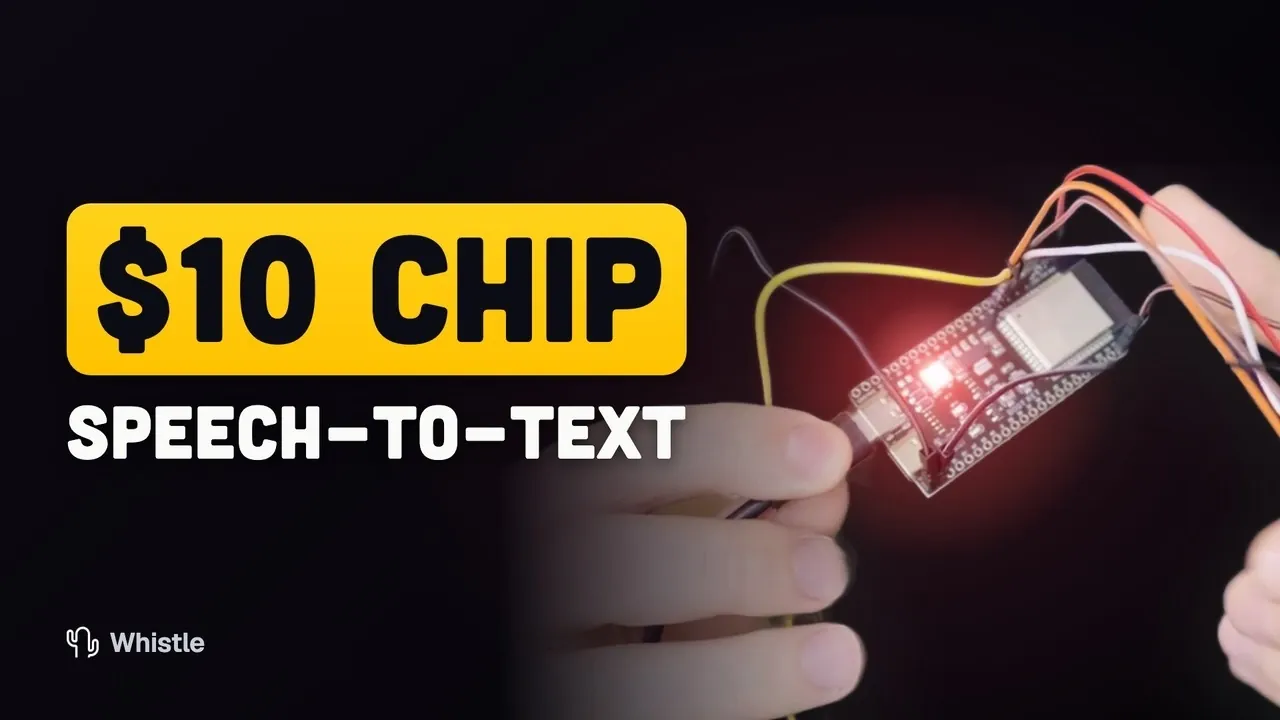
Speech recognition is often associated with resource-intensive systems, but Better Stack highlights how the Whistle speech-to-text model operates on a $10 ESP32S3 microcontroller. Developed by Cactus Compute, Whistle is a 16.9 MB model that runs entirely offline, supporting seven languages, including English, French and German. The setup includes an INMP441 digital microphone for capturing audio, a push button for activation and an RGB LED for visual feedback. This design prioritizes privacy by eliminating the need for internet connectivity while showcasing the capabilities of low-cost hardware in handling AI-driven tasks.
Explore how Whistle uses 8-bit integer math and dual-core architecture to enable real-time processing on constrained hardware. Learn about its applications in areas like voice-activated home automation and portable devices that prioritize offline functionality. Gain insight into techniques such as keyword biasing, which improve recognition accuracy in diverse environments.
Understanding the Whistle Model
TL;DR Key Takeaways :
- The Whistle speech-to-text model enables offline voice recognition on a $10 ESP32S3 microcontroller, making advanced AI accessible for low-cost, resource-constrained hardware.
- Whistle supports seven languages (English, German, French, Spanish, Italian, Dutch and Polish) and offers features like language detection, word-level timestamping, and audio embeddings for efficient analysis.
- The system operates entirely offline, making sure privacy and reliability, and is optimized for real-time performance with a compact 16.9 MB model size.
- Hardware integration includes an INMP441 digital microphone, push button, and RGB LED, with optimizations like 8-bit integer math and dual-core processing for efficient operation.
- Whistle is open source (Apache 2.0 license) and suitable for applications such as voice-controlled home automation, portable privacy-focused devices, and educational tools, providing widespread access to access to AI technologies.
Whistle, developed by Cactus Compute, is a compact and efficient speech-to-text model designed to operate on constrained hardware. At just 16.9 MB, it supports seven languages—English, German, French, Spanish, Italian, Dutch and Polish—making it versatile for multilingual applications. Its features include language detection, word-level timestamping, and audio embeddings for analysis without requiring full transcription. Despite its small size, Whistle demonstrates superior speed and efficiency compared to OpenAI’s Whisper Base model, making it an ideal choice for environments where computational resources are limited.
The model’s ability to deliver high performance in a compact form factor highlights its potential for practical applications in areas such as home automation, portable devices and privacy-focused systems. By allowing speech recognition on low-cost hardware, Whistle bridges the gap between advanced AI capabilities and accessible technology.
Hardware Integration and Design
The Whistle model is implemented on the ESP32S3 microcontroller, a cost-effective chip priced at $10. This microcontroller is equipped with 16 MB of flash storage and 8 MB of memory, providing sufficient resources for the optimized model. The hardware setup includes:
- An INMP441 digital microphone for capturing high-quality audio input
- A push button for activation, making sure efficient power usage
- An RGB LED for visual feedback, enhancing user interaction
One of the standout features of this system is its ability to operate entirely offline, eliminating the need for Wi-Fi or Bluetooth connectivity. This ensures privacy and reliability, even in environments without internet access. The offline functionality makes the system particularly suitable for sensitive applications where data security is a priority.

Check out more relevant guides from our extensive collection on speech-to-text that you might find useful.
- Leaked Google Pixel 11 Pro XL Renders Show a Radical Camera Bar Redesign
- Apple Maps vs. Google Maps vs. Waze: Which CarPlay App Wins?
- Google Pixel 11 Pro Fold Leak Reveals the Thinnest Pixel Fold Yet
- Google Pixel 11 Pro XL Specs Revealed: Display, Battery, and Tensor G6 Details Inside
- How to Pick the Perfect AI Speaker Diarization API for Your Project
- Free Open-Source App Turns Any Audio File Into Text Offline
- Whryte 4x Faster than Typing : Offline Speech-to-Text App for Mac
- Google Pixel 11 Pro: Leaks, Specs, Tensor G6, and Everything We Know
- Improve AI Voice Assistant Voice Detection with Turn Detection and Diarization
- 5 Best Free Speech-to-Text APIs in 2025 Compared & Tested
Optimizing Whistle for Constrained Hardware
Adapting the Whistle model for the ESP32S3 microcontroller required overcoming several challenges. Initially, the model’s size exceeded the storage capacity of the microcontroller. To address this, the decoder layers were trimmed, reducing the model’s size while maintaining its accuracy. Additional optimizations included:
- Implementing 8-bit integer math to enhance processing efficiency
- Using the microcontroller’s dual-core architecture for parallel processing
These adjustments significantly reduced latency, allowing the system to process voice commands in real time. The result is a responsive and efficient speech recognition system capable of operating within the constraints of low-cost hardware.
Performance and Accuracy
The optimized system processes voice commands with an average response time of approximately 10 seconds, making it suitable for practical applications. While Whistle performs well with short phrases, its accuracy decreases for single-word inputs. For example, in tests involving English color commands, the system achieved a 78% accuracy rate. This performance was further improved through techniques such as keyword biasing and retry mechanisms, making sure reliable operation in real-world scenarios.
These performance metrics demonstrate the model’s ability to deliver consistent results in resource-constrained environments. By focusing on practical use cases, the system strikes a balance between accuracy and efficiency, making it a valuable tool for developers and engineers.
Technical Workflow
The Whistle model’s audio processing pipeline begins with the conversion of raw audio into MEL spectrograms, a compact and efficient representation of sound. These spectrograms are then compressed using convolutional layers, which allow the model to process audio data efficiently. The encoder-decoder architecture of the model enables it to understand context, improving transcription accuracy.
A custom parser is used to interpret recognized commands, allowing the system to perform specific actions. For instance, the model can control an RGB LED based on voice input, demonstrating its potential for voice-controlled automation. This technical workflow showcases the model’s ability to deliver advanced functionality on constrained hardware.
Applications and Broader Implications
Whistle is open source software, licensed under Apache 2.0 and is available on HuggingFace. Its compact size, offline functionality and multilingual support make it suitable for a wide range of applications, including:
- Voice-controlled home automation, such as smart lighting or appliance control
- Portable devices that prioritize privacy and do not rely on cloud connectivity
- Educational tools for teaching speech recognition and embedded AI concepts
By allowing speech recognition on low-cost hardware, Whistle democratizes access to advanced AI technologies. It enables developers to create innovative solutions that were previously limited to high-end devices or cloud-based systems.
The Significance of Embedded AI
This project underscores the potential of embedded AI systems to transform everyday technology. By optimizing the Whistle model for the ESP32S3 microcontroller, developers can achieve reliable speech recognition in offline, low-cost devices. This innovation not only enhances accessibility but also highlights the ingenuity required to adapt innovative AI for constrained hardware environments.
As the demand for privacy-focused, cost-effective solutions continues to grow, projects like Whistle demonstrate how advanced AI can be integrated into practical, real-world applications. This development paves the way for a future where speech recognition and other AI capabilities are no longer confined to expensive or resource-intensive platforms, but are instead accessible to a broader audience.
Media Credit: Better Stack
Disclosure: Some of our articles include affiliate links. If you buy something through one of these links, Geeky Gadgets may earn an affiliate commission. Learn about our Disclosure Policy.
