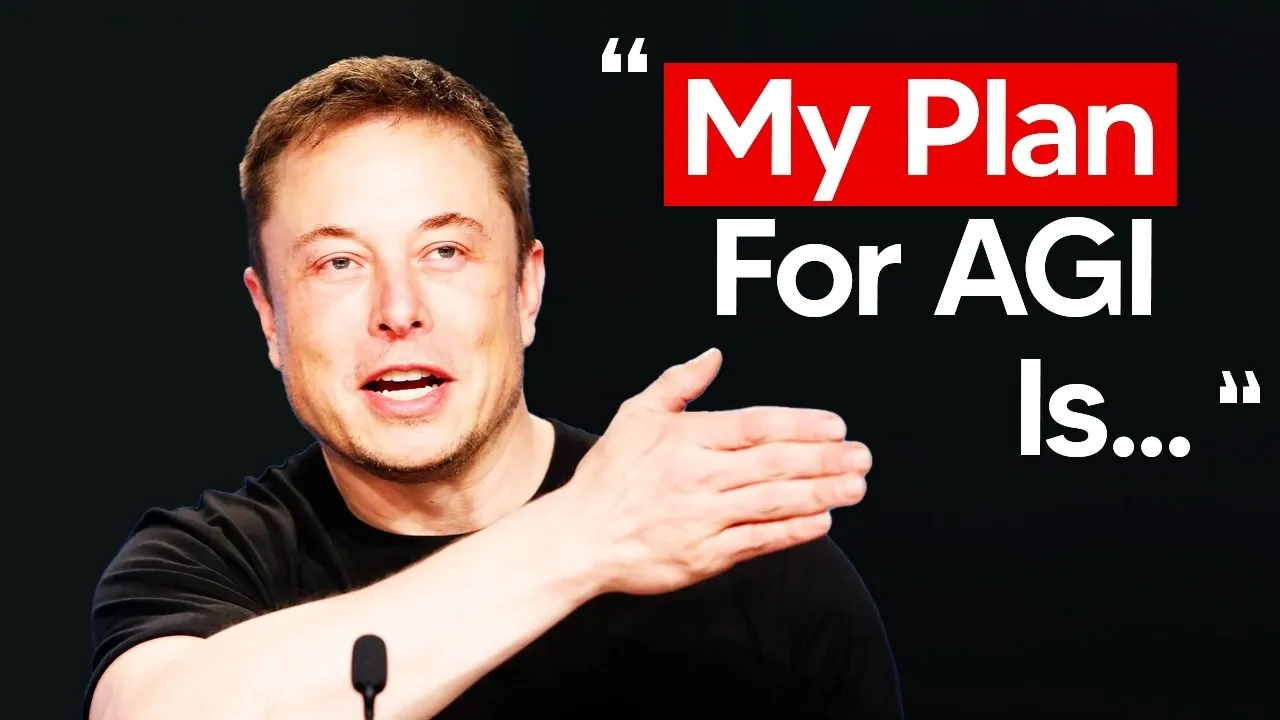
Elon Musk has unveiled xAI’s ambitious roadmap for Grok 5, a next-generation AI model designed to push the boundaries of Artificial General Intelligence (AGI). As detailed by AI Grid, this plan builds on the foundation of the Grok 4 series, with Grok 5 aiming to scale up to 10 trillion parameters. This leap in computational scale is supported by Tesla’s GPU clusters and SpaceX’s engineering expertise, allowing xAI to accelerate training timelines and refine model performance. Musk has emphasized that Grok 5’s development is not solely about parameter scaling but also about achieving adaptability and reasoning capabilities essential for AGI.
Dive into the specifics of xAI’s strategy, including how supplemental training techniques are shaping the transition from Grok 4 to Grok 5. Gain insight into the challenges of balancing computational power with intelligent design and explore the role of xAI’s Colossus training cluster in reducing development timelines. This breakdown also examines xAI’s competitive positioning in the AI landscape and the broader implications of Grok 5 for the future of AGI research.
Building on the Grok 4 Series: A Foundation for Progress
TL;DR Key Takeaways :
- xAI, led by Elon Musk, is advancing toward Artificial General Intelligence (AGI) with the development of Grok 5, a next-generation AI model featuring up to 10 trillion parameters.
- The Grok 4 series, with models scaling up to 1.5 trillion parameters, serves as the foundation for Grok 5, using iterative improvements and real-world testing to refine capabilities.
- Grok 5 emphasizes not only scaling computational power but also achieving adaptability and broad cognitive abilities, aligning with the core principles of AGI.
- xAI uses Tesla’s GPU clusters, SpaceX’s engineering expertise and the Colossus training cluster to accelerate development and maintain a competitive edge in the AI race.
- While Grok 5 has the potential to redefine AI benchmarks, xAI faces challenges such as ethical considerations, post-training alignment and competition from major players like OpenAI and Google.
The Grok 4 series serves as the critical foundation for xAI’s journey toward AGI, paving the way for the development of Grok 5. Currently, the Grok 4.3 beta model is operational, with subsequent iterations, Grok 4.4 and Grok 4.5, expected to launch soon. These models are projected to feature 1 trillion and 1.5 trillion parameters, respectively, marking significant advancements in scale and capability.
To ensure these models meet performance expectations, xAI is employing supplemental training techniques to address limitations identified during beta testing. This iterative approach allows xAI to refine its models, learn from real-world applications and establish a robust platform for the leap to Grok 5. By building on the lessons learned from the Grok 4 series, xAI is positioning itself to deliver a more scalable and adaptable AI system.
Grok 5: Scaling to 10 Trillion Parameters
Grok 5 represents a monumental step forward in AI model development, with plans to create versions featuring 6 trillion and 10 trillion parameters. Musk has stated that pre-training the 10 trillion parameter model could be completed in just two months, thanks to xAI’s advanced compute infrastructure. This rapid timeline underscores the efficiency of xAI’s systems and its commitment to accelerating progress in AI research.
However, Musk has emphasized that achieving AGI requires more than just scaling up parameters. Grok 5’s design focuses on adaptability and broad cognitive abilities, aligning with the broader definition of AGI as a system capable of reasoning, learning and generalizing knowledge across diverse domains. This approach reflects xAI’s understanding that true AGI demands a balance between computational power and intelligent design.

Here are more detailed guides and articles that you may find helpful on Grok.
- Grok 4.2 Beginner Guide : Agents, Best Prompts & Limits
- Grok 4’s Jailbreak Mode: What You Need to Know
- Grok 4.2 vs Gemini 3.0 : Speed-To-Quality & Coding Tests
- Unlock AI Potential with Grok-2 API: A Developer’s Guide
- ChatGPT vs Claude vs Gemini vs Perplexity: Best Uses
- Grok 4.2 and Sonoma Sky Alpha: A New Era for Artificial Intelligence
- Grok 4.20 AI Trading Model Beats Rivals in Two Weeks
- Exploring Grok 5: Elon Musk’s Vision for Next-Gen AI and AGI
- ChatGPT vs Claude vs Gemini & More : Compare AI Features & Pricing
- Grok 4.2 Early Performance Tests : Sharper UI Design & Reliable Coding
xAI’s Comprehensive Development Strategy
To realize its ambitious vision, xAI has adopted a multi-faceted development strategy that prioritizes speed, scale and innovation. Key elements of this strategy include:
- Using Tesla’s GPU clusters to provide the computational power necessary for training large-scale AI models.
- Incorporating SpaceX’s engineering expertise to optimize hardware and software integration for maximum efficiency.
- Using the Colossus training cluster, a state-of-the-art infrastructure designed to enable parallel training across multiple models.
This approach allows xAI to iterate rapidly, reducing the time required to develop and deploy new models. By combining advanced infrastructure with innovative engineering, xAI aims to maintain a competitive edge in the rapidly evolving AI landscape.
The Potential Impact of Grok 5 on AGI
Grok 5 has been positioned as a potential AGI-level model, though Musk remains cautious about making definitive claims. Achieving AGI requires more than just technical advancements; it demands breakthroughs in reasoning, learning and generalization across a wide range of tasks. Grok 5’s success could redefine xAI’s role in the AI industry, setting new benchmarks for what advanced AI systems can achieve.
If successful, Grok 5 could serve as a fantastic milestone in the development of AGI, demonstrating the feasibility of creating systems capable of human-like intelligence. However, the journey to AGI is complex, requiring not only technical innovation but also careful consideration of ethical and societal implications.
Challenges and Competition in the AI Landscape
The development of Grok 5 is not without its challenges. Post-training alignment and safety evaluations will be critical to ensure the model operates reliably and ethically. Additionally, the immense expectations surrounding AGI place significant pressure on xAI to deliver results that meet both technical and ethical standards.
xAI also faces stiff competition from established players such as OpenAI, Google and Anthropic. Unlike its competitors, xAI is focusing on massive compute resources and rapid iteration rather than incremental improvements. This bold strategy positions xAI as a serious contender in the race toward AGI, but it also raises the stakes for Grok 5’s success.
The Road Ahead for xAI and Grok 5
Elon Musk’s announcement of the Grok 5 roadmap highlights xAI’s determination to push the boundaries of AI capabilities. By scaling to 10 trillion parameters and using state-of-the-art infrastructure, xAI aims to redefine what is possible in artificial intelligence. However, the journey to AGI is fraught with challenges, including technical hurdles, ethical considerations and intense competition.
As Grok 5 approaches its release, the world will be watching closely to see if xAI can deliver on its ambitious promises. Whether or not Grok 5 achieves AGI, its development represents a pivotal moment in the evolution of AI technology. The success of Grok 5 could reshape the future of artificial intelligence, setting the stage for a new era of innovation and discovery.
Media Credit: TheAIGRID
Disclosure: Some of our articles include affiliate links. If you buy something through one of these links, Geeky Gadgets may earn an affiliate commission. Learn about our Disclosure Policy.
