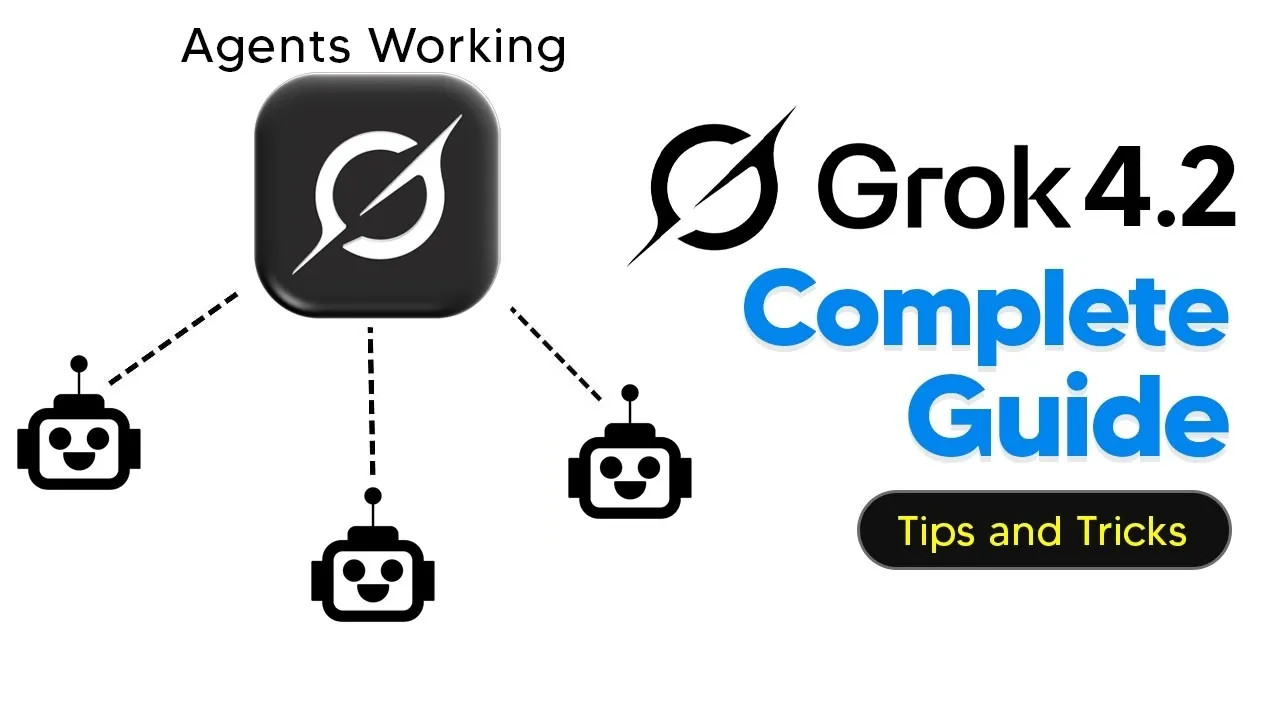
Grok 4.2 is an advanced AI model designed to handle complex reasoning and decision-making tasks through a collaborative multi-agent framework. As overviewed by the AI Grid, this system integrates the expertise of four specialized agents, Captain Grok, Harper, Lucas, and Benjamin, to deliver outputs that are precise, balanced, and transparent. However, its lack of memory requires users to provide structured, context-rich prompts for optimal performance, and its $30 monthly subscription reflects the computational resources needed to power its capabilities.
In this how-to guide, you will learn how to effectively structure your prompts to maximize Grok 4.2’s potential, including strategies for assigning roles to its agents and reducing inaccuracies. Additionally, you’ll explore practical use cases, such as conducting detailed policy analyses or evaluating investment opportunities, where the model’s collaborative approach shines. By understanding these workflows and tailoring your inputs, you can achieve more accurate and actionable results with Grok 4.2.
New Grok 4.2 Launches
TL;DR Key Takeaways :
- Grok 4.2 is an advanced AI model built on a multi-agent framework, featuring four specialized agents (Captain Grok, Harper, Lucas, and Benjamin) to deliver precise, balanced, and transparent outputs.
- The model excels in tasks requiring deep reasoning, such as policy analysis and investment decisions, by using collaboration among its agents to reduce errors and enhance insights.
- It lacks memory, requiring users to provide complete context and structured prompts for each interaction to achieve optimal results.
- Grok 4.2 is available via a $30/month premium subscription, reflecting its computational intensity and advanced capabilities, but it imposes strict usage limits.
- Key strengths include error reduction, nuanced outputs, fact-checking, transparency, and source prioritization, making it ideal for tackling complex, multi-dimensional problems.
At its core, Grok 4.2 is a collaborative AI system that operates through the interaction of four distinct agents, each with a specialized role. These agents work together to ensure that the model delivers comprehensive and reliable outputs:
- Captain Grok: The central coordinator responsible for delegating tasks among the agents and synthesizing their contributions into a unified response.
- Harper: A research and fact-checking expert who ensures the accuracy and reliability of the information provided.
- Lucas: Focused on creativity and balance, Lucas offers nuanced perspectives and ensures that outputs are well-rounded and unbiased.
- Benjamin: A specialist in technical computations, coding, and logic, Benjamin handles tasks requiring mathematical precision and logical reasoning.
This multi-agent system is particularly well-suited for tasks that require deep reasoning, such as analyzing complex policies, evaluating investment opportunities, or addressing open-ended questions. Unlike traditional AI models, Grok 4.2 emphasizes collaboration among its agents, which reduces errors and enhances the depth and reliability of its insights.
How to Access Grok 4.2
Grok 4.2 is available exclusively through a premium subscription priced at $30 per month. This cost reflects the model’s advanced capabilities and the significant computational resources required to operate it. However, the resource-intensive nature of Grok 4.2 imposes strict usage limits, making it essential for users to approach it strategically. To maximize the value of your subscription, you should focus on crafting well-structured and detailed prompts that align with your specific needs.
Grok 4.2 For Beginners
Check out more relevant guides from our extensive collection on Grok that you might find useful.
- Grok 4.2 vs Gemini 3.0 : Speed-To-Quality & Coding Tests
- Grok 4.1 xAI Model Tested : Everything You Need to Know
- GPT-5 Pro vs Grok 4 Heavy vs Claude 4.1 Opus vs Gemini 2.5 Pro
- xAl Grok 4 : Elon Musk’s Latest AI Model Explained
- Grok 4.20 AI Trading Model Beats Rivals in Two Weeks
- Claude 4 vs Grok 4 : Which AI Model is Best for AI Coding?
- Grok Code Fast 1 : New Efficient, High Quality AI Coding Assistant
- How Grok 3 is Enhancing Game Development with AI Automation
- Grok 4.1 Multimodal Features, Speed Gains, and Limits Explained
- Grok 4 Review: Is This AI Tool Worth the Hype for Businesses?
Optimizing Your Prompts for Grok 4.2
To fully use the capabilities of Grok 4.2, it is crucial to structure your prompts effectively. Since the model lacks memory, each query must include all relevant background information. Here are some strategies to optimize your interactions:
- Assign Roles: Clearly define tasks for each agent. For instance, direct Harper to verify facts, Lucas to explore alternative perspectives, and Benjamin to handle technical calculations. Captain Grok will integrate their contributions into a cohesive response.
- Provide Context: Include all necessary details in your query to ensure accurate and relevant outputs. Without memory, the model cannot recall previous interactions, so every prompt must stand alone.
- Reduce Hallucinations: Use structured and detailed prompts to minimize the risk of the model generating incorrect or fabricated information.
By following these guidelines, you can ensure that Grok 4.2 delivers outputs that are both accurate and tailored to your specific requirements.
Key Strengths of Grok 4.2
The multi-agent framework of Grok 4.2 offers several distinct advantages, particularly for tasks that require nuanced reasoning and diverse perspectives. These strengths make it a valuable tool for users seeking reliable and comprehensive insights:
- Error Reduction: The collaborative nature of the agents minimizes inaccuracies and inconsistencies in the outputs.
- Nuanced Outputs: Lucas ensures that responses incorporate diverse viewpoints, avoiding oversimplification and bias.
- Fact-Checking: Harper’s expertise in research enhances the reliability and accuracy of the information provided.
- Transparency: The model allows users to trace its reasoning process, offering insights into how conclusions are reached.
- Source Prioritization: Users can specify preferred sources for domain-specific tasks, making sure that outputs align with trusted and authoritative information.
These features make Grok 4.2 particularly effective for tackling complex, multi-dimensional problems that require careful analysis and balanced decision-making.
Limitations to Consider
While Grok 4.2 offers numerous strengths, it also has limitations that users should be aware of. Understanding these constraints is essential for using the model effectively:
- No Memory: The model cannot retain information from previous interactions, requiring users to provide complete context in every prompt.
- Computational Intensity: Its resource-heavy nature imposes strict usage limits, making it less suitable for high-frequency or resource-intensive tasks.
These limitations highlight the importance of careful planning and structured inputs to maximize the model’s potential.
Practical Applications of Grok 4.2
Grok 4.2 is particularly well-suited for scenarios that demand deep reasoning and multiple perspectives. Here are two examples of how the model can be effectively used:
- Investment Decisions: Assign Harper to research market trends, Lucas to analyze opposing viewpoints, and Benjamin to calculate potential returns. Captain Grok will synthesize these inputs into a comprehensive recommendation tailored to your investment goals.
- Policy Analysis: Use Harper to gather supporting evidence, Lucas to evaluate counterarguments, and Benjamin to assess the logical implications of proposed policies. The model can then provide a balanced and well-supported conclusion.
These examples demonstrate the model’s ability to handle complex, multi-faceted tasks with precision and nuance, making it a valuable tool for professionals and decision-makers.
Unlocking the Potential of Grok 4.2
Grok 4.2 represents a significant advancement in AI-driven reasoning and decision-making. Its multi-agent framework fosters collaborative problem-solving, reducing errors and delivering nuanced insights. While its computational intensity and lack of memory require careful usage, its strengths in transparency, fact-checking, and balanced outputs make it a powerful tool for addressing complex, open-ended tasks. By structuring your prompts effectively and using the unique expertise of each agent, you can unlock the full potential of Grok 4.2 and achieve highly accurate and actionable results.
Media Credit: TheAIGRID
Disclosure: Some of our articles include affiliate links. If you buy something through one of these links, Geeky Gadgets may earn an affiliate commission. Learn about our Disclosure Policy.
