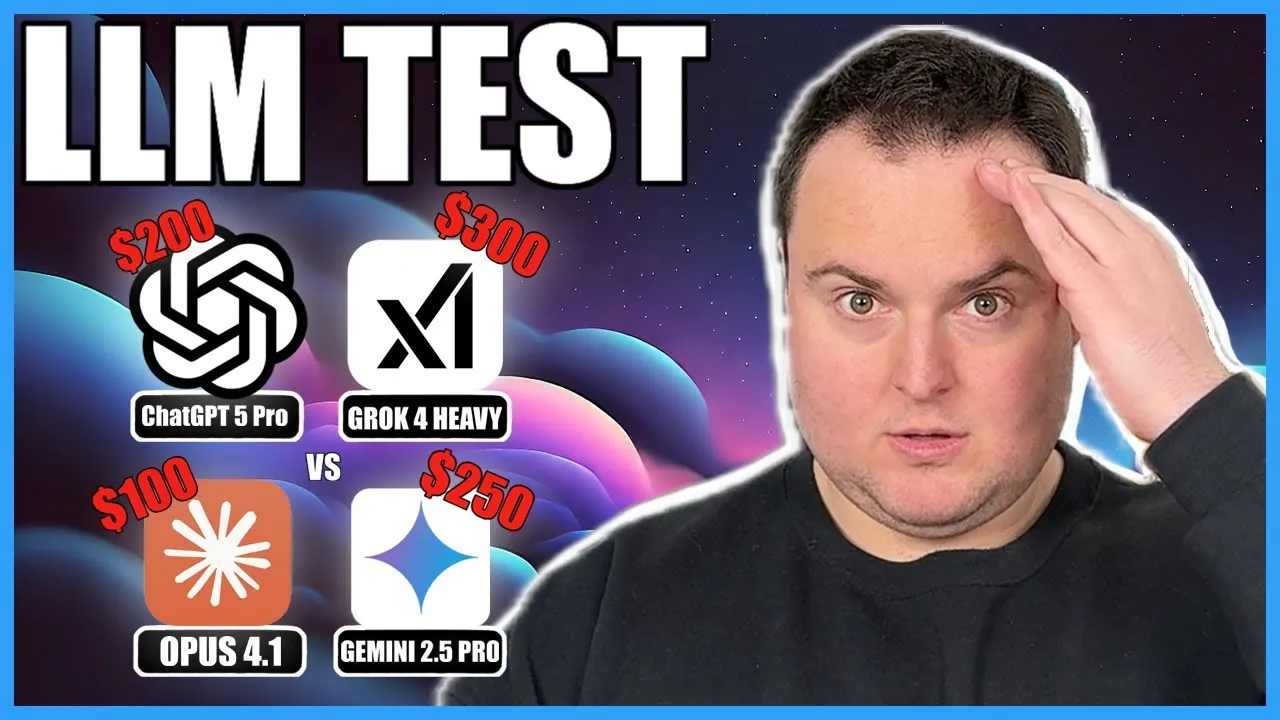
What happens when the most advanced AI models go head-to-head in a battle of creativity, technical prowess, and problem-solving? The results are rarely predictable. In a world where AI drives innovation across industries, comparing the likes of GPT-5 Pro, Grok 4 Heavy, Claude 4.1 Opus, and Gemini 2.5 Pro isn’t just a technical exercise—it’s a glimpse into the future of human-machine collaboration. From building browser-based operating systems to crafting immersive roleplay scenarios and even coding first-person shooter games, these models are pushed to their limits. But which one rises to the challenge, and which falters under the weight of complexity? The answers might surprise you.
Below Bijan Bowen tests the performance of these four AI powerhouses across three distinct tests, revealing their unique strengths and glaring weaknesses. You’ll discover why some models shine in creative tasks while others dominate in technical execution—and why no single AI is a one-size-fits-all solution. Whether you’re an innovator seeking the perfect AI partner or simply curious about the state of innovative technology, this breakdown offers insights that go beyond the surface. By the end, you might find yourself questioning what truly defines “the best” AI: raw capability, ethical boundaries, or the ability to adapt to diverse challenges?
AI Model Performance Comparison
TL;DR Key Takeaways :
- Claude 4.1 Opus emerged as the most reliable and balanced performer, excelling in technical precision, usability, and functionality across all tests.
- GPT-5 Pro showed potential in creative and visual tasks but struggled with execution in performance-heavy scenarios and imposed self-restrictions in roleplay.
- Grok 4 Heavy underperformed in all tests, delivering outputs that were less detailed, lacked functionality, and failed to meet modern standards.
- Gemini 2.5 Pro excelled in creative roleplay with exceptional imagination but struggled with technical and functional tasks due to its older architecture.
- The evaluation highlights the importance of tailoring AI models to specific tasks, with future iterations like Gemini 3 expected to address current limitations and enhance versatility.
Building a Browser-Based Operating System
The first test required the models to design a functional browser-based operating system. This included essential features such as a taskbar, start menu, and user-friendly interface. The task evaluated their ability to combine technical precision with practical design.
- Claude 4.1 Opus: Delivered the most polished and functional result. Its design featured a cohesive layout, a working taskbar, and a fully operational start menu. The model demonstrated a strong understanding of user experience and attention to detail.
- GPT-5 Pro: Produced a functional taskbar and clock but lacked the refinement and visual appeal of Claude’s output. While the technical aspects were present, the overall user experience was less intuitive.
- Grok 4 Heavy: Struggled significantly with this task. Its output was limited in functionality, and the interface design appeared rudimentary, failing to meet modern usability standards.
- Gemini 2.5 Pro: Performed the weakest in this test, delivering minimal functionality and an outdated design. The result lacked both technical depth and practical usability.
Creative Roleplay Performance
The second test assessed the models’ ability to engage in a complex roleplay scenario. This task measured their creativity, imagination, and ability to generate contextually appropriate and engaging content.
- Gemini 2.5 Pro: Surprised with its exceptional creativity and depth. It delivered the most immersive and engaging response, showcasing its strength in imaginative tasks despite its older architecture.
- Grok 4 Heavy: Produced a brief and simplistic response. The lack of depth and complexity in its output made it unsuitable for creating a compelling roleplay experience.
- GPT-5 Pro: Followed the prompt but imposed self-restrictions on its role, which limited its ability to fully engage with the scenario. This cautious approach hindered its creative potential.
- Claude 4.1 Opus: Declined to participate in the roleplay due to built-in safeguards prioritizing ethical considerations. While this reflects its commitment to responsible AI use, it impacted its performance in this specific test.
GPT-5 Pro vs Grok 4 Heavy vs Claude 4.1 Opus vs Gemini 2.5 Pro

Unlock more potential in advanced language AI models by reading previous articles we have written.
- Understanding the Advanced Capabilities of Large Language
- How to Run Large Language Models on Your Laptop
- Mistral Large vs GPT-4 vs Gemini Advanced prompt comparison
- Understanding GPTs: A Deep Dive into AI Language Models
- How AI Agents are powered by large language models
- MIXTRAL 8x22B large language model from Mistral AI
- Add a ChatGPT Chatbot to Your Website in 10 Minutes
- Google Gemini Advanced: A Deep Dive into Its Capabilities
- Deepseek VL-2 : The Future of Scalable Vision-Language AI
- Unlock the Secrets of Context Engineering to Supercharge AI Models
Developing a First-Person Shooter Game
The final test challenged the models to create a first-person shooter game in Python. This task required them to handle complex gameplay mechanics, scoring systems, and mini-maps, testing their programming capabilities and problem-solving skills.
- Claude 4.1 Opus: Delivered the most functional and complete game. It included enemies, a scoring system, and a working mini-map, demonstrating advanced programming skills and a strong grasp of game development concepts.
- GPT-5 Pro: Created a visually detailed map but struggled with performance issues. The game lacked essential gameplay mechanics, which limited its overall functionality.
- Grok 4 Heavy: Produced a non-functional script that failed to meet the task’s requirements. This highlighted its technical limitations and inability to handle complex programming tasks.
- Gemini 2.5 Pro: Faced significant challenges, delivering an incomplete and outdated result. The game lacked functionality and failed to meet modern development standards.
Performance Insights and Key Observations
The results of these tests reveal distinct strengths and weaknesses among the models, emphasizing their varying levels of specialization and competence:
- Claude 4.1 Opus: Emerged as the most reliable performer, consistently excelling in functionality and adherence to prompts. Its ability to balance technical precision with usability made it the standout model overall.
- GPT-5 Pro: Demonstrated potential in creative and visual tasks but struggled with execution in performance-heavy scenarios. Its cautious approach to certain prompts limited its versatility.
- Grok 4 Heavy: Underperformed across all tests, producing outputs that were shorter, less detailed, and often lacking in functionality. Its limitations were particularly evident in complex technical tasks.
- Gemini 2.5 Pro: Showcased unique strengths in creative roleplay, delivering imaginative and engaging responses. However, its older architecture hindered its performance in technical and functional tasks.
Looking Ahead: The Future of AI Models
This comparison highlights the diverse capabilities and limitations of current AI models. While Claude 4.1 Opus emerged as the most balanced and reliable performer, each model demonstrated unique strengths that could be used for specific applications. For instance, Gemini 2.5 Pro excelled in creative tasks, making it a strong candidate for imaginative projects, while GPT-5 Pro showed promise in visual and design-oriented tasks despite its inconsistencies.
As AI technology continues to evolve, future iterations—such as the anticipated Gemini 3—are expected to address these limitations, offering more robust and versatile solutions. This evaluation underscores the importance of tailoring AI models to specific tasks, making sure they meet the diverse needs of users in both creative and technical domains. The ongoing development of AI promises to unlock new possibilities, paving the way for innovative applications across industries.
Media Credit: Bijan Bowen
Disclosure: Some of our articles include affiliate links. If you buy something through one of these links, Geeky Gadgets may earn an affiliate commission. Learn about our Disclosure Policy.
