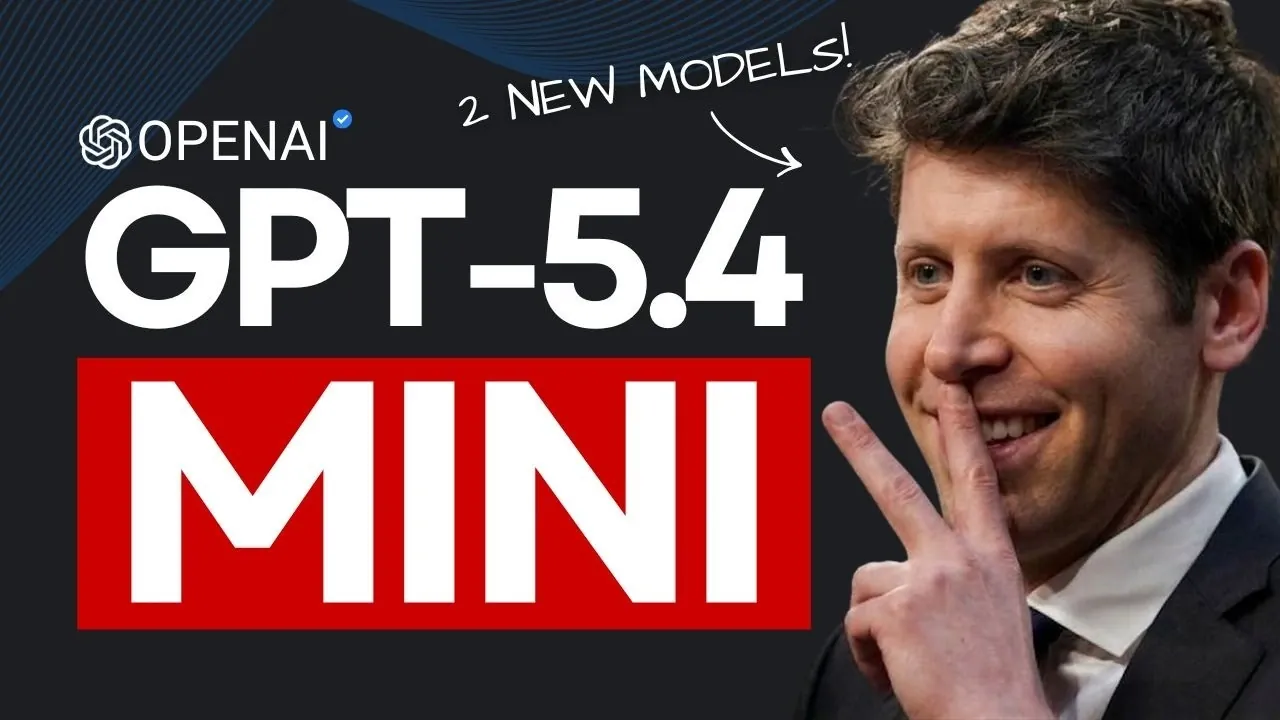
OpenAI has introduced two new AI models, ChatGPT 5.4 Mini and ChatGPT 5.4 Nano, aimed at providing more accessible and cost-efficient options for developers and businesses. As highlighted by Universe of AI, these models are tailored for specific workloads where full-scale capabilities of GPT 5.4 may not be necessary. For instance, ChatGPT 5.4 Mini is designed to handle tasks like coding workflows and multimodal understanding with reduced resource consumption, while Nano focuses on high-volume, repetitive tasks such as data extraction and classification. Both models prioritize affordability, with Nano priced at just $0.20 per million input tokens, making it an attractive choice for budget-conscious applications.
Explore how these models can optimize workflows in areas like customer service automation, coding assistance and sub-agent integration within larger AI systems. You’ll gain insight into the performance benchmarks of Mini and Nano, including their respective strengths in efficiency and scalability. Additionally, learn how their pricing structure compares to GPT 5.4, offering significant savings for enterprises without compromising essential functionality. This preview provides a detailed breakdown of how these models can fit into diverse operational needs.
The Value of Smaller AI Models
TL;DR Key Takeaways :
- OpenAI introduced ChatGPT 5.4 Mini and Nano, smaller AI models designed for cost-efficient, scalable and task-specific applications, broadening accessibility to advanced AI technologies.
- ChatGPT 5.4 Mini balances performance and affordability, excelling in coding workflows, reasoning and multimodal tasks, while consuming only 30% of GPT 5.4’s resources.
- ChatGPT 5.4 Nano is optimized for lightweight, high-volume tasks like classification and data extraction, offering unparalleled affordability for large-scale operations.
- Both models feature agentic tool calling, enhancing their utility in automation-heavy environments and are priced significantly lower than GPT 5.4, making them attractive for budget-conscious enterprises.
- OpenAI’s tiered strategy with Mini and Nano redefines AI deployment by reserving flagship models for complex tasks and introducing smaller models for simpler workloads, accelerating AI adoption across industries.
The introduction of ChatGPT 5.4 Mini and Nano highlights OpenAI’s strategic focus on creating AI tools optimized for specific workloads. These smaller models are particularly suited for applications where absolute precision is less critical, but speed and cost-effectiveness are essential. Common use cases include:
- Customer service chatbots: Efficiently handling routine queries and improving response times.
- Coding assistants: Supporting developers with code suggestions and debugging.
- Sub-agents in larger systems: Performing specialized tasks within broader AI frameworks.
- Multimodal applications: Integrating text, image and other data types for diverse functionalities.
By offering these tailored solutions, OpenAI enables businesses and developers to optimize their workflows while maintaining a balance between performance and cost.
ChatGPT 5.4 Mini: Performance Meets Affordability
ChatGPT 5.4 Mini is designed to deliver a robust combination of performance and cost savings. It excels in tasks requiring moderate computational power, such as coding workflows, reasoning and multimodal understanding. Mini also supports agentic tool calling, a feature that enhances its utility in automation-heavy environments. Key performance metrics include:
- 54.4% on the Software Engineering Bench Pro, demonstrating its capability in coding-related tasks.
- 72.1% on OS World Verified for desktop navigation, showcasing its versatility in practical applications.
Despite its smaller size, Mini achieves results comparable to GPT 5.4 in many scenarios, making it a cost-effective alternative. For instance, in coding workflows, Mini can efficiently handle subtasks with low latency while consuming only 30% of GPT 5.4’s resource quota. Priced at $0.75 per million input tokens and $4.50 per million output tokens, it offers significant savings for enterprises seeking high performance at a reduced cost.
Advance your skills in ChatGPT 5 by reading more of our detailed content.
- ChatGPT 5.4 Thinking vs Earlier Models : Token Savings and Stronger Self-Checks
- ChatGPT 5.4 1M-Token Context, Extreme Reasoning Mode: Longer Tasks, Fewer Mistakes
- ChatGPT 5.3 Upgrade Focus on Reasoning and Reliability Boost
- OpenAI GPT-5.4 Leak During Codex Demo Sparks Release Questions
- ChatGPT 5.3 Instant Cuts Unneeded Disclaimers
- Opus 4.6 vs ChatGPT 5.3 : Code Size, Speed & Build Tradeoffs
- OpenAI ChatGPT 5.4: 1M-token Context, Tool Search & New Prices
- OpenAI Codex 5.3 vs Anthropic Opus 4.6 : Coding Comparison
- Gemini 3.5 Leak Details, Early Tests Show Mixed Performance
- OpenAI GPT-5.3 Codex: 5 Things You Need to Know
ChatGPT 5.4 Nano: Lightweight and Scalable
ChatGPT 5.4 Nano is the most compact model in the lineup, optimized for high-volume, repetitive tasks such as classification, data extraction and ranking. While its performance is more modest, scoring 52.39% on the Software Engineering Bench Pro and 39% on OS World Verified, it is specifically designed for lightweight operations. Nano is ideal for developers managing extensive pipelines of simple tasks, where cost efficiency is a top priority.
At $0.20 per million input tokens and $1.25 per million output tokens, Nano offers unparalleled affordability. Although it is not intended for complex reasoning or intricate problem-solving, its ability to handle large-scale workloads makes it an attractive option for businesses aiming to scale their operations without exceeding budget constraints.
Cost Efficiency: Mini and Nano vs. GPT 5.4
The pricing structure of Mini and Nano underscores OpenAI’s commitment to affordability. Compared to the flagship GPT 5.4, which costs $2.50 per million input tokens and $15 per million output tokens, the smaller models provide substantial cost savings:
- Mini: $0.75 per million input tokens, $4.50 per million output tokens
- Nano: $0.20 per million input tokens, $1.25 per million output tokens
These cost-effective options make advanced AI technology more accessible to a broader range of users, allowing businesses to scale their AI capabilities without compromising on quality or exceeding financial limitations.
Enterprise Adoption and Practical Applications
Enterprises have reported notable success with ChatGPT 5.4 Mini, particularly in workflows where cost efficiency and source attribution are critical. Both Mini and Nano now support agentic tool calling, a feature previously exclusive to larger models. This functionality enhances their effectiveness in automation-driven environments, where precision and scalability are essential.
Mini is available across ChatGPT, Codex and OpenAI’s API, providing developers with multiple integration options. Nano, on the other hand, is currently offered exclusively through the API, making sure that developers can select the model that best aligns with their specific requirements.
Redefining AI Deployment Strategies
The launch of ChatGPT 5.4 Mini and Nano represents a strategic evolution in OpenAI’s approach to AI model architecture. By reserving the flagship GPT 5.4 for complex, high-stakes tasks and introducing smaller models for simpler workloads, OpenAI is reshaping how AI is deployed across industries. This tiered strategy not only enhances cost efficiency but also accelerates the adoption of AI technologies in diverse applications.
The development of these models reflects a broader trend in the AI industry toward creating practical, scalable solutions. As businesses and developers continue to seek tools that balance performance, affordability and usability, the introduction of Mini and Nano sets a new standard for accessible and efficient AI deployment.
Media Credit: Universe of AI
Disclosure: Some of our articles include affiliate links. If you buy something through one of these links, Geeky Gadgets may earn an affiliate commission. Learn about our Disclosure Policy.
