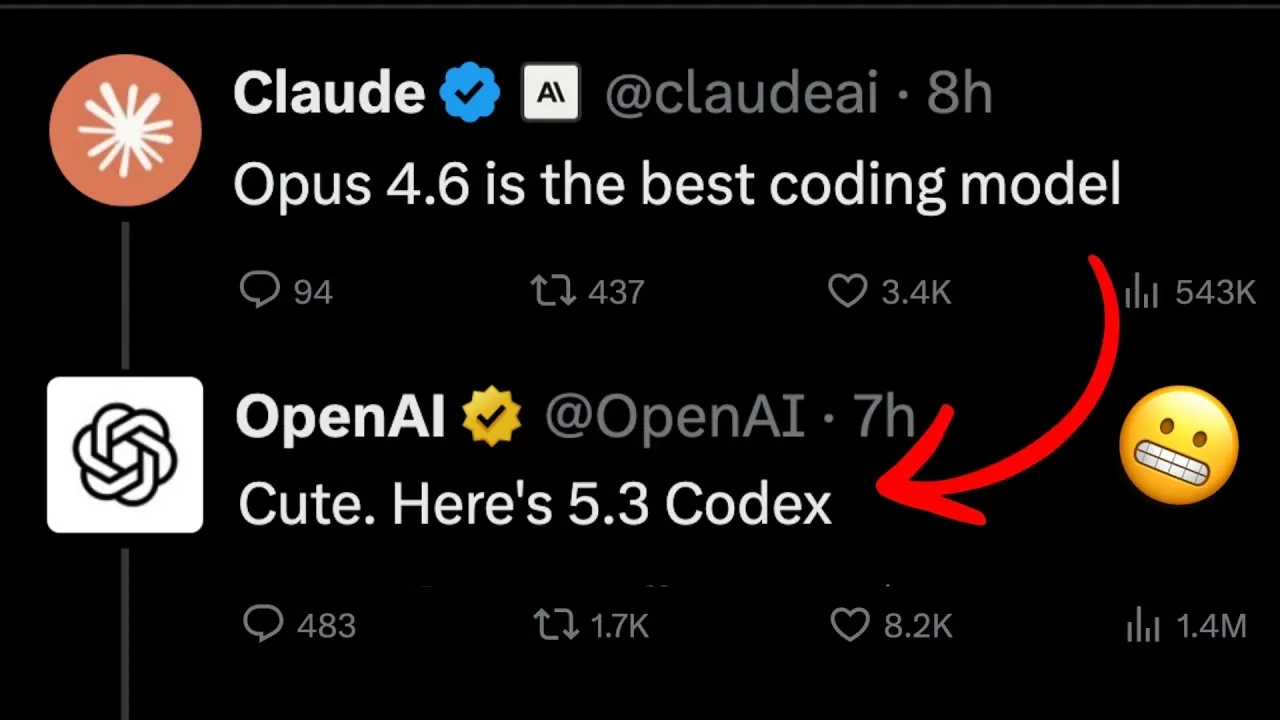
What if the future of coding wasn’t just faster, but smarter, safer, and more collaborative than ever before? In this walkthrough, Better Stack shows how the latest advancements in AI coding models, OpenAI’s GPT 5.3 Codex vs Anthropic’s Claude Opus 4.6, are reshaping the way developers approach everything from debugging to creative design. These two powerhouses are not just incremental upgrades; they represent a bold leap forward in AI-driven development. With Codex 5.3 delivering a staggering 25% improvement in execution speed and Opus 4.6 introducing a new 1-million-token context window, the competition between OpenAI and Anthropic is heating up in ways that could redefine the industry. But which model truly delivers on its promises, and what does this mean for your workflow?
This analysis dives into the strengths and trade-offs of these innovative systems, exploring how Codex 5.3’s real-time interaction and cybersecurity features stack up against Opus 4.6’s reliability and collaborative capabilities. You’ll discover how GPT 5.3 Codex excels in precision and adaptability, while Opus 4.6 shines in handling large-scale projects with its sub-agent functionality. Whether you’re curious about which model is better suited for creative tasks or how these advancements could transform your approach to coding, this breakdown offers a closer look at the innovations driving the next frontier of AI development. The question isn’t just which model is winning, it’s how these breakthroughs are changing the game entirely.
GPT 5.3 vs Opus 4.6
TL;DR Key Takeaways :
- OpenAI’s GPT 5.3 Codex outperforms Anthropic’s Claude Opus 4.6 in benchmarks, showcasing superior speed, precision, and adaptability for coding and problem-solving tasks.
- Claude Opus 4.6 introduces a 1-million-token context window and sub-agent capabilities, enhancing collaboration and efficiency for large-scale projects but at a higher cost.
- GPT 5.3 Codex features a 25% improvement in execution speed, real-time interaction for guided task execution, and advanced cybersecurity tools for identifying software vulnerabilities.
- Both models excel in different areas: Opus 4.6 prioritizes reliability and practicality, while Codex 5.3 leads in UI design, speed, and creative task performance.
- The competition between OpenAI and Anthropic is driving rapid innovation, offering developers increasingly powerful tools for programming, creativity, and task execution.
Claude Opus 4.6: Prioritizing Reliability and Collaboration
Anthropic’s Claude Opus 4.6 builds on the foundation of its predecessor, Opus 4.5, with several notable enhancements. One of its standout features is the beta 1-million-token context window, which allows you to work with extensive codebases and complex prompts. This capability is particularly beneficial for large-scale projects, allowing seamless navigation through vast amounts of data. However, the increased cost associated with extended usage may limit its accessibility for some users, especially those with budget constraints.
Another key feature of Opus 4.6 is its sub-agent capabilities, which enable task delegation within a project. This functionality improves efficiency by allowing you to assign specific tasks to specialized sub-agents, streamlining workflows and reducing bottlenecks. Additionally, the model’s adaptive thinking mode enhances its ability to adjust to evolving requirements, making it a reliable choice for dynamic projects. The inclusion of API features like context compaction further optimizes workflows by minimizing unnecessary overhead, making sure smoother task execution and better resource management.
GPT 5.3 Codex: Redefining Speed, Precision, and Security
OpenAI’s GPT 5.3 Codex represents a significant leap forward in AI coding technology. Building on the success of GPT 5.2, this model delivers a 25% improvement in execution speed, making it ideal for long-running or computationally intensive tasks. This speed enhancement allows you to complete projects more efficiently, reducing downtime and improving overall productivity. The real-time interaction feature is another major advancement, allowing you to guide the model during task execution. This interactive capability enhances both efficiency and user control, allowing for more precise and tailored outcomes.
A defining feature of GPT 5.3 Codex is its advanced cybersecurity capabilities. The model excels at identifying software vulnerabilities, providing you with a powerful tool for making sure code security. Whether you’re debugging or reviewing code, Codex 5.3 offers unmatched precision and adaptability. Its enhanced UI design capabilities further expand its utility, allowing the creation of visually appealing and innovative outputs. This versatility makes Codex 5.3 a valuable asset not only for traditional coding tasks but also for creative and design-oriented projects.
OpenAI is Winning… Opus 4.6 vs Codex 5.3
Check out more relevant guides from our extensive collection on OpenAI ChatGPT that you might find useful.
- How ChatGPT 5 Pro Solved a Decades-Old Math Problem
- ChatGPT 5 Overview : Features, Benefits and Ethical Implications
- ChatGPT 5 vs Claude Sonnet: Real-World AI Coding Comparison
- AI Video Battle: Google Veo 3 vs. OpenAI Sora
- How ChatGPT 5 is Transforming Creative Writing and Storytelling
- ChatGPT 5.3 Upgrade Focus on Reasoning and Reliability Boost
- Google Chrome vs ChatGPT Atlas : Which Browser Truly Delivers?
- ChatGPT 5.1: How to Use Its New Features for Better Results
- ChatGPT 5.2 Performance : Faster Reasoning & Pro-Grade Coding
- New ChatGPT 5.1 AI Models : Instant & Thinking, Features & Release
Head-to-Head: Coding, Creativity, and UI Design
When tested on complex coding challenges, both GPT 5.3 Codex and Claude Opus 4.6 demonstrated impressive capabilities. For example, in resolving migration issues in a Convex agent package, GPT 5.3 Codex excelled in tool approval logic, showcasing its ability to handle intricate problem-solving tasks with precision. In contrast, Opus 4.6 demonstrated superior use of built-in functions, highlighting its focus on practical and reliable solutions.
In creative tasks, such as developing a Club Penguin clone using 3JS, Opus 4.6 delivered a more polished final product, emphasizing its strength in collaborative and iterative development. However, Codex 5.3 matched its functionality and outperformed in UI design by producing a more visually engaging and innovative landing page. Opus 4.6 prioritized practicality over aesthetics, catering to users who value functionality above all else. These differences underscore the distinct strengths of each model, allowing you to choose the one that best aligns with your specific needs and priorities.
Benchmark Results and Key Observations
On Terminal Bench 2.0, GPT 5.3 Codex scored 10% higher than Opus 4.6, reflecting its superior performance in coding and reasoning tasks. This performance gap highlights the significant advancements made by OpenAI in areas such as speed, precision, and adaptability. While Opus 4.6 offers incremental improvements over its predecessor, the leap from GPT 5.2 to 5.3 is more pronounced, underscoring OpenAI’s commitment to pushing the boundaries of AI technology.
Both models bring distinct strengths to the table. Opus 4.6’s focus on reliability, collaborative features, and adaptive thinking makes it an excellent choice for large-scale or team-based projects. Meanwhile, Codex 5.3’s speed, cybersecurity advancements, and real-time interaction capabilities redefine what you can expect from AI coding tools. These differences provide you with a range of options, making sure that you can select the model that best suits your specific requirements.
What These Advancements Mean for You
The progress seen in GPT 5.3 Codex and Claude Opus 4.6 signals a new era in AI-driven coding. Codex 5.3’s real-time steering and cybersecurity features set new standards for user interaction and code safety, offering you greater control and confidence in your projects. At the same time, Opus 4.6’s emphasis on reliability and collaboration ensures it remains a competitive option for developers working on complex or team-based projects.
As these models continue to evolve, you can expect even greater integration of advanced features such as adaptive thinking, extended context windows, and creative task performance. The ongoing competition between OpenAI and Anthropic is driving rapid innovation, ultimately benefiting you by providing more powerful and versatile tools for coding, design, and beyond. These advancements promise to redefine how you approach programming, creativity, and problem-solving, paving the way for a more efficient and innovative future in AI-driven development.
Media Credit: Better Stack
Disclosure: Some of our articles include affiliate links. If you buy something through one of these links, Geeky Gadgets may earn an affiliate commission. Learn about our Disclosure Policy.
