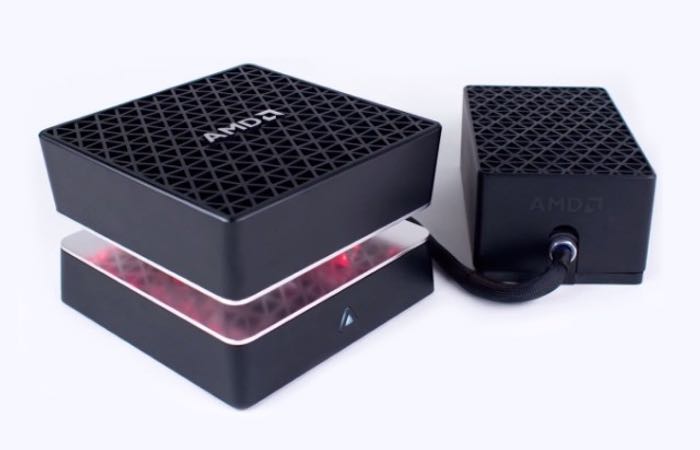
AMD has this week unveiled more details about their new AMD Project Quantum prototype mini PC that is styled with a very unique casing that consists of two chambers.
The AMD Project Quantum is water-cooled and fitted with dual-GPU Radeon R9 Fury X graphics cards, providing powerful graphical processing in a small desktop form factor. This innovative design showcases AMD’s commitment to pushing the boundaries of what is possible in the realm of compact computing.
Innovative Cooling and Design
One of the standout features of the AMD Project Quantum is its advanced cooling system. The water-cooling mechanism is not just a novelty but a necessity to maintain the high performance of the dual-GPU setup. Traditional air cooling would not suffice in such a compact space, making water cooling an essential component to ensure the system runs efficiently without overheating.
The two-chamber design is another unique aspect of Project Quantum. This design separates the heat-generating components from the rest of the system, allowing for better thermal management. The lower chamber houses the power supply and cooling system, while the upper chamber contains the motherboard and GPUs. This separation helps in maintaining optimal temperatures and enhances the overall performance of the mini PC.
High-Bandwidth Memory (HBM)
Watch the video below to learn more about AMD’s Project Quantum. AMD was able to make such a small, powerful system using HBM (high-bandwidth memory), which the company has been developing with Hynix since 2013.
HBM memory allows for compact PCB designs that are up to 65 percent smaller than current designs and also reduce power requirements by as much as 68 percent over DDR5. This significant reduction in size and power consumption is a game-changer for compact computing devices. HBM stacks memory chips vertically, which not only saves space but also increases the bandwidth, allowing for faster data transfer rates. This makes HBM an ideal choice for high-performance computing tasks, such as gaming and professional graphics work.
The new AMD Project Quantum is just a prototype and unfortunately is not expected to be launched as a consumer product. However, the technology and design principles showcased in Project Quantum are likely to influence future AMD products. The use of HBM and advanced cooling solutions could become standard in upcoming high-performance mini PCs and other compact computing devices.
Potential Applications and Future Prospects
While Project Quantum may not be available for purchase, its implications for the future of computing are significant. The compact yet powerful design makes it an ideal candidate for various applications, from gaming to professional content creation. Imagine a mini PC that can handle the latest AAA games at high settings or render complex 3D models without breaking a sweat. This is the promise that Project Quantum holds.
Moreover, the advancements in HBM and cooling technology could trickle down to more affordable consumer products. As these technologies become more mainstream, we could see a new generation of compact, energy-efficient, and powerful mini PCs hitting the market. This would be a boon for users who need high performance but have limited space, such as those living in small apartments or working in compact office environments.
In conclusion, AMD’s Project Quantum is a testament to the company’s innovative spirit and technical prowess. While it may not be available for purchase, the technologies and design principles it showcases are likely to shape the future of compact computing. We will keep you updated with any more details regarding pricing or release dates announced by AMD as always.

Source:
Disclosure: Some of our articles include affiliate links. If you buy something through one of these links, Geeky Gadgets may earn an affiliate commission. Learn about our Disclosure Policy.
