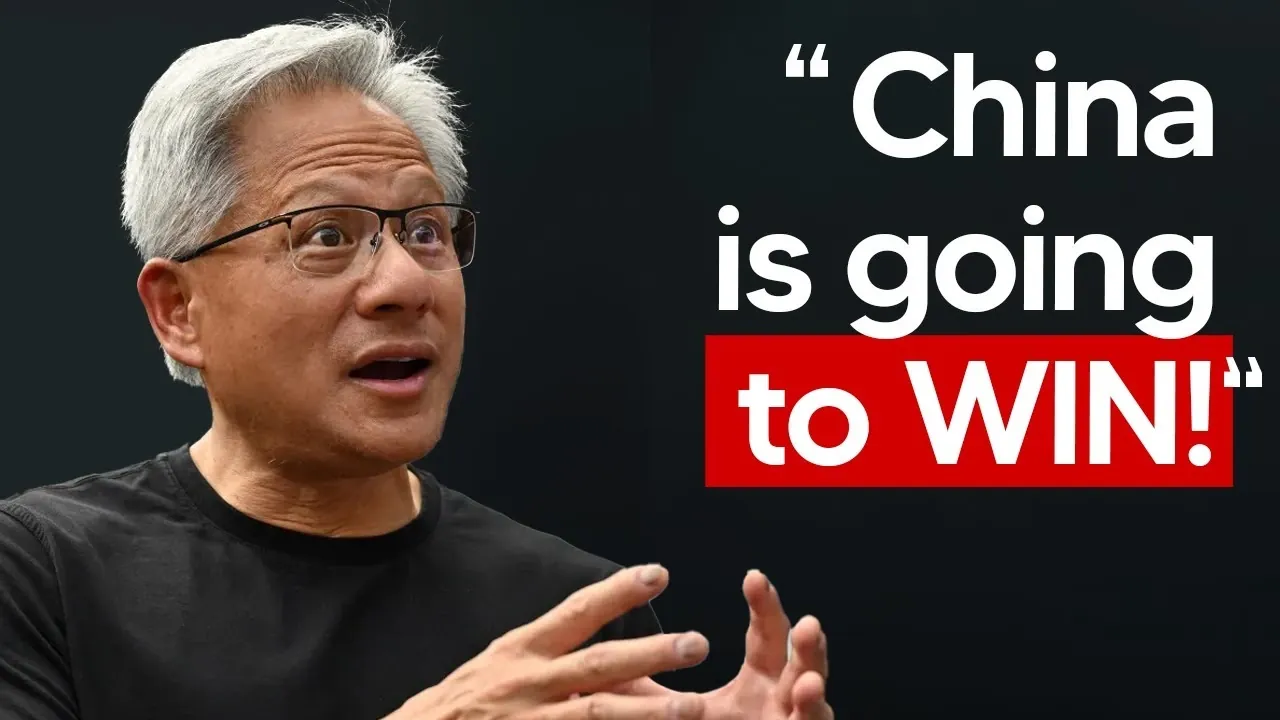
What if the future of global power wasn’t decided by military strength or economic might, but by who leads in artificial intelligence? NVIDIA CEO Jensen Huang has sent shockwaves through the tech world with his bold assertion: China is on track to win the AI race. While the United States has long been seen as the epicenter of innovation, Huang’s claim underscores a seismic shift in the balance of technological power. With China’s AI ecosystem advancing at an unprecedented pace and U.S. policies potentially backfiring, the stakes couldn’t be higher. Could this be the moment the world witnesses a new leader in global AI dominance?
In this overview, AI Grid explains more about the factors fueling China’s meteoric rise in AI, from its massive concentration of researchers to its strategic investments in infrastructure. We’ll also examine the challenges facing the U.S., including energy constraints and the unintended consequences of export restrictions. Beyond the technology itself, this race has profound implications for geopolitics, ethics, and the future of global governance. As the competition intensifies, the question isn’t just who will lead in AI, it’s how this leadership will reshape the world as we know it.
The U.S.-China AI Race
TL;DR Key Takeaways :
- NVIDIA CEO Jensen Huang predicts that China is on track to surpass the U.S. in the race for AI dominance, driven by its rapid advancements and strategic investments in AI infrastructure.
- China hosts approximately 50% of the world’s AI researchers and is making significant progress in applied AI technologies, such as open source models, autonomous systems, and healthcare solutions.
- The U.S. faces challenges like energy infrastructure limitations and the unintended consequences of AI chip export restrictions, which could push China to develop independent ecosystems.
- The AI race has significant geopolitical implications, with China’s state-driven AI governance model contrasting with the U.S.’s focus on transparency, ethics, and individual rights.
- The competition between the U.S. and China in AI will shape global power dynamics, economic systems, and societal structures, emphasizing the need for strategic collaboration and ethical governance.
China’s Rapid AI Advancements
China has emerged as a formidable force in AI development, with approximately 50% of the world’s AI researchers based within its borders. This concentration of expertise has driven remarkable progress in areas such as open source AI models, autonomous systems, and AI-powered healthcare solutions. These advancements are not only enhancing technological capabilities but also contributing to economic growth and operational efficiency across various sectors.
For example, the Kimmy K2 AI model, developed in China, has demonstrated innovative capabilities, showcasing the nation’s ability to compete with leading U.S. AI research institutions. This progress is further supported by China’s strategic investments in infrastructure, including advanced data centers and energy systems tailored to meet the computational demands of AI technologies. These efforts reflect a deliberate and coordinated approach to securing a leadership position in the global AI landscape.
Challenges Facing the U.S. in the AI Race
While the United States remains a leader in AI innovation, it faces significant challenges that could undermine its long-term competitive edge. One pressing issue is the strain on the nation’s energy infrastructure, which is critical for supporting the massive computational requirements of AI data centers. Without scalable and sustainable energy solutions, the U.S. risks falling behind in the expansion of its AI capabilities.
Moreover, U.S. export restrictions on advanced AI chips, intended to limit China’s progress, may have unintended consequences. Jensen Huang has warned that these policies could incentivize Chinese developers to build independent ecosystems, potentially rivaling U.S. dominance. Such isolation could also reduce America’s influence over global AI standards and innovation, creating a fragmented technological landscape.
Will China Win the AI Race, Jensen Huang Weighs the Risks
Uncover more insights about Artificial Intelligence (AI) in previous articles we have written.
- The Complete ChatGPT Artificial Intelligence OpenAI Training
- FREE: Learn the Basics of Artificial Intelligence 4-Week Course
- The Ultimate AI ChatGPT & Python Programming Bundle | StackSocial
- Focais: Meet One – Your AI-Powered Assistant to Capture
- Linus Torvalds shares thoughts on artificial intelligence (AI) in
- Learn how artificial intelligence AI actually works
- Connectomics : Mapping the Brain using artificial intelligence (AI
- Machine Learning, Deep Learning and Generative AI explained
- Apple’s New AI Strategy for Artificial Intelligence Beyond 2025
Geopolitical Ramifications of the AI Race
The competition between the U.S. and China in AI extends beyond technology, influencing global geopolitics. Experts, including former Google CEO Eric Schmidt, have cautioned that if China takes the lead in AI, it could reshape international norms and governance structures. A central concern is the divergence in values between the two nations, particularly regarding AI’s role in surveillance and individual freedoms.
China has embraced AI-driven surveillance technologies, raising ethical questions about privacy and state control. These systems are being integrated into public security frameworks, allowing extensive monitoring of citizens. In contrast, the U.S. faces the challenge of balancing innovation with ethical considerations, such as data privacy and freedom of expression. These differing approaches highlight the broader implications of AI leadership on global society and governance.
Diverging Strategies in AI Development
The U.S. and China are pursuing distinct strategies in their quest for AI supremacy. The United States is heavily focused on achieving artificial general intelligence (AGI), which aims to create machines capable of human-like reasoning and decision-making. While this ambitious goal holds the promise of innovative breakthroughs, it also involves significant risks and long-term investments.
China, on the other hand, is prioritizing practical and immediate applications of AI. By integrating AI into industries such as manufacturing, logistics, and healthcare, China is achieving measurable economic benefits while building a robust foundation for future advancements. This pragmatic approach allows China to maintain momentum in the AI race while addressing pressing societal needs, positioning itself as a leader in applied AI technologies.
Ethics and the Future of AI Governance
The ethical dimensions of AI development are central to the global debate over leadership in this field. As AI technologies become increasingly pervasive, questions about governance, accountability, and societal impact take on greater significance. The U.S. and China offer contrasting models of AI governance: the U.S. emphasizes transparency, individual rights, and ethical standards, while China focuses on state-driven objectives and centralized control.
Jensen Huang has advocated for a global AI ecosystem that uses American technology to promote ethical standards and foster innovation. However, achieving this vision requires a careful balance between national security concerns and the need for international collaboration in AI research. The challenge lies in creating a framework that encourages cooperation while safeguarding critical technologies and values.
The High Stakes of the AI Race
The race for AI dominance is not merely a technological competition, it is a contest that will define the future of global power dynamics. Both the United States and China are vying for supremacy, and the stakes are extraordinarily high. For the U.S., addressing internal challenges such as energy infrastructure and fostering innovation through strategic policies will be essential to maintaining its leadership. Meanwhile, China’s rapid advancements and pragmatic approach signal a shift in the global AI landscape, emphasizing the urgency of strategic collaboration and ethical governance.
As this competition unfolds, the implications extend far beyond technology. The outcome of the AI race will influence economic systems, societal structures, and geopolitical alliances for decades to come. The decisions made today by both nations will shape not only their own futures but also the trajectory of global progress in artificial intelligence.
Media Credit: TheAIGRID
Disclosure: Some of our articles include affiliate links. If you buy something through one of these links, Geeky Gadgets may earn an affiliate commission. Learn about our Disclosure Policy.
