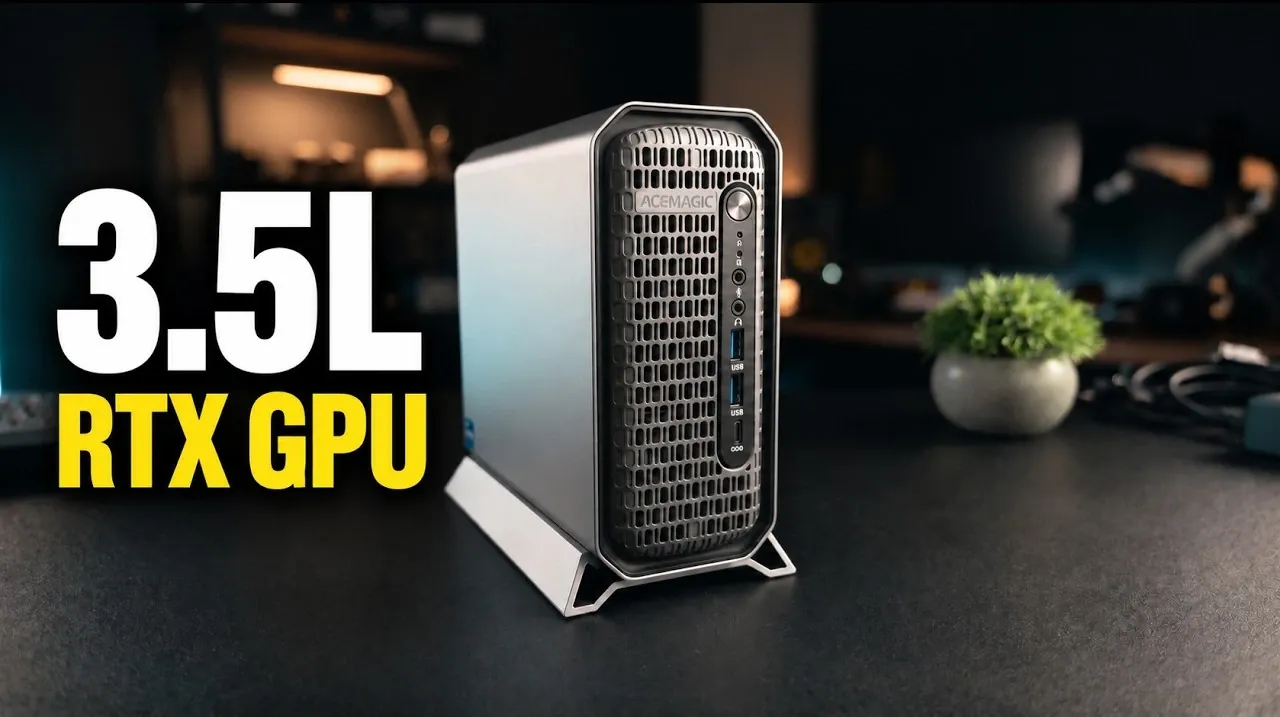
The ACEMAGIC G3A is a compact workstation that pairs a desktop Intel Core i9 processor with an NVIDIA RTX 2000 Ada GPU and 16GB of dedicated graphics memory. Available with different hardware configurations, it puts workstation graphics in a small desktop enclosure. The tested model can run games and generate images locally, according to ETA Prime.
See how the CPU’s sustained power limit affects benchmark scores, and compare 1440p gaming results with the settings used to achieve them. You can also check the available display and network connections, along with the options for adding storage, before deciding whether the G3A fits your desk and daily workload.
Hardware and Upgrade Access
TL;DR Key Takeaways :
- The tested G3A runs Windows 11 with a desktop Core i9-13900F, an RTX 2000 Ada GPU with 16 GB of GDDR6 ECC memory, and 32 GB of DDR5 memory, expandable to 96 GB.
- The CPU’s 65-watt sustained power limit leaves substantial performance unused. It scored 1,821 single-core and 17,255 multi-core in Geekbench 7; testing did not establish a way to raise the limit.
- For local AI, the RTX 2000 ran GPT-OSS 20B at around 70 tokens per second and generated Flux images in under 13 seconds. Its 16 GB of graphics memory limits the size of models it can load.
- Forza Horizon 6 averaged about 80 FPS at 1440p high without scaling, while Cyberpunk 2077 averaged over 70 FPS at 1440p high with DLSS quality and the Transformer 2 model.
- The G3A drew around 34 watts idle and 172 watts while gaming at 1440p, reaching 193 watts under combined CPU and GPU stress. CPU temperature averaged 59°C and peaked at 76°C; fan noise was not excessive.
The tested G3A runs Windows 11 and uses a desktop processor rather than a mobile chip. Its main specifications are:
- CPU: Intel Core i9 13900F, 24 cores and 32 threads, with up to 5.6 GHz boost.
- GPU: RTX 2000 Ada generation, 2,816 CUDA cores and 16GB of GDDR6 ECC memory.
- GPU power: Around 70 watts, supplied through the PCIe slot without an extra power connector.
- Memory: 32 GB DDR5-5600 SO-DIMM installed, with support for up to 96 GB.
- Wireless: Wi-Fi 6E and Bluetooth 5.2.
- Power supply: External 230-watt, four-pin unit.
The CPU has eight performance cores and 16 efficiency cores, with a 65-watt sustained TDP in the G3A. A rear latch releases the shell for access to the interior, though the SO-DIMM memory appears to be hidden. A SATA connector allows you to add a 2.5-inch drive.
The included aluminum stand holds the PC vertically and has rubber feet. The package also includes an HDMI-to-mini-DisplayPort cable, M.2 mounting hardware, a power cable and a manual.
Ports and Display Outputs
The front panel has separate 3.5 mm microphone and audio output jacks, two full-size USB 3.2 Gen 2 ports and a USB-C port limited to USB 3.2 Gen 2. At the rear are DisplayPort 1.4, HDMI 2.0 and four mini DisplayPorts on the dedicated GPU.
Rear connections also include two serial ports, two USB 2.0 ports, two USB 3.2 Gen 1 ports and two Ethernet ports. Only one Ethernet port supports 2.5 Gb speeds.

Become an expert in ACEMAGIC mini PCs with the help of our in-depth articles and helpful guides.
- Massive 38% Off: Get the Powerful ACEMAGIC K1 Intel Core i5-12600H Mini PC for Only $359.99
- ACEMAGIC G1 AMD Ryzen 7 5800H mini gaming PC
- STOP SCROLLING. Black Friday Has Started: ACEMAGIC Drops i9 Mini PCs to Record Low Prices
- NVIDIA RTX 2000 Rivals RTX 4060 in Minisforum MS-A2 PC
CPU Power Limit and Benchmarks
The i9-13900F has a 65-watt base TDP but can reach a maximum turbo power of up to 219 watts on another motherboard without the G3A’s power constraints. In the G3A, the CPU briefly reached about 70 watts in testing but did not stay there long. A single core might get close to 5.5 GHz, though the limit restricts maximum clocks across the cores.
In Geekbench 7, the G3A scored 1,821 single-core and 17,255 multi-core. A system that let the same processor boost higher scored 2,499 single-core, a 37% increase. A different system scored about 19,134 multi-core, an 11% increase.
The power limit leaves substantial CPU performance unused. BIOS hotkey combinations did not reveal TDP controls, and Intel Extreme Tuning Utility did not allow the limit to be raised. More CPU power could improve performance, while a BIOS option to disable some efficiency cores could direct more power to the performance cores for higher clocks.
Local AI and Image Generation
The RTX 2000 ran GPT-OSS 20B at around 70 tokens per second, Llama 3.1 8B at 36.8 tokens per second and Qwen 2.5 14B at 19.7 tokens per second. Flux generated images in under 13 seconds, while SDXL Juggernaut took around 14.4 seconds.
In Geekbench AI, the GPU scored about 16,445 for single precision, 29,523 for half precision and 12,853 for quantized performance. The 16GB GPU cannot load models as large as those supported by a Ryzen Max Plus mini PC with 128 GB of RAM, which can dedicate up to 96 GB to VRAM. The RTX 2000 could still run a couple of smaller models at the same time.
Gaming, Temperatures and Power Draw
Although the RTX 2000 is a workstation card rather than a GPU marketed for gaming, it scored 8,395 graphics and 15,880 CPU in 3DMark Time Spy, plus 1,832 overall in Steel Nomad.
Forza Horizon 6 averaged about 80 FPS at 1440p high without scaling, while ultra settings occasionally dropped below 60 FPS. DLSS quality produced around the same frame rate as the high-settings run. Spider-Man 2 and Red Dead Redemption 2 used DLSS at 1440p high; Spider-Man 2 used the quality setting.
Cyberpunk 2077 averaged over 70 FPS at 1440p high with DLSS quality and the Transformer 2 model. Crimson Desert ran in the mid-40s at those resolution and quality settings without frame generation, rising to the high 60s on average with frame generation set roughly to X2. The RTX 2000 supports DLSS frame generation, but not multi-frame generation without modification.
Measured at the wall, the G3A drew around 34 watts idle, 172 watts while gaming at 1440p in Windows performance mode, and a maximum of 193 watts while stressing the CPU and GPU together. CPU temperature averaged 59°C and peaked at 76°C; the CPU power limit contributed to those temperatures. At the temperatures recorded, fan noise was not excessive and the fans did not reach full speed.
ETA Prime likes the G3A’s vertical design and believes it has more performance to give. It can run the tested local AI models and games, but its 16GB graphics memory limits the size of models it can load. ETA Prime believes a higher CPU power limit could improve performance, though testing did not establish a way to raise it.
Media Credit: ETA PRIME
Disclosure: Some of our articles include affiliate links. If you buy something through one of these links, Geeky Gadgets may earn an affiliate commission. Learn about our Disclosure Policy.
