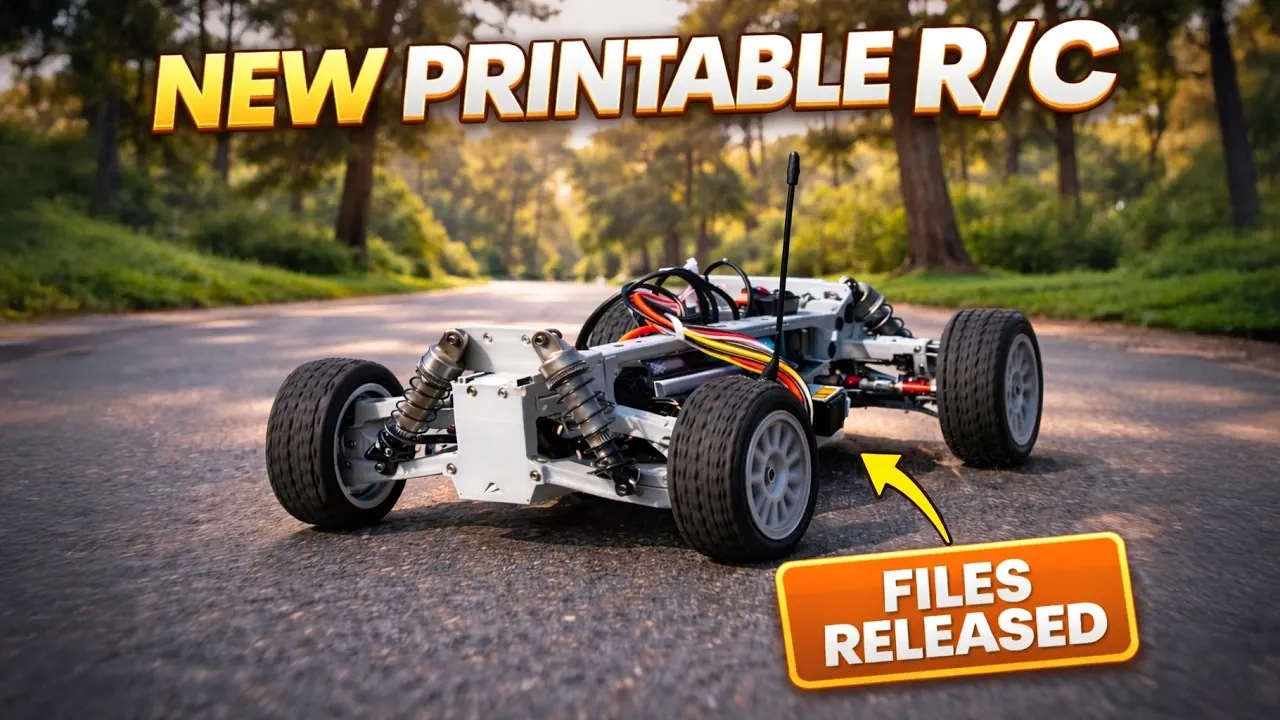
Turning a series of setbacks into a functional, print-ready RC chassis is no small feat, but curv lab’s latest project demonstrates how persistence and thoughtful design can overcome even the most frustrating challenges. Over six months, the team tackled issues like drivetrain failures and weak suspension components, ultimately creating a modular chassis that balances durability, performance and repairability. One standout feature is the use of longitudinal 3D printing techniques for drive shafts, which significantly improved their strength under torsional stress. These innovations highlight the potential of 3D printing to produce components that rival traditional manufacturing in demanding applications.
In this project overview, you’ll explore how modular suspension towers allow for easy experimentation with shock configurations, why PETG was chosen for its balance of strength and flexibility and how off-the-shelf components like GPM differentials enhanced reliability. You’ll also gain insights into the iterative design process that refined the chassis through rigorous testing on gravel, asphalt and grass. Whether you’re an RC enthusiast or curious about applying 3D printing to complex projects, this breakdown offers practical takeaways to help you tackle your own design challenges.
3D Printed RC Car Chassis
TL;DR Key Takeaways :
- The project successfully developed a durable, modular and high-performance 3D-printed RC car chassis, overcoming challenges like drivetrain failures and suspension issues through iterative design and innovation.
- Key features include modular suspension towers for easy upgrades, integration of off-the-shelf components for reliability and longitudinal 3D printing techniques to enhance strength and durability.
- Material selection, particularly PETG and advanced printing techniques like optimized infill patterns and wall loops were critical to achieving a balance of strength, flexibility and ease of repair.
- Rigorous testing across diverse terrains and crash scenarios informed continuous refinements, making sure the chassis is both high-performing and resilient under real-world conditions.
- The project emphasizes accessibility, offering free 3D print files, build guides and hardware lists, allowing customization and making it approachable for both hobbyists and newcomers.
Iterative Design and Modular Innovation
The project began with a clear objective: to develop a 3D-printable RC car chassis capable of withstanding real-world conditions. Early prototypes exposed weaknesses in material strength and component integration, but through iterative design, the team achieved a modular system. This modularity allows you to assemble, repair and upgrade individual parts effortlessly, making the chassis adaptable to various terrains and configurations.
Key design decisions prioritized practicality and ease of use. For instance:
- Modular suspension towers were introduced, allowing you to test different shock configurations without the need to reprint the entire chassis.
- Drivetrain components were designed to integrate off-the-shelf parts, making sure reliability and simplifying sourcing.
This approach not only enhances the chassis’s versatility but also reduces maintenance complexity, making it suitable for a wide range of applications.
Overcoming Drivetrain Challenges
The drivetrain presented some of the most significant hurdles. Initial designs relied on steel ball bearings in soft plastic races, which quickly wore out under stress. To address this, the team incorporated off-the-shelf GPM differentials with hardened steel components, significantly boosting durability and performance.
Drive shafts were another area of concern. Early versions failed under torsional stress, prompting the team to adopt longitudinal 3D printing techniques. This method improved the shafts’ strength and reduced the likelihood of failure. These solutions underscore the importance of combining innovative 3D printing methods with high-quality materials to achieve reliable and functional results.

Below are more guides on 3D printers from our extensive range of articles.
- lilM8 affordable ultraquiet 3D printer hits Kickstarter
- The War On 3D Printing : Design Files, Printer Sales & Platform Pressure
- open source ESP32 3D printer controller
- Kidoodle MiniBox A1 kids 3D printer
- DIY NAS Build with a 3D Printed Case & Mini PC Controller
- StrataSys J55 full color 3D resin printer offers 640,000 distinct color combinations
- Multi-Color 3D Printing : The Future of Design and Manufacturing?
- Creality K2 Plus 3D Printer Review: Features, Pros, and Cons
- PolySmoother lets you polish your 3D prints with ease
- 3D print 8 different colors simultaneously with PITTA
Optimizing Suspension and Reinforcing the Chassis
Suspension geometry plays a critical role in both handling and durability. Early prototypes suffered from poor handling and frequent breakages, leading to a comprehensive redesign. By optimizing the suspension geometry, the team improved alignment and load distribution, resulting in better overall performance.
To further enhance durability, the chassis plate was reinforced. Increased stiffness and improved alignment minimized flex and boosted stability, making the chassis capable of handling diverse terrains, from smooth tracks to rugged off-road environments. These enhancements ensure that the chassis is not only high-performing but also resilient under demanding conditions.
Material Selection and Advanced Printing Techniques
Choosing the right material was a pivotal factor in the project’s success. The team selected PETG for its balance of strength, flexibility and ease of printing. To maximize durability, they optimized infill patterns and wall loops, making sure that critical components could endure high stress without compromising performance.
Innovative 3D printing techniques further contributed to the project’s success. For example:
- Longitudinal printing was employed for drive shafts, significantly improving torsional strength and reliability.
- Modular designs allowed for quick replacement of damaged parts, minimizing downtime and simplifying repairs.
These strategies highlight how 3D printing can be used to create robust, functional components for demanding applications, offering a practical alternative to traditional manufacturing methods.
Rigorous Testing and Continuous Refinement
Extensive testing was a cornerstone of the project. The chassis was subjected to various terrains, including gravel, grass and asphalt, to evaluate its performance under diverse conditions. These tests informed adjustments to gear ratios, suspension stiffness and motor mounts, making sure optimal functionality.
Crash testing was equally critical. By exposing the chassis to high-impact scenarios, the team identified weak points and reinforced them in subsequent iterations. This meticulous testing process guarantees that the final design is both durable and reliable, capable of withstanding real-world use without compromising performance.
Customization and Accessibility for All
One of the most remarkable aspects of this project is its emphasis on customization and accessibility. The 3D print files, build guides and hardware lists are freely available online, empowering you to replicate or modify the design to suit your specific needs. The modular design further enhances accessibility, allowing you to reprint and replace individual parts with ease, reducing both downtime and costs.
The integration of off-the-shelf components adds another layer of practicality. These components not only improve reliability but also simplify sourcing, making the project approachable for both seasoned RC enthusiasts and newcomers to the hobby. Whether you’re looking to build a high-performance RC car or explore the capabilities of 3D printing, this project offers a comprehensive and accessible solution.
Practical Insights for Future Projects
This project serves as a testament to the potential of 3D printing in creating customizable, high-performance RC vehicles. By addressing challenges in drivetrain design, suspension geometry and material selection, the team developed a robust and modular chassis that meets the demands of real-world use. The lessons learned from this endeavor provide a solid foundation for anyone interested in designing and building their own RC car or exploring the broader applications of 3D printing technology.
Media Credit: curv lab
Disclosure: Some of our articles include affiliate links. If you buy something through one of these links, Geeky Gadgets may earn an affiliate commission. Learn about our Disclosure Policy.
