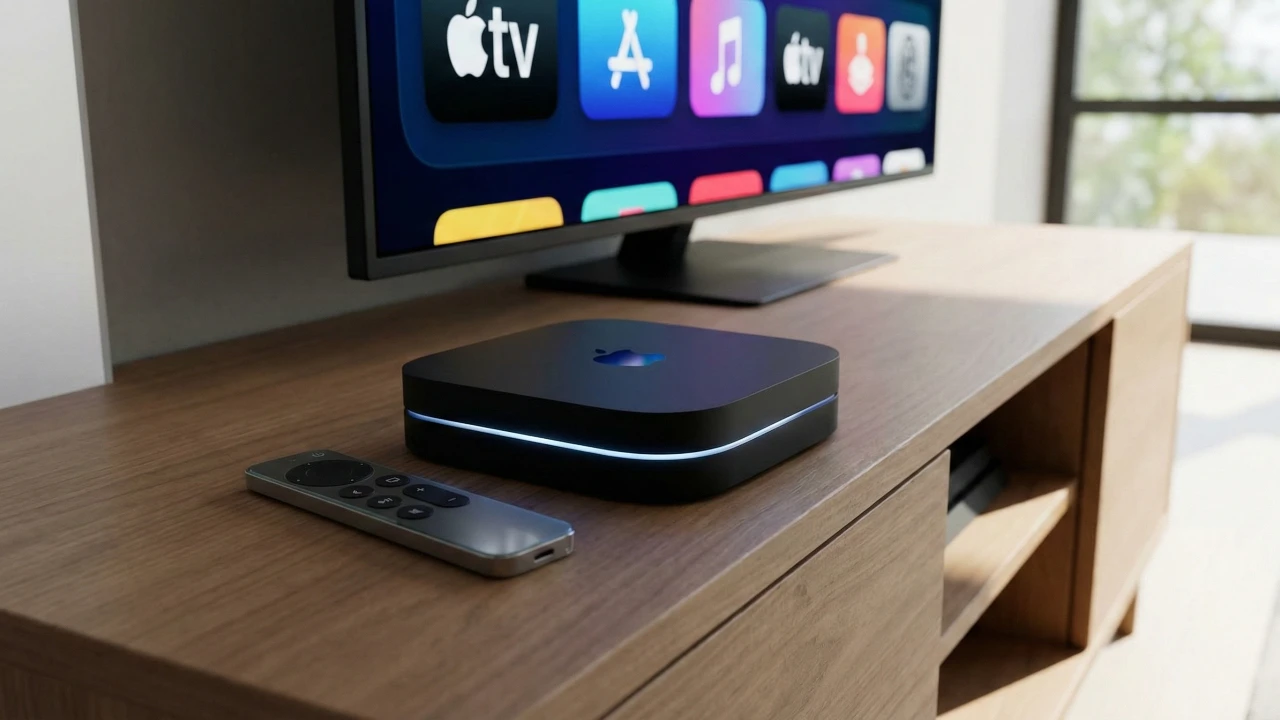
For years, the Apple TV 4K has occupied a curious space in the Cupertino ecosystem. It was the “hobby” that grew into the gold standard for streaming boxes, but then—unexpectedly—it fell silent. After the 2022 refresh, Apple enthusiasts expected a 2024 update that never came. As we detailed in our previous report on the 2026 Apple TV 4K delay, the hardware was ready, but the vision wasn’t.
Now, in the first quarter of 2026, the pieces have finally fallen into place. Following Apple’s historic January 12, 2026 announcement of a multi-year partnership with Google, the 2026 Apple TV 4K arrives not just as a streamer, but as the first home device powered by a “Gemini-infused” Siri. This is the device that finally turns the living room into an intelligent command center.
1. The Strategic Pause: Why Apple Skipped Three Years
To understand the 2026 model, you must understand why Apple skipped the 2024 and 2025 holiday windows. The hardware—specifically the A17 Pro chip—has been sitting in “EVT” (Engineering Validation Test) stages since late 2024. However, Apple CEO Tim Cook reportedly vetoed a 2025 launch, insisting that the next Apple TV must be the “definitive showcase for Apple Intelligence.”
Launching earlier would have meant shipping a “dumb” box with a fast chip. By waiting until 2026, Apple has aligned the hardware launch with the maturity of its foundation models. The final catalyst was the pivot away from relying solely on in-house models. By integrating Google’s Gemini technology as the primary backbone of the new Siri, Apple finally achieved the low-latency, high-reasoning performance required for a complex, voice-first living room assistant.
2. The “Silicon Trinity”: A17 Pro, 8GB RAM, and the N1 Chip
The internal architecture of the 2026 Apple TV 4K represents the most significant hardware leap since the device moved to 4K in 2017. Apple is moving away from using “binned” or older iPhone chips and is instead treating the Apple TV as a high-performance compute node for the home.
The A17 Pro Powerhouse
By standardizing on the A17 Pro (the 3nm marvel), Apple is bringing hardware-accelerated ray tracing to the big screen. In a streaming box, this sounds like overkill, but the A17 Pro isn’t just for pixels—it’s for the Neural Engine. With 16 cores dedicated to AI processing, this chip allows the Apple TV to handle complex voice requests locally, ensuring your viewing habits remain private and response times stay instantaneous.
8GB of RAM: The AI Requirement
For the first time, an Apple TV will ship with 8GB of RAM. This is a non-negotiable requirement for the local execution of LLMs (Large Language Models). This doubling of memory over the 2022 model allows for “Instant App Resume” across a dozen high-fidelity apps and provides the overhead needed for Siri to maintain long-term conversational memory without clearing the cache.
The N1 Networking Chip
Perhaps the most underrated upgrade is the N1 Chip. This is Apple’s first in-house integrated networking solution, handling Wi-Fi 7, Bluetooth 6.0, and Thread. The N1 is designed to solve the “Handover Headache.” Whether it’s moving a FaceTime call from your iPhone to the TV or connecting a pair of AirPods Max 2, the N1 reduces latency to near-zero levels. It also ensures that the Apple TV remains the most stable Matter-enabled hub on the market.
3. Siri 2.0: The Google Gemini Partnership
The headline feature of the 2026 Apple TV 4K is undoubtedly Siri 2.0. For over a decade, Siri was the “weakest link” of the Apple TV experience. That changed on January 12, 2026, when Apple confirmed that Google Gemini would serve as the primary foundation for the next generation of Siri.
This $1 billion-a-year deal gives Siri access to a custom 1.2-trillion parameter Gemini model. While Apple previously integrated OpenAI’s ChatGPT for complex world-knowledge queries, Gemini is now the default “reasoning” layer. This has several massive implications for the user:
- Conversational Media Discovery: You can now speak to your TV as if it were a cinephile friend. “Hey Siri, find me that movie where the guy is stuck on a planet, but not the Matt Damon one.” Or, “Find me a romantic comedy that isn’t too cheesy, has at least a 4-star rating, and is under 90 minutes because I have to be up early.”
- Deep Personal Context: Because of the Google partnership’s scale, Siri can now cross-reference your personal data (with permission) more effectively. It can check your flight status in Mail and automatically suggest a movie that fits the exact duration of your upcoming travel.
- On-Screen Awareness: Siri now “sees” what is on your screen. If you’re watching a trailer, you can simply say, “Remind me when this comes out,” or “Who is the actor in the background?” and Siri will use Gemini’s multimodal capabilities to provide the answer instantly.
Crucially, Apple has integrated Google’s models into its own Private Cloud Compute (PCC) architecture. This means that while the “intelligence” comes from Gemini, your data never leaves Apple’s secure environment. The requests are processed on-device or on Apple-owned silicon servers, ensuring that your viewing habits remain strictly between you and your hardware.
4. “Liquid Glass”: The Death of the Grid
For over a decade, the Apple TV interface has been a grid of rounded rectangles. The 2026 model introduces “Liquid Glass,” a design language that replaces static icons with dynamic, translucent “Live Tiles.”
The home screen is no longer a graveyard of apps; it’s a predictive dashboard. Using Apple Intelligence, the Liquid Glass UI shifts based on the time of day and who is in the room. If your Apple Watch detects you’ve just walked into the living room at 8:00 PM, the interface prioritizes your “Continue Watching” list. The icons themselves are interactive—hovering over the Photos tile might show a “Memory” from five years ago, while the Home tile expands to show your doorbell camera feed without you ever clicking an app.
5. The “Stealth Console”: Gaming Reimagined
Apple is finally ready to admit that the Apple TV is a game console. With the A17 Pro’s GPU, the 2026 model is being positioned as a “Stealth Console” for those who don’t want a massive box under their TV. Thanks to the device’s constant power supply, the A17 Pro can run at its maximum clock speed indefinitely without thermal throttling. This allows for performance that rivals the Xbox Series S, complete with 4K upscaling and 120Hz support for compatible titles. The 2026 refresh also brings “Game Mode” to tvOS, which automatically triggers your TV’s Low Latency mode.
6. The New Siri Remote: Find My and Haptics
The Siri Remote is getting its first major update in years. The 2026 version includes a U2 Ultra-Wideband Chip, enabling “Precision Finding” via the Find My app. Your iPhone will lead you directly to the remote, even if it’s buried deep between the couch cushions. It also features Haptic Touch; the clickpad now features the same haptic engine found in the MacBook trackpad, providing tactile feedback as you scrub through a movie timeline.
7. Pricing, Tiers, and Availability
Apple is moving to a two-tier strategy for the 2026 launch. The standard Apple TV 4K (64GB) will retail for $129, acting as the entry-level AI box. The Apple TV 4K Pro (128GB) will retail for $189 and includes a built-in 12MP Ultra-Wide Center Stage camera for permanent FaceTime capability and gesture controls. Expect an official announcement in March 2026, with a release date in early April.
Conclusion: Was the Delay Worth It?
Looking at the 2026 Apple TV 4K now, the reason for the delay is clear. Apple wasn’t building a streaming box; they were building the first AI Appliance for the home. By waiting for the Google Gemini partnership to materialize and for the A17 Pro to become the standard, they have transformed the TV from a passive screen into an active, intelligent participant in the household. If you have been holding onto a 2021 or 2022 model, the 2026 version is finally the upgrade worth making.
Read about the latest in Apple TV 4K 2026 by exploring our other resources and articles.
- New Apple TV Coming in 2026
- New Apple TV: When Will It Launch?
- 2026 Apple TV: Liquid Glass UI, A17 Pro & More
- Apple TV, AirTags, and HomePod Mini: Why No Updates in 2025
- Apple TV Release Date, Features, and Pricing Details
Disclosure: Some of our articles include affiliate links. If you buy something through one of these links, Geeky Gadgets may earn an affiliate commission. Learn about our Disclosure Policy.
