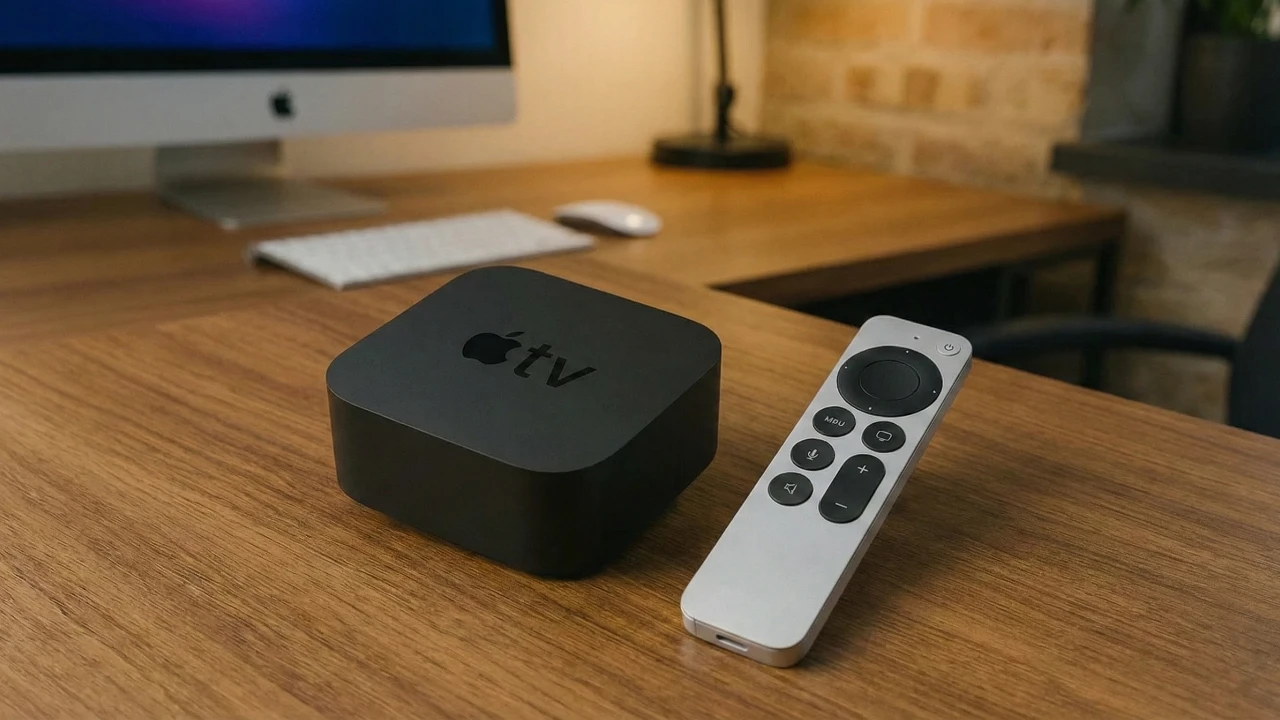
Last week, we broke down the hardware revolution coming to the living room in our exclusive report on the 2026 Apple TV 4K. We detailed the “Silicon Trinity”—the A17 Pro, 8GB of RAM, and the N1 Chip—that will finally turn Apple’s set-top box into a stealth gaming console.
New information surfacing from software development circles and supply chain analysts has begun to paint a complete picture of why Apple skipped the 2025 holiday window. The delay isn’t just about manufacturing; it is about a radical software overhaul that requires specific hardware to run. We are talking about a new interface language, a pivot to serious gaming, and an AI integration so deep it requires a dedicated neural architecture.
Here is the definitive follow-up on the 2026 Apple TV 4K, including the newly leaked “Liquid Glass” interface and why your current model is about to feel very, very old.
The “Liquid Glass” Interface: A Visual Overhaul
For years, the Apple TV home screen has been a static grid of icons. It’s functional, but safe. According to sources familiar with early builds of tvOS 26, safety is being traded for spectacle.
The new design language is internally codenamed “Liquid Glass.”
Unlike the flat layers of today, Liquid Glass is reportedly a generative, fluid interface designed to leverage the GPU power of the A17 Pro. Instead of just highlighting an app icon, the interface uses real-time rendering to create depth and motion.
- Generative Backgrounds: Imagine hovering over Cyberpunk 2077 or Foundation on Apple TV+. Instead of a static JPEG background, the OS reportedly uses the chip’s ray-tracing cores to render dynamic lighting effects that match the mood of the content. Neon hues might bleed through the “glass” tiles for a sci-fi movie, while soft, warm shadows render for a drama.
- AI Parallax: Using the Neural Engine, the OS can analyze standard 2D artwork and separate it into layers in real-time, creating a 3D parallax effect as you swipe across the remote. The interface feels alive, reacting to your inputs with a physics-based weight that the current A15 Bionic simply cannot calculate smoothly at 4K 60fps.
This explains why Apple couldn’t just slap an A16 chip in the box and call it a day. To run a UI that relies on hardware-accelerated ray tracing, the A17 Pro isn’t a luxury—it’s a requirement.
The “Stealth” Console: Unleashing the A17 Pro
In our previous article, we touched on the gaming potential of the A17 Pro. New leaks suggest we might have actually underestimated Apple’s ambition here.
The A17 Pro is the same silicon that brought Resident Evil Village and Assassin’s Creed Mirage to the iPhone 15 Pro. However, inside an iPhone, that chip is thermally throttled; it can only run at peak performance for minutes before slowing down to prevent overheating.
The 2026 Apple TV 4K removes those handcuffs.
With a constant power supply (no battery constraints) and a rumored redesigned thermal system (likely a larger, whisper-quiet fan), the A17 Pro can run at peak clock speeds indefinitely. Leaks suggest Apple is targeting “Series S” levels of performance for select titles.
We are hearing chatter about a new “Game Mode Pro” in tvOS 26. When activated, this mode kills all background processes except audio, diverting nearly 100% of the CPU and GPU resources to the active game. This isn’t just for Angry Birds; this is Apple finally attempting to capture the casual console market that Nintendo has dominated for decades.
The N1 Chip: The Secret Weapon for Mac Users
While the processor gets the glory, the connectivity update might be the feature that changes your daily life. Our previous report identified the N1 Chip as a key component of the “Trinity,” bringing Wi-Fi 7 and Thread support.
However, new details suggest the N1 has a secret capability: Ultra-Low Latency Mirroring.
If you own a Mac with an M3, M4, or M5 chip, the N1 chip in the Apple TV reportedly handshakes directly with your computer to create a display pipeline that rivals a wired HDMI connection. This means you could theoretically stream a game running on your high-end MacBook Pro to your living room TV with virtually zero input lag.
For creative professionals, this is a dream. You could cast your Final Cut Pro timeline to the big screen for a client review in 4K HDR, without the stuttering or compression artifacts that plague current AirPlay implementations. The N1 chip turns the Apple TV into a wireless “Pro Display” extender.
The Real Reason for the Delay: Waiting for Siri
If the hardware is this good, why didn’t it launch last month? The consensus among analysts is that the hardware is waiting for the software to catch up—specifically, Apple Intelligence.
The current version of Siri on tvOS is functional but limited. It can find movies, but it doesn’t “understand” them. The 2026 Apple TV is built to be the home for the new LLM-powered Siri, which isn’t expected to be fully stable until March 2026.
Apple reportedly refuses to launch this device until Siri can handle “Conversational Media Queries.” You should be able to ask:
- “Find that 90s sci-fi movie where the guy travels back in time to save the whales.”
- “Show me only the scary episodes of Black Mirror.”
- “What is the song playing in this scene?” (and have it add it to your Apple Music library instantly).
These queries require 8GB of RAM and significant Neural Engine power to process locally. Launching the hardware before the software was ready would have resulted in a “dumb” box with a fast chip. By waiting until Spring 2026, Apple ensures the day-one experience delivers on the AI promise.
The Camera Question: Why the “Puck” Stays
One rumor we need to address is the built-in camera. For months, whispers circulated that the new Apple TV would feature an integrated lens for FaceTime and gesture controls.
Latest CAD leaks and manufacturing schematics suggest this is not happening. The device retains its sleek, black puck aesthetic.
Why? Two reasons: Cost and Continuity. Adding a high-quality camera would push the price toward $200, alienating the mass market. Furthermore, Apple wants you to use the high-end camera you already own: your iPhone. The Continuity Camera feature—which turns your iPhone into a webcam for your TV—is being doubled down on. Expect new MagSafe mounts to appear alongside the new Apple TV launch, encouraging users to mount their phones for workouts and calls rather than relying on a mediocre built-in sensor.
Pricing: The Two-Tier Strategy
As we predicted in our last piece, the pricing strategy seems locked in. Apple is keenly aware that the $150+ price point is a barrier when a Fire TV Stick costs $40.
- The Entry Model (~$99): Likely running a binned version of the chip, aimed purely at high-end streaming. It gets you into the ecosystem.
- The Pro Model ($149+): The full “Silicon Trinity” experience. This includes the unbinned A17 Pro, the N1 chip with Thread support, and Gigabit Ethernet. This is the model for gamers and power users.
Conclusion: The Spring Awakening
The 2026 Apple TV 4K is shaping up to be the most significant update in the product’s history. It is no longer just a way to watch Netflix; it is a ray-tracing game console, a zero-latency wireless monitor, and an AI assistant for your living room.
While the wait until March 2026 is frustrating, the inclusion of the “Liquid Glass” UI and the full power of the A17 Pro suggests it will be worth it. If you are sitting on a 2021 or 2022 model, hold fast. The revolution is coming, and it’s going to look spectacular.
Advance your skills in Apple TV 4K by reading more of our detailed content.
- The New Apple TV 4K: Everything We Know About the
- New Apple TV 4K: Everything You Need to Know
- Apple TV 4K Has a Faster Chip and a Lower Price
- Apple TV 4K for Retro Gaming: Is It Worth It?
- Apple TV 4K Rumors: Features, Price, and Release Date
Disclosure: Some of our articles include affiliate links. If you buy something through one of these links, Geeky Gadgets may earn an affiliate commission. Learn about our Disclosure Policy.
