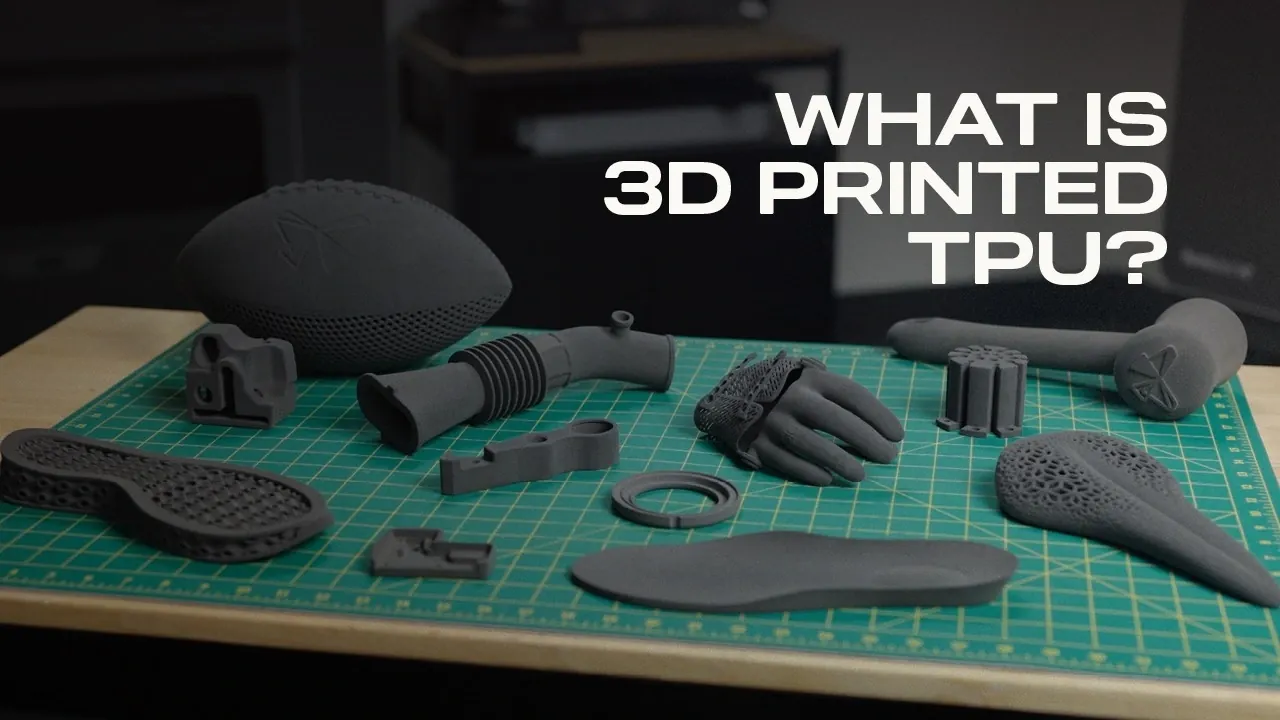
3D printing with thermoplastic polyurethane (TPU) is reshaping how manufacturers approach complex designs and low-volume production. Unlike traditional injection molding, which relies on costly molds and is better suited for large-scale manufacturing, 3D printing offers greater flexibility and customization. Formlabs highlights how Selective Laser Sintering (SLS) technology, in particular, enables the creation of isotropic TPU parts that maintain consistent strength and durability in all directions. This makes it an ideal choice for industries requiring intricate geometries or tailored solutions, such as healthcare and consumer goods.
In this overview, you’ll explore the practical advantages of 3D printed TPU over injection molding, including its ability to produce complex lattice structures and reduce material waste. Learn how SLS printing compares to other methods like Fused Deposition Modeling (FDM) and discover real-world applications ranging from ergonomic prototypes to durable end-use components. By the end, you’ll have a clear understanding of how 3D printed TPU meets modern manufacturing demands while offering unique benefits for specialized projects.
What Makes TPU a Standout Material?
TL;DR Key Takeaways :
- 3D printing with TPU, especially using Selective Laser Sintering (SLS), offers a flexible, efficient and cost-effective alternative to traditional injection molding, allowing the creation of durable and complex parts.
- TPU’s unique properties, such as flexibility, durability, wear resistance and adjustable hardness, make it ideal for industries like automotive, healthcare and consumer goods.
- SLS 3D printing produces isotropic TPU parts with uniform strength and durability, outperforming Fused Deposition Modeling (FDM) for high-stress and complex applications.
- Applications of 3D printed TPU include rapid prototyping, manufacturing aids and end-use products, addressing diverse needs in industries such as healthcare, transportation and consumer goods.
- SLS 3D printing enhances customization, efficiency and sustainability by allowing intricate geometries, reducing material waste and tailoring TPU parts to specific requirements.
TPU stands out as a versatile elastomer due to its unique combination of flexibility, durability and resistance to wear and tear. Its applications span industries such as automotive, healthcare, sporting goods and consumer products, where performance and reliability are critical. One of TPU’s defining features is its adjustable hardness, or durometer, which can be tailored to meet specific application requirements. When paired with SLS 3D printing, TPU parts gain isotropic properties, meaning they exhibit uniform strength and durability in all directions. This characteristic makes TPU an ideal material for demanding applications, making sure consistent performance under various conditions.
Why Choose 3D Printing Over Injection Molding?
3D printing offers distinct advantages over injection molding, particularly for low-volume production, rapid prototyping and specialized applications. Here are the key reasons why industries are increasingly turning to 3D printing:
- Faster Development Cycles: 3D printing accelerates product development by allowing rapid prototyping and iterative design. This significantly reduces the time required to transition from concept to production.
- Geometric Freedom: Unlike injection molding, which requires complex tooling for intricate designs, 3D printing can produce complex geometries such as lattices, internal channels and organic shapes without additional costs or delays.
- Cost-Effective Customization: With 3D printing, creating tailored parts is more affordable since it eliminates the need for expensive mold modifications. This makes it particularly valuable in industries like healthcare and consumer goods, where personalization is a priority.

Uncover more insights about 3D printing in previous articles we have written.
- Recycle & Create Your Own Filament : Creality M1 & R1 Launching Soon
- Top Tools for Improving 3D Printing Efficiency and Success
- ELEGOO OrangeStorm Giga large volume 3D printer
- Worlds Largest 3D Printed Human Sculpture
- Co Print Bowden 3D printer multi-filament module
- The War On 3D Printing : Design Files, Printer Sales & Platform Pressure
- DIY 3D Printed RC Chassis Testing: Gear Ratios, Shocks & Crash Fixes
- TOPPOSH Nebulizer3D print polisher
- Bambu Lab Filament Shortage: PETG High Flow Sold Out, ABS Missing
- How to Use AI to Make 3D Models You Can Print Yourself
Comparing 3D Printing Methods for TPU
Not all 3D printing methods are equally suited for TPU. Two commonly used techniques, Fused Deposition Modeling (FDM) and Selective Laser Sintering (SLS)—offer distinct advantages and limitations:
- FDM (Fused Deposition Modeling): This method uses TPU filament to build parts layer by layer. While FDM is cost-effective and widely accessible, it often results in anisotropic parts, meaning the strength varies along different axes. Additionally, delamination between layers can occur, limiting its suitability for high-stress or load-bearing applications.
- SLS (Selective Laser Sintering): SLS utilizes TPU powder and a laser to fuse particles together, producing isotropic parts with uniform strength and durability. This method excels in creating precise, durable and complex designs, making it the preferred choice for industrial applications and end-use products.
SLS stands out as the superior option for manufacturing high-performance TPU parts, particularly when durability and design complexity are essential.
Applications of 3D Printed TPU
The combination of TPU’s material properties and the capabilities of SLS 3D printing has unlocked a wide range of applications across various industries. These include:
- Prototyping: SLS 3D printing enables the rapid creation of elastomeric prototypes for consumer goods, footwear and manufacturing tools. Its precision allows for quick testing and refinement of designs, reducing development time.
- Manufacturing Aids: Custom TPU components, such as bumpers, cable guides and mounts, extend machinery lifespan and reduce operational costs by providing durable and tailored solutions.
- End-Use Products: TPU’s durability and flexibility make it ideal for producing end-use parts in industries like healthcare (e.g., prosthetics and orthotics), drones and transportation (e.g., train components).
These applications demonstrate the versatility of 3D printed TPU in addressing diverse industrial needs, from prototyping to final production.
Customization and Efficiency with SLS Printing
One of the most significant advantages of SLS 3D printing is its ability to adjust TPU’s hardness without requiring changes to materials or equipment. This flexibility allows manufacturers to produce parts tailored to specific requirements, allowing rapid iteration and high-quality results. Additionally, SLS excels at creating complex geometries, such as lattice structures and intricate internal features, which enhance performance while minimizing material usage. This capability not only improves efficiency but also reduces waste, aligning with sustainability goals in modern manufacturing.
Real-World Use Cases
Industries worldwide are using SLS 3D printing of TPU to address unique challenges and improve operational efficiency. Some notable examples include:
- Consumer Goods: Radio Flyer uses SLS 3D printing to prototype soft grip handlebars for their iconic wagons, making sure ergonomic design and durability.
- Transportation: Deutsche Bahn manufactures protective train components using 3D printed TPU, enhancing durability and reducing maintenance-related downtime.
- Healthcare: Companies like Aryan produce customized prosthetics and orthotics with TPU, improving patient comfort and outcomes through tailored designs.
These real-world applications highlight the adaptability and effectiveness of 3D printed TPU in solving complex industrial challenges while delivering tangible benefits.
The Future of TPU in Manufacturing
SLS 3D printing of TPU is emerging as a powerful alternative to traditional injection molding, particularly for industries that demand customization, rapid prototyping and intricate designs. By combining TPU’s material versatility with the precision of advanced manufacturing techniques, this technology enables the production of durable, high-performance parts at a competitive cost. Whether you’re developing prototypes, manufacturing aids, or end-use products, 3D printed TPU provides a practical and efficient solution that aligns with the evolving demands of modern industries.
Media Credit: Formlabs
Disclosure: Some of our articles include affiliate links. If you buy something through one of these links, Geeky Gadgets may earn an affiliate commission. Learn about our Disclosure Policy.
