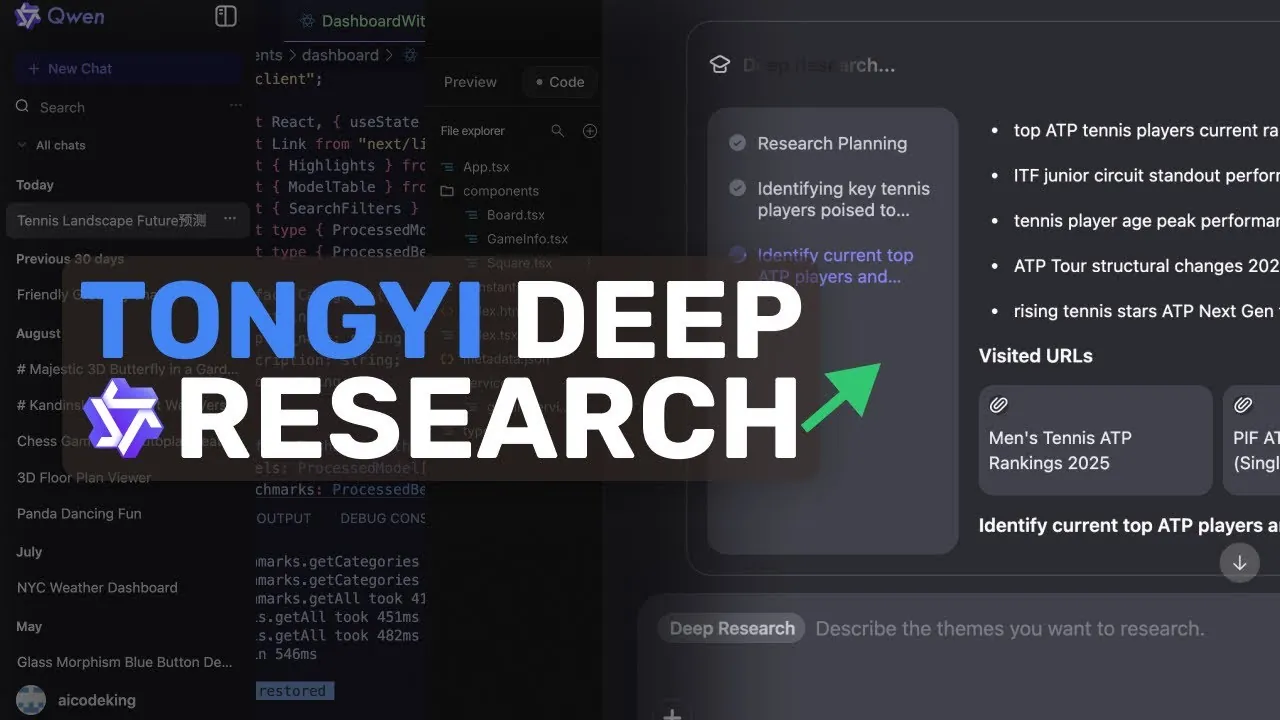
What if the future of research wasn’t just faster, but fundamentally smarter? Imagine a tool that could not only parse through dense datasets but also reason through complex problems, adapt to your unique workflow, and do it all without breaking the bank on computational costs. Enter Tongyi DeepResearch, an open source large language model (LLM) developed by Alibaba. With its ability to handle intricate, multi-step research tasks, this model is poised to redefine how researchers and developers approach advanced problem-solving. Whether it’s navigating vast webs of information or tailoring solutions to specific challenges, Tongyi DeepResearch promises to be more than just a tool, it’s a collaborator.
In this deep dive, AI See King explains how Tongyi DeepResearch combines innovative reasoning capabilities with a flexible, open source framework to empower users across disciplines. From its innovative approach to parameter efficiency to its agentic retrieval systems, this model is designed to tackle the most demanding research workflows with precision and ease. You’ll discover how its unique training methodologies and inference modes make it adaptable to diverse applications, and why its open source accessibility is a fantastic option for fostering innovation. As you read on, consider this: could Tongyi DeepResearch be the key to unlocking breakthroughs in your field?
Key Features That Set Tongyi DeepResearch Apart
TL;DR Key Takeaways :
- Open source and Customizable: Tongyi DeepResearch is an open source large language model (LLM) released under the Apache 2.0 license, allowing for local deployment, customization, and integration into various platforms like GitHub and Hugging Face.
- Advanced Features for Research: It excels in complex reasoning, file parsing, agentic retrieval, and efficient parameter activation, making it ideal for handling intricate, multi-step research tasks.
- Flexible Inference Modes: Offers two modes, React Mode for lightweight tasks and Ader Mode for resource-intensive scenarios, making sure adaptability to diverse research needs.
- State-of-the-Art Performance: Demonstrates exceptional results on benchmark datasets like Humanity’s Last Exam, Browser Comp, and Web Walker, showcasing its capabilities in reasoning, search, and data analysis.
- Extensive Support and Ecosystem: Provides comprehensive documentation, example files, and community support, while being part of a growing ecosystem that fosters collaboration and innovation.
Tongyi DeepResearch is purpose-built to handle long-horizon, multi-step research tasks with precision and efficiency. Its standout features include:
- Advanced Reasoning: The model excels at complex reasoning and information retrieval, allowing users to navigate intricate workflows with ease.
- Efficient Parameter Activation: Out of its 30.5 billion parameters, only 3.3 billion are activated per token, significantly reducing computational demands while maintaining high performance.
- File Parsing and Agentic Retrieval: It supports diverse file formats and employs agentic systems to streamline data extraction and analysis, saving time and effort.
These features make Tongyi DeepResearch an ideal tool for researchers tackling sophisticated challenges across various domains.
Open source Accessibility and Customization
As an open source model, Tongyi DeepResearch is freely available under the Apache 2.0 license, offering significant advantages to its users:
- Customizability: Modify the model to suit specific research needs, making sure it aligns with unique workflows and objectives.
- Local Deployment: Deploy the model locally without proprietary restrictions, providing greater control over data and operations.
- Platform Integration: Access the model via platforms like GitHub, Hugging Face, and ModelScope for seamless integration into existing systems.
This open source approach fosters innovation and collaboration, making advanced research tools more accessible to a global audience.
Tongyi DeepResearch Overview

Expand your understanding of Large Language Model (LLM) with additional resources from our extensive library of articles.
- How to install any AI model large language model (LLM) locally
- How Storage Speed Impacts Large Language Model Performance
- Learn How to Build Your Own AI Large Language Model (LLM
- AnyGPT any-to-any open source multimodal large language model
- Diffusion LLMs Arrive : Is This the End of Transformer Large
- How Do Large Language Models Like GPT Really Work?
- How to Run AI Large Language Models (LLM) on Your Laptop
- Falcon 180B demo now available for the best openly released LLM
- New Mixtral 8x22B MoE powerful open source large language
- How to Run Large Language Models Locally with Ollama for Free
Training and Optimization Techniques
Tongyi DeepResearch employs innovative training methodologies to ensure its advanced capabilities remain robust and reliable. Key aspects of its training include:
- Synthetic Data Generation: An automated pipeline enables scalable pre-training and fine-tuning, making sure the model remains adaptable to diverse tasks.
- Agentic Data Pre-Training: Continuous pre-training on agentic datasets enhances its reasoning and decision-making capabilities.
- Reinforcement Learning: A custom Group Relative Policy Optimization framework ensures stable and efficient training outcomes, optimizing the model for real-world applications.
These techniques ensure that Tongyi DeepResearch remains a powerful and reliable tool for tackling complex research challenges.
Flexible Inference Modes for Diverse Applications
Tongyi DeepResearch supports two distinct inference paradigms, allowing users to balance computational efficiency with task complexity:
- React Mode: Optimized for lightweight inference, this mode is ideal for standard tasks that require core ability evaluation without excessive computational demands.
- Ader Mode: Designed for high-demand scenarios, this mode maximizes performance scaling, making it suitable for complex, resource-intensive tasks.
This flexibility ensures that the model can adapt to a wide range of research scenarios, from routine analyses to advanced problem-solving.
Performance on Benchmark Datasets
Tongyi DeepResearch has demonstrated exceptional performance on several benchmark datasets, solidifying its reputation as a state-of-the-art research tool. Notable benchmarks include:
- Humanity’s Last Exam: Showcasing its ability to handle complex reasoning tasks.
- Browser Comp: Highlighting its proficiency in agentic search and information retrieval.
- Web Walker: Demonstrating its capability to navigate and analyze web-based data effectively.
These results underscore the model’s ability to address sophisticated research challenges with accuracy and efficiency.
Expanding Ecosystem and Collaborative Potential
Tongyi DeepResearch is part of a growing ecosystem that includes complementary tools like Web Walker and Web Sailor. These projects enhance its functionality and connect it to ongoing academic research and development efforts. By using this ecosystem, users can access a wide range of resources to support their research needs, fostering collaboration and innovation across disciplines.
Setup and Deployment Requirements
Deploying Tongyi DeepResearch is straightforward, with minimal requirements to get started:
- Python 3.10: Ensure compatibility with the model’s codebase for smooth operation.
- API Keys: Required for allowing advanced features like web search and file parsing.
- JSONL Format: Supported for evaluation data and benchmarking, making sure standardized workflows.
For users without access to high-end hardware, the model can be used via the OpenRouter API, providing a flexible and accessible deployment option.
Comprehensive Documentation and Community Support
Tongyi DeepResearch offers extensive documentation and active community support to assist users in maximizing its potential. Key resources include:
- Example Files: Ready-to-use examples simplify the onboarding process, helping users quickly familiarize themselves with the model’s capabilities.
- GitHub Repository: Regular updates and community engagement foster collaboration, allowing users to contribute to and benefit from ongoing developments.
This collaborative environment encourages innovation and provides opportunities for research partnerships and further advancements.
Considerations and Limitations
While Tongyi DeepResearch is a powerful tool, it is important to be aware of its limitations:
- Lack of SDK: Advanced use cases may require manual setup due to the absence of a dedicated software development kit.
- API Key Management: Managing API keys for allowing all features may pose challenges for less experienced users.
Understanding these limitations can help users plan effectively and make the most of the model’s capabilities.
Media Credit: AISeeKing
Disclosure: Some of our articles include affiliate links. If you buy something through one of these links, Geeky Gadgets may earn an affiliate commission. Learn about our Disclosure Policy.
