Every hobby has its unicorns. Pokémon cards are not the trophy cards handed out at 1998 Japanese tournaments, which change hands privately and rarely. They are the cards that were printed for retail, pulled from packs by ordinary people, and have since become almost impossible to find in perfect condition. CardTrack tracks 2,141 cards from the scarcest rarity tiers, secret rares, gold stars, illustration rares, and the like, and ranks them by market value. The median card on that list is worth $30. The top of it is a different world.
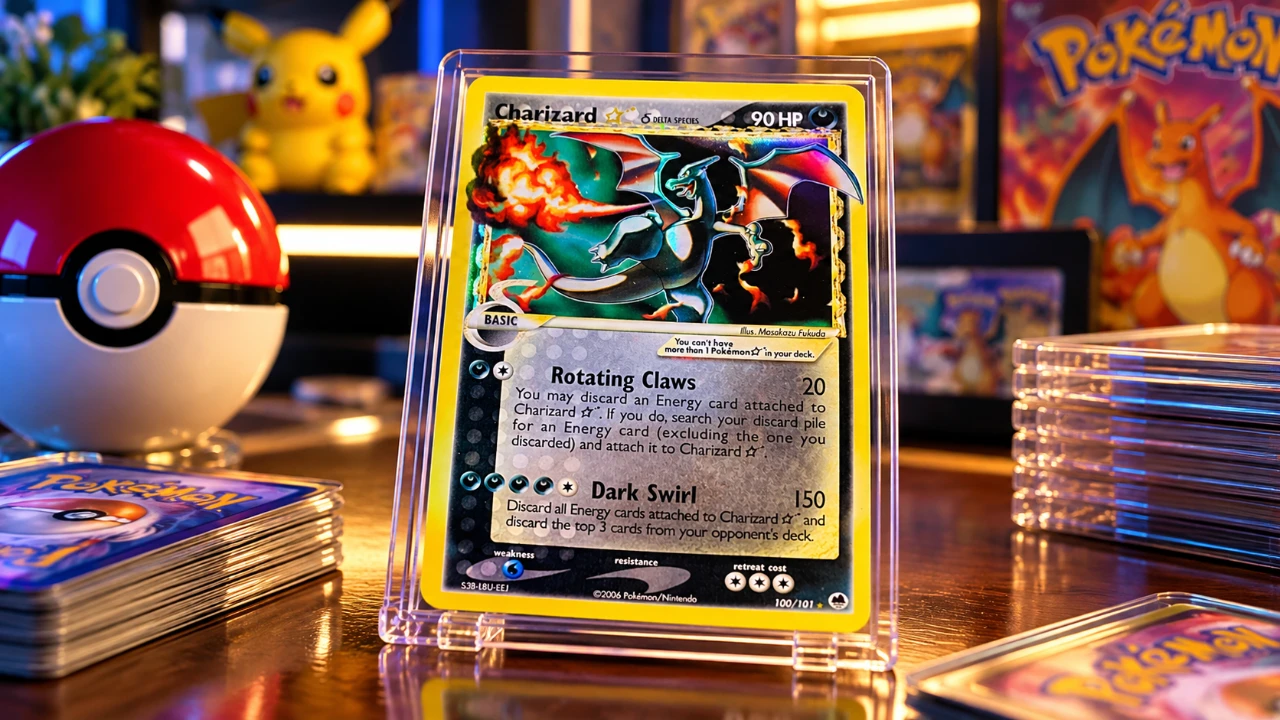
1. Charizard ☆ δ, Dragon Frontiers (2006)
The gold-star Charizard from the last EX-era set. A raw copy is about $6,280. A PSA 10 lists at $384,000, and a PSA 9 at $44,652. The gap between raw and PSA 10 is the story of this card: it was printed on stock that scratched if you looked at it, so almost none survive at a 10.
2. Rayquaza ☆, Deoxys (2005)
The other gold star that collectors treat as a grail. A PSA 10 sits at $365,750 on the current list. Gold-star cards were roughly one per two boxes, and most were played with.
3. Lugia, Aquapolis (2003)
The crystal-type secret rare from the e-Card era. Raw copies are about $4,863; a PSA 10 is $132,000 and a PSA 9 $26,400. Skyridge and Aquapolis crystal cards were pulled from packs that had already left most shops by the time anyone realised what they were.
4. Espeon ☆, POP Series 5 (2007)
Given out through the Pokémon Organized Play programme rather than sold in boosters, which is why the supply is so thin. A PSA 10 is $127,500. Its sibling, the Umbreon ☆ from the same series, is about $7,651 raw and $106,514 in a 10.
5. Pikachu ☆, Holon Phantoms (2006)
The gold-star Pikachu. About $4,322 raw, $114,000 as a PSA 10, $21,850 as a PSA 9.
What the list does not say
These are graded prices at the top grade, and the graded market is a different market from the raw one. The Skyridge Charizard, a crystal-type secret rare from 2003, is about $8,606 raw and $102,000 as a PSA 10. The Skyridge Gengar is $4,169 raw and $160,000 as a 10. In both cases the perfect copy is worth more than ten times the imperfect one, and the number of perfect copies is measured in dozens.
The other thing the top five hides is that the category as a whole has done well, not just the grails. The median value of a rare card is up 78 percent since January 2021 and 48 percent in the last year. The standout riser over twelve months is the Gengar LV.X from 2009’s Arceus set, up 457 percent. Modern chase cards are on the same list at a lower altitude: the Umbreon VMAX alternate art from Evolving Skies is about $2,642 raw and $4,200 as a PSA 10, and the Umbreon ex special illustration rare from Prismatic Evolutions is $1,648 raw.
You can see the full ranking of the rarest Pokémon cards with each card’s raw and graded price, and how the tier has moved month by month since 2021. It is the kind of list where the gadget is the card itself: a piece of printed cardboard, twenty years old, that a machine will grade to the tenth of a millimetre and a market will price to the dollar.
Disclosure: Some of our articles include affiliate links. If you buy something through one of these links, Geeky Gadgets may earn an affiliate commission. Learn about our Disclosure Policy.
