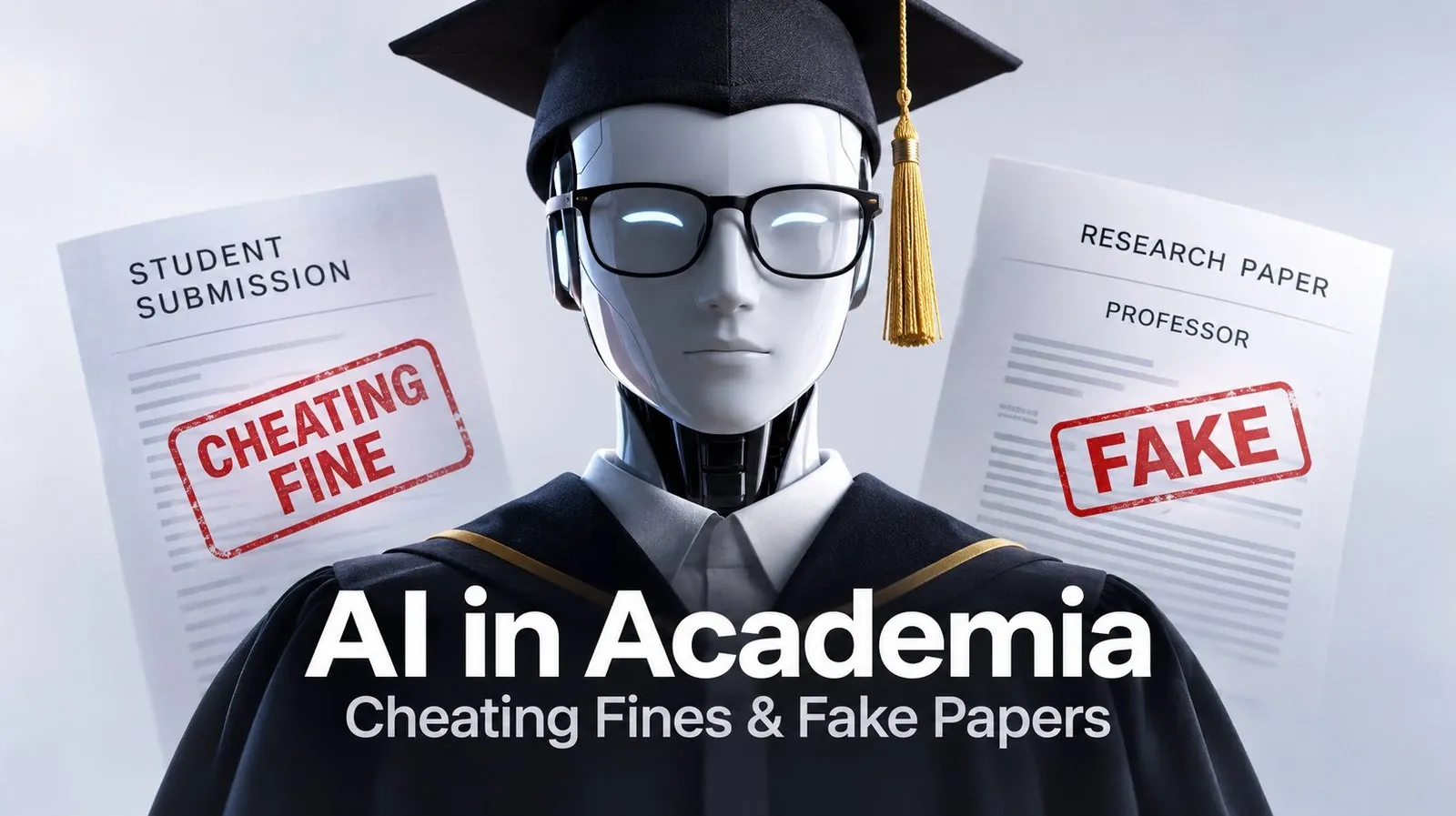
AI’s influence on academia is growing, but not without complications. Some journals have been caught publishing AI-generated papers under the names of respected academics without their consent, raising serious ethical concerns. In one case, a professor’s name was removed from a fraudulent paper, only for it to reappear under a different author. To combat this misuse, researchers are encouraged to set up alerts to monitor unauthorized publications, as highlighted by Andy Stapleton.
Explore how AI is reshaping academic norms, from accelerating scientific discoveries to challenging traditional education systems. Learn about groundbreaking achievements like AlphaGenome 2 replicating months of lab work in minutes, and understand the implications of AI-assisted cheating on university assessments. This feature also examines how institutions like Harvard and Chicago are navigating these shifts, offering insights into the evolving balance between innovation and integrity in higher education.
TL;DR Key Takeaways :
- Some lesser-known academic journals are reportedly publishing AI-generated papers under the names of established professors without their consent, allegedly to boost credibility. Affected academics have advised setting up alerts to monitor unauthorized use of their names.
- Google DeepMind’s AI model, AlphaGenome 2, replicated key aspects of a scientific discovery on inflammatory bowel disease in just 30 minutes, compared to 18 months of traditional lab work, though human oversight remains necessary to mitigate risks like hallucinations and errors.
- Anthropic’s analysis of over 200,000 Claude research sessions found that researchers primarily use AI for assistive tasks like data analysis, writing, and data gathering, with lower adoption rates in fields such as library sciences and religion.
- AI-assisted cheating is reportedly undermining higher education, with students using large language models to complete assessments quickly and achieve comparable grades. Universities are being urged to implement systemic changes to maintain the credibility of degrees.
- Harvard and the University of Chicago are leading AI education initiatives, with Harvard introducing an AI guidance tool for educators and Chicago launching an AI-free writing course for first-year students to preserve traditional writing skills.
AI-Generated Papers Spark Ethical Concerns in Academia
A troubling trend has emerged in academic publishing: some lesser-known journals are releasing AI-generated papers under the names of established professors without their consent. In one instance, a professor discovered such a paper and had their name removed, only for the paper to be republished under a different name, which was later changed again.
Affected academics have stated, “I confirmed that I did not write the paper, was not involved in its submission, and did not authorize the use of my name. I was also unaware of its existence until the email.” This misuse of names appears aimed at boosting the credibility of these journals by associating them with prominent researchers.
To reduce such risks, academics are advised to set up alerts, such as Google Scholar notifications, to monitor unauthorized use of their names in publications.
AI Accelerates Scientific Discovery
AI is showing its potential to transform scientific research, as demonstrated by a comparison between traditional lab work and AI-driven methods. In 2024, researchers identified a new driver of inflammatory bowel disease through 18 months of conventional lab experiments. In contrast, Google DeepMind’s AI model, AlphaGenome 2, replicated key aspects of this discovery in just 30 minutes, without any physical lab work.
While this rapid verification is promising, testing highlighted that AI models like AlphaGenome 2 still require human oversight due to risks such as hallucinations and errors. However, as a complementary tool for validation, AI offers significant potential to support traditional research methods.

Check out more relevant guides from our extensive collection on AI research that you might find useful.
- Undermined AI Research Tool Finds 100% of Your Papers in Seconds
- 6 Powerful Free Al Tools Every Researcher Should Be Using in 2026
- No Code Autonomous AI Research Assistant for Deep Web Research
- 29 Powerful AI Research Tools : Cut Your Research Time and Boost Efficiency
- New OpenAI PaperBench : Autonomous AI Research Benchmarking
How Researchers Use Claude
Anthropic analyzed over 200,000 Claude research sessions to understand how scientists are using AI tools like Claude. The analysis revealed that data analysis is the most common application, particularly in fields such as medicine, computer science, and engineering. In contrast, disciplines like library sciences, nutrition, and religion showed lower adoption rates.
The study also found that researchers primarily use AI in assistive or collaborative roles, with fewer relying on it autonomously or avoiding it entirely. This suggests that AI is most effective when augmenting tasks like data analysis, writing, and data gathering, rather than replacing them outright.
AI Cheating Challenges Higher Education
AI-assisted cheating is posing a serious threat to the credibility of higher education. Students have reportedly used large language models to complete assessments in minutes, achieving grades comparable to peers who completed the work independently. Despite detection efforts, tools like OpenAI’s watermarking and Claude’s detection systems have proven unreliable.
The Office for Students has warned universities that they could face fines if they fail to address this issue. Institutions are being urged to help students develop AI skills while maintaining confidence in the value of degrees. However, many universities still rely on unsupervised assessments, which are no longer effective measures of learning. The host argued that systemic changes are needed to prevent students from earning degrees without genuine learning.
The host also suggested that universities consider implementing a full AI-free year before allowing students to use AI in controlled ways. This approach would resemble past practices, such as requiring one math exam with a calculator and one without, though it is unclear if such methods are still in use today.
Harvard and Chicago Lead AI Education Initiatives
Two leading universities are taking proactive steps to address AI’s impact on education. Harvard’s Graduate School of Education has introduced a tool designed to provide AI guidance tailored to different age groups. This tool offers quick takes, recommendations, and insights into how AI might support or hinder human development at various stages. Features include guidance on key developmental processes and milestones for different age groups.
While the tool is based on hypotheses rather than established facts, it is seen as a valuable resource for educators. Meanwhile, the University of Chicago has launched an AI-free writing course for all first-year students. Administered through the university’s writing center, this initiative aims to preserve traditional writing skills while exploring new practices and technologies. The center is also developing additional writing labs and campus partnerships to support both students and faculty.
Implications for Academia
AI’s expanding role in academia presents both opportunities and challenges. Tools like AlphaGenome 2 demonstrate the potential to accelerate scientific discovery, while platforms like Claude are reshaping how researchers approach data analysis and writing. However, the misuse of AI in academic publishing and assessments highlights the urgent need for ethical safeguards and systemic reforms.
Universities must balance fostering AI literacy with preserving the integrity of education. Initiatives like Harvard’s developmental tool and Chicago’s AI-free writing courses are early steps in this direction. Yet, the broader academic system faces a critical challenge: adapting to AI’s capabilities without compromising the core values of learning and research.
Media Credit: Andy Stapleton
Disclosure: Some of our articles include affiliate links. If you buy something through one of these links, Geeky Gadgets may earn an affiliate commission. Learn about our Disclosure Policy.
