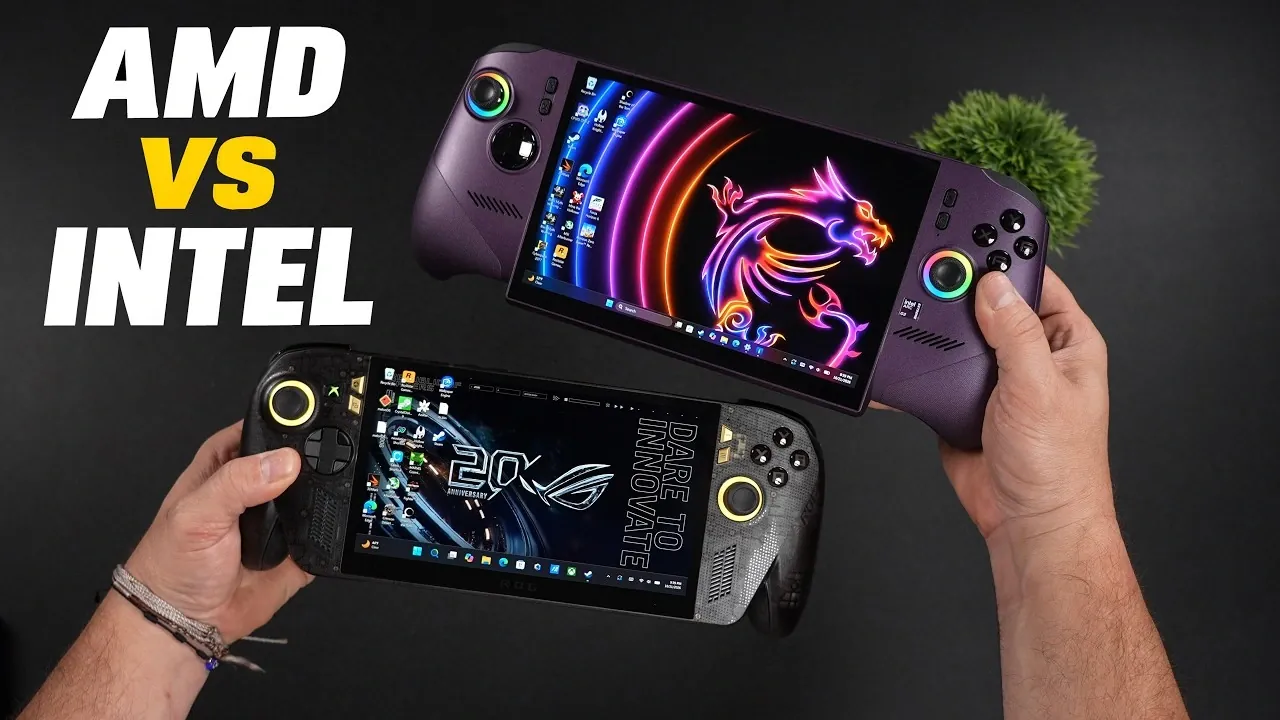
The handheld gaming market continues to push boundaries, with devices like the ROG Ally X20 and MSI Claw 8 EX showcasing the latest advancements in portable performance. In a detailed breakdown by ETA Prime, these two devices are put head-to-head, highlighting their distinct approaches to gaming on the go. The MSI Claw 8 EX, powered by Intel’s Arc G3 Extreme processor and 32GB of RAM, delivers impressive multi-core and GPU performance, particularly in demanding titles like Cyberpunk 2077 and Red Dead Redemption 2. Meanwhile, the ROG Ally X20, equipped with AMD’s Ryzen Z1 Extreme and a vibrant OLED display, offers a balance of affordability and visual quality, appealing to gamers who value immersive graphics.
Explore how these devices compare across key metrics, including gaming benchmarks, battery performance and display quality. Gain insight into how the Claw 8 EX’s raw power translates to higher frame rates at elevated TDP settings and understand the trade-offs of its premium price. Additionally, discover why the Ally X20’s OLED display and lower price point make it a compelling option for gamers prioritizing visuals and value. This overview will help you weigh the strengths of each device to determine which aligns best with your gaming needs.
ROG Xbox Ally X20 vs MSI Claw 8 EX
TL;DR Key Takeaways :
- The MSI Claw 8 EX outperforms the ROG Ally X20 in both synthetic and gaming benchmarks, delivering up to 61% better frame rates in graphically intensive games.
- The ROG Ally X20 features a premium 7.4-inch OLED display for superior contrast and vibrant visuals, while the MSI Claw 8 EX offers a larger 8-inch IPS display with consistent color accuracy.
- Both devices have comparable battery life, lasting up to 8 hours for light gaming and around 2.5 hours for high-performance gaming at higher TDP settings.
- The ROG Ally X20 is priced at $1,299, offering a more affordable option with balanced performance, while the MSI Claw 8 EX costs $1,799, justifying its premium price with superior hardware and multitasking capabilities.
- The choice between the two depends on priorities: the MSI Claw 8 EX is ideal for raw performance and multitasking, while the ROG Ally X20 excels in display quality and affordability.
Both devices are designed to cater to gamers seeking high-performance hardware, but their configurations reflect different priorities:
- ROG Ally X20: Equipped with AMD’s Ryzen Z1 Extreme processor featuring 8 cores and 16 threads, paired with the Radeon 890M integrated GPU. It includes 24GB of RAM, a 7.4-inch OLED display with 1080p resolution and a 120Hz refresh rate and an 80Wh battery.
- MSI Claw 8 EX: Powered by Intel’s Arc G3 Extreme processor with 14 cores and 14 threads, alongside the Intel Arc B390 iGPU. It offers 32GB of RAM, an 8-inch IPS display with the same 1080p resolution and 120Hz refresh rate and an 80Wh battery.
The ROG Ally X20 emphasizes balanced performance and superior display quality, while the MSI Claw 8 EX focuses on delivering raw power with a more robust CPU and GPU combination.
Performance Benchmarks
Performance is a critical factor in handheld gaming and the MSI Claw 8 EX consistently outperforms the ROG Ally X20 in both synthetic and gaming benchmarks.
- Synthetic Benchmarks: The ROG Ally X20 performs admirably in single-core tasks, but the MSI Claw 8 EX dominates in multi-core and GPU-intensive tests. For example, in 3DMark Time Spy, the Claw 8 EX achieves significantly higher scores, showcasing its superior graphical capabilities.
- Gaming Benchmarks: In demanding titles such as Cyberpunk 2077, Shadow of the Tomb Raider, and Red Dead Redemption 2, the Claw 8 EX delivers frame rate advantages ranging from 24% to 61%, depending on TDP (Thermal Design Power) settings. At higher TDPs (25W and 35W), the performance gap becomes even more pronounced.
These results highlight the Claw 8 EX’s ability to handle graphically intensive games with smoother gameplay and higher frame rates, making it the preferred choice for performance-focused gamers.

Explore further guides and articles from our vast library that you may find relevant to your interests in gaming handhelds.
- Valve Confirms Steam Deck 2 with Unreal Engine 5 Support
- Sony’s PlayStation 6 Details Leaks: First Look at the Next-Gen Console
- SteamOS Hits 78 FPS in Cyberpunk 2077 on the GPD Win Max 3
- RG56 Pro Max First Look & Performance Guide: What Runs Well & What Struggles
- Pricing for Acer Predator Atlas 8 Starts at £999 in the UK
- New ROG Xbox Ally X20 Hands-on: Upgrades to OLED, Retains APU
- Intel Panther Lake Handheld PCs Expected at $599 To $799
- Ambernick Win600 Delivers X86 Handheld Gaming for Just $99
- MSI Claw 8EX Ai+ Costs $1800 but Hits 70 FPS in Cyberpunk 2077
- Install Armada OS on Android Handhelds to Create a Steam Deck in Under 5 Minutes
Battery Life
Battery life is a crucial consideration for handheld devices and both models offer comparable performance under similar TDP settings:
- Light Gaming (6-8W TDP): Approximately 8 hours of usage.
- AAA Gaming (17W TDP): Around 3 hours of battery life.
- High-Performance Gaming (25W TDP): Roughly 2.5 hours of usage.
While both devices consume significant power during intensive gaming, they remain viable for extended sessions at lower TDP settings. This balance ensures that gamers can enjoy portability without sacrificing too much on performance.
Display and Design
The display technology and design of these devices cater to different user preferences, enhancing their appeal to specific audiences:
- ROG Ally X20: Features a 7.4-inch OLED display, offering superior contrast, deeper blacks and vibrant colors. This makes it an excellent choice for gamers who prioritize visual quality and immersive graphics.
- MSI Claw 8 EX: Includes a larger 8-inch IPS display. While it lacks the contrast of OLED, it provides consistent color accuracy and wider viewing angles, appealing to those who prefer a larger screen for gaming.
The Ally X20’s OLED display gives it a distinct advantage for users who value premium visuals, while the Claw 8 EX’s larger screen may attract gamers seeking a more expansive viewing experience.
Pricing
Pricing plays a significant role in determining the value proposition of these devices, reflecting their respective priorities:
- ROG Ally X20: Priced at $1,299, it offers a more affordable entry point into high-performance handheld gaming.
- MSI Claw 8 EX: At $1,799, it commands a premium price for its superior performance and higher RAM capacity.
The Claw 8 EX justifies its higher price with better performance and multitasking capabilities, while the Ally X20 provides a more budget-friendly option without compromising too much on quality.
Final Thoughts
The MSI Claw 8 EX stands out as the more powerful handheld gaming device, excelling in both synthetic and gaming benchmarks. Its robust CPU and GPU combination make it the ideal choice for gamers who prioritize raw performance and multitasking capabilities. However, its higher price tag may deter those seeking a more affordable option.
On the other hand, the ROG Ally X20 offers a compelling alternative with its premium OLED display and lower price point. It’s an excellent choice for gamers who value visual quality and affordability over absolute performance.
Ultimately, your decision will depend on your gaming priorities. If you’re after top-tier performance and are willing to invest in a premium device, the MSI Claw 8 EX is the clear winner. However, if you prefer a high-quality display and better value for money, the ROG Ally X20 is a strong contender. Both devices showcase the forefront of handheld gaming technology, making sure an immersive experience regardless of your choice.
Media Credit: ETA PRIME
Disclosure: Some of our articles include affiliate links. If you buy something through one of these links, Geeky Gadgets may earn an affiliate commission. Learn about our Disclosure Policy.
