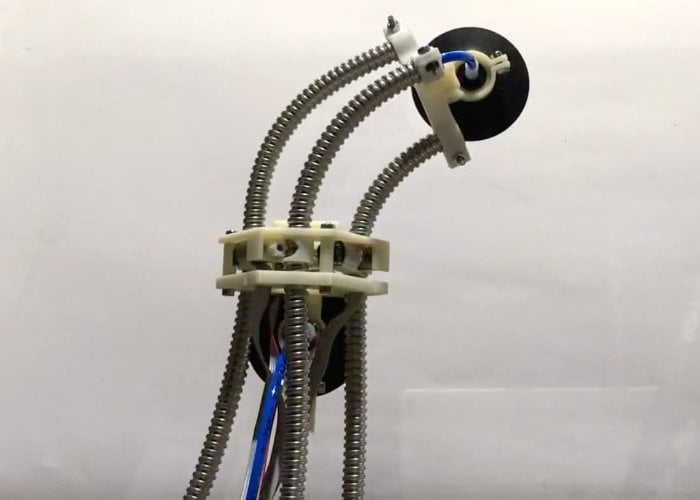
Researchers at Toyohashi University of Technology have made a groundbreaking advancement in robotics with the creation of the LEeCH robot. Inspired by the natural movement of leeches, this innovative robot is the world’s first free-movement climbing robot that utilizes suckers to navigate its environment. Watch the demonstration video below to learn more about the “LEeCH: a sucker for walls” robot.
Equipped with a flexible body, the LEeCH robot is capable of ambidextrous movement, which the researchers are calling a “world’s first achievement in developing a soft and flexible robot that is capable of free movement on a wall.” The robot’s name, LEeCH, stands for Longitudinally Extensible Continuum-robot inspired by Hirudinea.

Innovative Design and Functionality
The LEeCH robot’s design is a marvel of modern engineering. Its flexible body allows it to bend and twist, mimicking the natural movements of a leech. This flexibility is crucial for its ability to climb flat walls and transition between different surfaces. The robot’s suckers provide the necessary adhesion, enabling it to stick to and move along vertical and horizontal planes with ease.
The bending motions investigated in LEeCH are flat-wall climbing and wall-to-wall transitions. These motions occur only in one plane at a time, which allows for an accurate description of the system with a planar model. To approximate the soft body, researchers use a chain of rigid bodies under the influence of gravity with acceleration g. They assign a linear torsional stiffness k and linear damping d at every joint. The first element is attached with a joint to an inertial reference system I. Each rigid body is associated with a mass m located at its tip and a length.
Potential Applications and Future Developments
The LEeCH robot’s unique capabilities open up a wide range of potential applications. For instance, it could be used in search and rescue missions, where its ability to navigate complex and vertical environments could prove invaluable. Additionally, the robot could be employed in industrial settings for tasks such as inspection and maintenance of hard-to-reach areas, reducing the need for human workers to perform dangerous tasks.
Moreover, the principles behind the LEeCH robot’s design could inspire the development of other bio-inspired robots. By studying and mimicking the movements of various organisms, researchers can create robots that are more adaptable and efficient in a variety of environments. This approach could lead to significant advancements in fields such as medicine, agriculture, and environmental monitoring.
The LEeCH robot is a testament to the potential of bio-inspired robotics. By drawing inspiration from nature, researchers at Toyohashi University of Technology have created a robot that not only pushes the boundaries of what is possible in robotics but also offers practical solutions to real-world problems. As research and development continue, we can expect to see even more innovative and versatile robots emerging from this exciting field.
Source: New Atlas
Disclosure: Some of our articles include affiliate links. If you buy something through one of these links, Geeky Gadgets may earn an affiliate commission. Learn about our Disclosure Policy.
