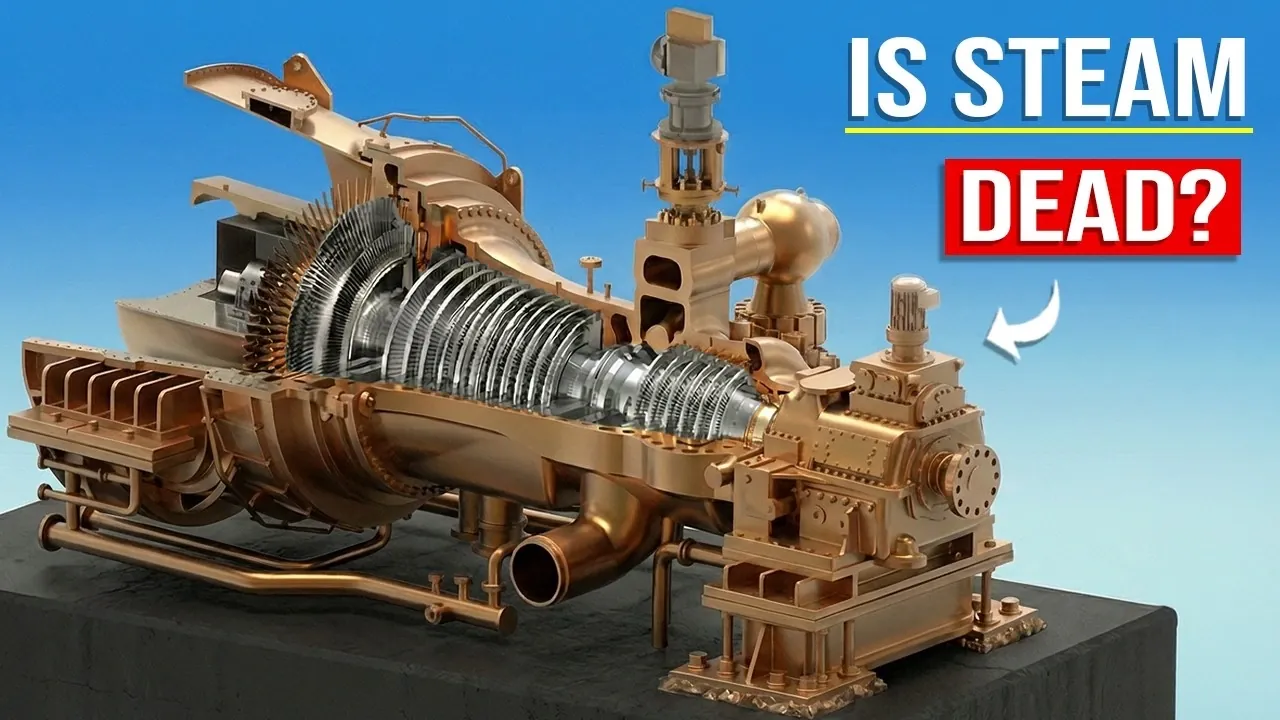
China’s Chaotan One turbine is a highly efficient energy system that uses supercritical CO₂ technology to generate 30 megawatts of power from waste heat at a steel plant. As detailed by Ziroth, the system capitalizes on the dual gas-liquid properties of supercritical CO₂ to minimize energy losses typically seen in steam-based turbines. Notable features include a printed circuit heat exchanger with microchannels for precise heat transfer and a dry gas seal designed to handle extreme pressures without leakage. These engineering solutions address key challenges in harnessing supercritical CO₂ for industrial applications.
You’ll learn how the Chaotan One system achieves its compact design, requiring significantly less space than conventional turbines and how neural networks are integrated to optimize performance in real time. Additionally, this feature examines diffusion bonding, a specialized manufacturing technique essential for producing components that endure high temperatures and pressures. These elements provide a detailed look at the technical and industrial significance of supercritical CO₂ technology.
China’s Supercritical CO₂ Breakthrough
TL;DR Key Takeaways :
- China has launched Chaotan One, the world’s first commercial supercritical CO₂ turbine, generating 30 megawatts of power by using waste heat from a steel plant, marking a milestone in energy innovation.
- Supercritical CO₂ technology offers key advantages such as compact turbine design, higher energy efficiency and adaptability to various energy sources like waste heat, solar and nuclear power.
- The Chaotan One system incorporates advanced features like a printed circuit heat exchanger and dry gas seal technology to maximize heat transfer efficiency and ensure operational safety under high-pressure conditions.
- Innovations like neural network integration for real-time optimization and diffusion bonding technology for durable heat exchangers were critical to overcoming engineering challenges during the system’s development.
- Chaotan One demonstrates the potential of supercritical CO₂ technology for energy efficiency and sustainability, positioning China as a global leader while paving the way for broader adoption in industrial and energy sectors worldwide.
What Makes Supercritical CO₂ Technology Innovative?
Supercritical CO₂ operates in a unique state where it exhibits properties of both a gas and a liquid, achieved at temperatures and pressures above its critical point, 31°C and 7.38 MPa. This state eliminates phase changes, which are common in traditional steam systems, resulting in higher energy efficiency and reduced energy losses.
Key advantages of supercritical CO₂ technology include:
- Compact Design: Supercritical CO₂ turbines are up to ten times smaller than conventional steam turbines, making them ideal for space-constrained environments such as small modular reactors and industrial waste heat recovery systems.
- Higher Efficiency: The dense, fluid-like state of supercritical CO₂ minimizes energy dissipation, allowing more effective power generation compared to traditional systems.
- Versatility: This technology is adaptable to various energy sources, including waste heat, solar power and nuclear reactors, making it a flexible solution for diverse applications.
These characteristics form the foundation of the Chaotan One system, setting it apart as a new advancement in energy efficiency and sustainability.
Inside the Chaotan One System
The Chaotan One turbine is specifically engineered to recover waste heat from a steel plant, an industrial setting that presents unique operational challenges. At the core of the system lies a printed circuit heat exchanger, a compact device featuring chemically etched microchannels. This innovative design maximizes heat transfer efficiency while withstanding the high pressures required for supercritical CO₂ operation.
To address the complexities of containing high-pressure CO₂, Chaotan One incorporates a state-of-the-art dry gas seal technology. This innovation minimizes CO₂ leakage, making sure operational safety and reducing the risk of contamination. Additionally, advanced pressure control systems enhance the turbine’s reliability, allowing consistent performance under demanding industrial conditions.
The system’s design reflects a meticulous approach to overcoming the technical challenges associated with supercritical CO₂ technology, showcasing China’s ability to innovate in the face of complex engineering requirements.
China’s Insanely Efficient CO₂ Generator Explored

Check out more relevant guides from our extensive collection on energy that you might find useful.
- The Nuclear Fusion Breakthrough Once Dismissed as Impossible
- Z Pinch Fusion Costs Drop, Compact Reactor Skips Magnets & Lasers
- Kesterite Solar Cells vs Perovskite: Efficiency and Stability
- Solar Energy S 40,000 mAh retractable solar panel and power bank
- EnergyLink’s Magnetic Wireless Charger Apple Watch Band
- Donut Lab Solid State Battery Claims, 400 Wh/kg and Fast Charge
- Samsung Galaxy Watch 7: Must-Know Tips & Tricks
- Donut Lab Solid State Battery or Pseudo-Capacitor, Experts Weigh In
- CATL Sodium-Ion Battery Uses Water-Based Lines for Cheaper Cells
- Osmotic Power Explained, How Saltwater Mixing Can Power Cities
Overcoming Engineering Challenges
The development of Chaotan One was a rigorous process, spanning 829 days of experimentation and problem-solving. With limited domestic expertise in supercritical CO₂ systems, the project team faced significant technical hurdles. However, several key breakthroughs ensured the system’s success:
- Neural Network Integration: Real-time optimization of temperature and pressure control was achieved using neural networks. These algorithms continuously analyze system performance and make adjustments to maximize efficiency and stability.
- Diffusion Bonding Technology: This advanced manufacturing process fuses metal components at a molecular level, creating durable, monolithic heat exchangers capable of withstanding extreme temperatures and pressures.
These innovations not only addressed the immediate challenges of the Chaotan One project but also laid the groundwork for future advancements in supercritical CO₂ technology. The successful integration of these technologies underscores the potential for further refinement and broader adoption in the energy sector.
Global Context: A New Frontier in Energy Systems
While supercritical CO₂ technology has been explored in Europe and the United States, the Chaotan One turbine represents a unique application focused on industrial waste heat recovery. This approach highlights the versatility of the technology and its alignment with global sustainability goals. By targeting waste heat, China has demonstrated a practical and scalable use case that could inspire similar initiatives worldwide.
The success of Chaotan One also emphasizes the growing importance of energy efficiency innovations. As industries increasingly prioritize reducing their carbon footprints, technologies like supercritical CO₂ turbines offer a viable pathway to achieving substantial energy savings. However, challenges such as material corrosion resistance and CO₂ leakage prevention remain critical areas for further research and development.
Future Prospects for Supercritical CO₂ Systems
The deployment of Chaotan One marks a significant step forward in energy efficiency and compact turbine design. While it is unlikely to completely replace steam turbines in the near future, supercritical CO₂ technology holds immense potential for transforming the energy sector. Its compact size, high efficiency and adaptability make it a promising candidate for applications ranging from industrial waste heat recovery to advanced nuclear reactors.
Looking ahead, addressing material durability and improving sealing mechanisms will be essential to unlocking the full potential of supercritical CO₂ systems. Continued research and development in these areas could pave the way for broader adoption, reshaping how energy is generated and used across industries.
By successfully deploying Chaotan One, China has demonstrated its ability to innovate and overcome complex technical challenges. This achievement not only establishes the country as a leader in supercritical CO₂ technology but also sets the stage for further advancements in energy efficiency and sustainability. The lessons learned from this project could serve as a blueprint for future developments, inspiring global efforts to adopt more efficient and environmentally friendly energy systems.
Media Credit: Ziroth
Disclosure: Some of our articles include affiliate links. If you buy something through one of these links, Geeky Gadgets may earn an affiliate commission. Learn about our Disclosure Policy.
