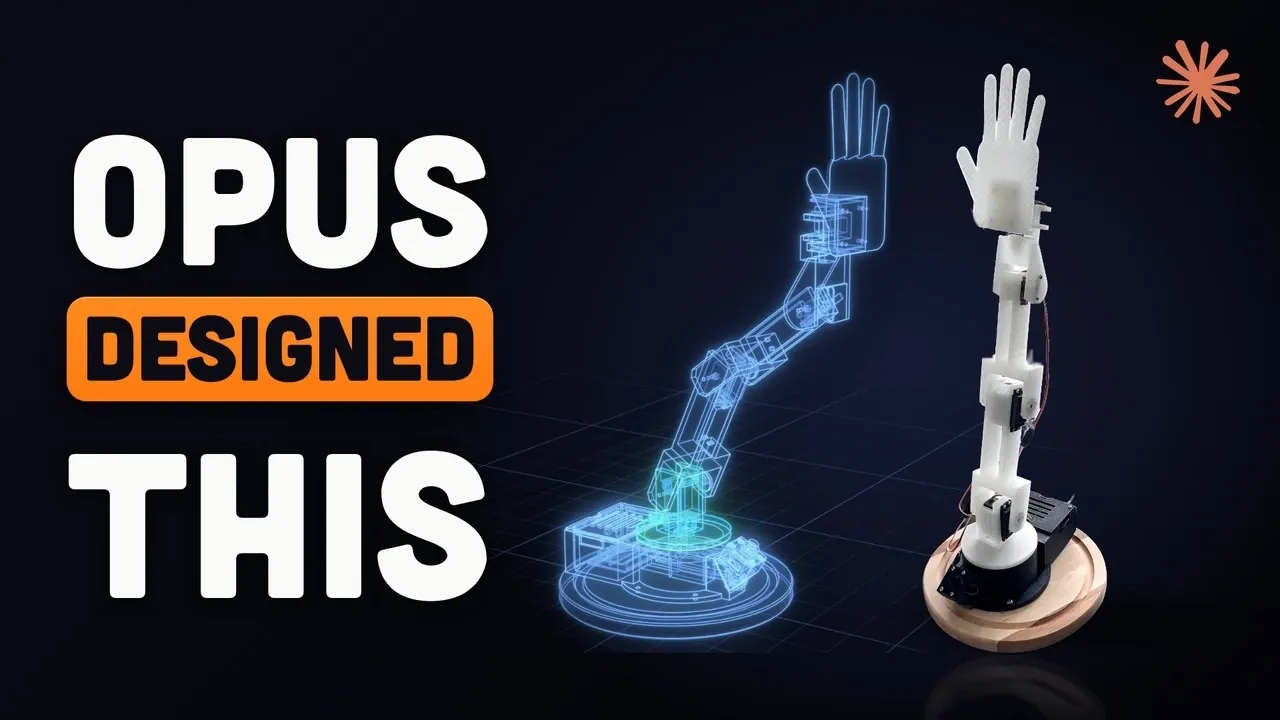
Greg, the high-five robot arm, showcases how AI-assisted design can streamline robotics development while still requiring human refinement. Designed with Opus 5.5, an AI model that generated the initial 3D part designs and firmware, Greg features five servo motors, an ESP32-S3 microcontroller and a Seeed Xiao ESP32-S3 Sense camera module. These components work together to detect an open palm and deliver a responsive high five. Better Stack explains how the process involved refining AI-generated outputs using Blender to ensure precise part compatibility and functionality, highlighting the collaboration between automation and manual adjustments.
Explore how Greg’s design integrates hardware and software to achieve fluid motion, the steps taken to address challenges like servo alignment and camera calibration and the modifications that added features such as voice control and a wide-angle camera module. This analysis provides a detailed look at both the technical and practical aspects of building an interactive robot.
How Greg Works
TL;DR Key Takeaways :
- Greg, a robot arm designed to deliver high fives, combines AI, 3D printing, electronics and programming to create an engaging and intuitive user experience.
- The robot uses five servo motors, an ESP32-S3 microcontroller and a Seeed Xiao ESP32-S3 Sense camera for precise motion and hand gesture detection.
- AI-assisted design tools like Opus 5.5 were used to streamline the development process, though human oversight and refinement were essential for success.
- Challenges such as servo alignment, camera calibration and software debugging were overcome through iterative testing and creative problem-solving.
- Upgrades like a fifth joint, wide-angle camera and voice control enhanced Greg’s functionality, showcasing the adaptability and potential of modern robotics projects.
Greg’s operation is straightforward yet remarkable. It detects an open palm and moves its arm to deliver a high five, thanks to the seamless integration of hardware and software. The robot’s core components include:
- Five servo motors for precise and coordinated joint movement.
- An ESP32-S3 microcontroller for processing data and controlling movements.
- A Seeed Xiao ESP32-S3 Sense camera module for vision-based hand detection.
The camera identifies the position and orientation of a user’s hand, while the microcontroller processes this input to guide the robot’s arm. This combination ensures smooth, responsive interactions, making Greg an excellent example of how robotics can mimic human gestures in an intuitive way.
AI-Assisted Design and Development
The design process for Greg began with the use of Opus 5.5, an AI model that generated initial 3D part designs, wiring diagrams and firmware. By using AI, the development team significantly reduced the time and effort required to create complex components. However, the AI-generated designs were not flawless. Adjustments were made using Blender, a 3D modeling software, to refine the parts and ensure compatibility with the robot’s mechanical and electronic systems.
This approach highlights the potential of AI-assisted design in simplifying the creation of intricate systems while emphasizing the need for human oversight to fine-tune and optimize results. The combination of AI and manual refinement allowed for a more efficient and precise development process.

Explore further guides and articles from our vast library that you may find relevant to your interests in AI design.
- Google Stitch vs Figma : Will AI Design Replace Your UI Team?
- Google Stitch Guide : No-Code to Working App in Minutes With Gemini 3
- How AI is transforming 3D product design
- Stable 3D AI creates 3D models from text prompts in minutes
- Create Stunning Presentations Effortlessly with Genspark AI Slides
- The Fastest Way to Start Coding with AI Tools (No Code) Beginners Guide
- 7 AI tools to design websites from wireframe to final landing page
- How to create amazing vector images using AI and Adobe Illustrator
- 5 Cutting-Edge AI Tools Every Designer Needs to Unlock Creativity, Colors and More
- Google Stitch : The Figma Killer Transforming UI Design in 2025
Key Components and Construction
Greg’s construction involved a mix of off-the-shelf components and custom-designed parts, making the project both cost-effective and scalable. The following elements were essential to its assembly:
- Five servo motors to control the arm’s joints and enable smooth motion.
- An ESP32-S3 microcontroller to process commands and coordinate movements.
- A Seeed Xiao ESP32-S3 Sense camera for detecting hand gestures with accuracy.
- A wide-angle camera module to enhance the robot’s field of view for better hand detection.
- A custom perf board for efficient power distribution and wiring organization.
The robot’s base and arm components were 3D-printed, making sure precision and ease of assembly. This combination of accessible hardware and custom fabrication techniques demonstrates how robotics projects can be tailored to suit individual needs and budgets.
Overcoming Challenges
As with any robotics project, the development of Greg presented several challenges. Each obstacle required creative problem-solving and iterative refinement:
- Servo Fitting and Wiring: Initial designs underwent multiple iterations to ensure proper alignment and functionality of the servos.
- Camera Positioning: Accurate hand detection depended on precise camera placement. Calibration involved mapping joint angles to the detected hand positions for optimal performance.
- Software Bugs: Issues such as conflicts in PWM channel configurations were resolved through careful debugging and manual adjustments.
These challenges underscored the importance of testing and refinement in both hardware and software development, providing valuable lessons for future projects.
Upgrades and Enhancements
To improve Greg’s functionality and user experience, several upgrades were implemented during the development process:
- A fifth joint was added to align the robot’s hand with the user’s palm, creating a more natural and fluid high-five motion.
- A wide-angle camera module expanded the robot’s field of view, making it more effective at detecting hands from various angles.
- Voice control and web-based sliders were introduced, allowing users to fine-tune movements and interact with the robot in innovative ways.
These enhancements not only improved Greg’s performance but also demonstrated the flexibility and adaptability of the design, showcasing how robotics can evolve to meet user needs.
Lessons Learned
The development of Greg provided valuable insights into the process of building functional and interactive robots. Key takeaways from the project include:
- Iterative Testing: Regular testing is essential for identifying and resolving design flaws, making sure the final product meets expectations.
- AI Limitations: While AI-generated designs can save time, they require careful review and adjustments to meet specific requirements and ensure compatibility.
- Power Management: Effective power distribution is critical for smooth and reliable servo operation, especially in multi-joint systems.
- 3D Printing Precision: Accurate 3D printing is vital for creating components that fit together seamlessly and function as intended.
These lessons are invaluable for anyone interested in exploring robotics, offering practical guidance for overcoming common challenges and achieving success.
Why This Matters
Greg’s creation highlights the fantastic potential of AI-assisted design and modern technology in making robotics more accessible. By integrating advanced features such as vision-based interaction, voice control and web-based interfaces, this project bridges the gap between complex engineering and hobbyist experimentation. Whether you are an experienced programmer or a beginner in electronics, Greg’s story serves as an inspiration to explore, learn and create through hands-on projects. It demonstrates that with the right tools and a willingness to experiment, anyone can bring innovative ideas to life.
Media Credit: Better Stack
Disclosure: Some of our articles include affiliate links. If you buy something through one of these links, Geeky Gadgets may earn an affiliate commission. Learn about our Disclosure Policy.
