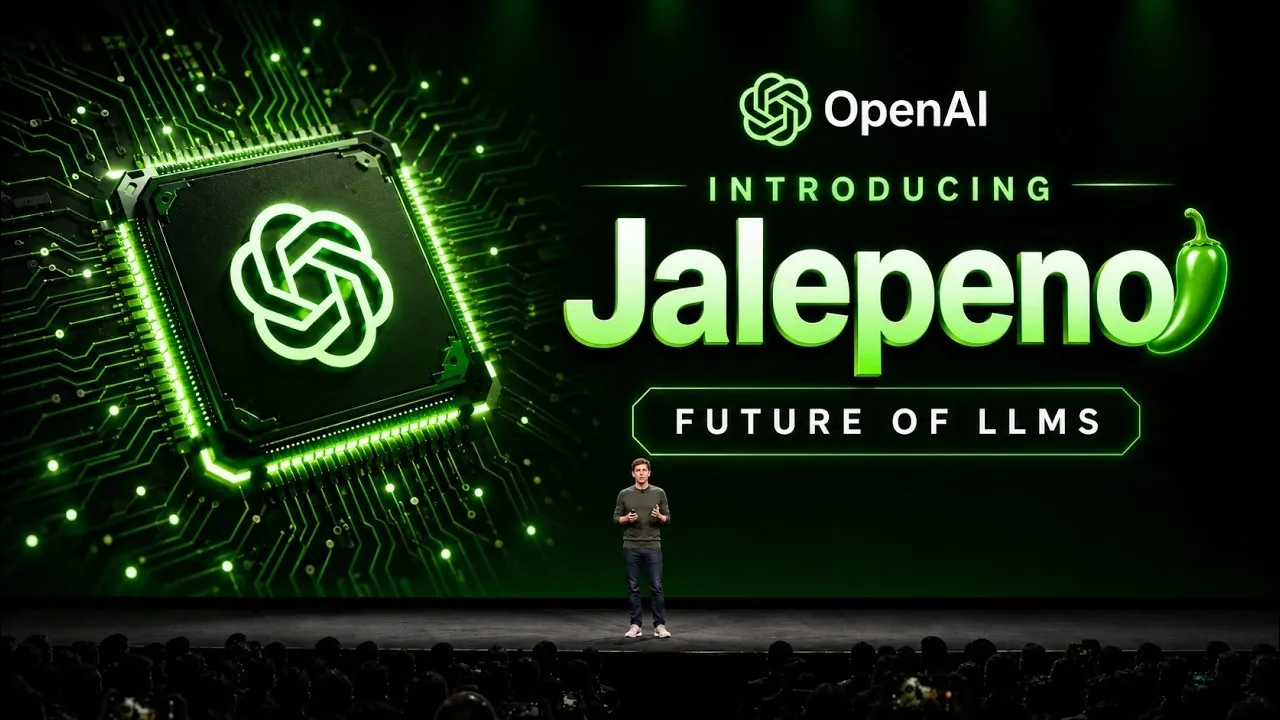
OpenAI’s new Jalapeño chip represents a significant step in the evolution of AI hardware, designed specifically to address the computational demands of large language models (LLMs). Developed in collaboration with Broadcom, this custom chip focuses on improving the efficiency and scalability of AI inference tasks, which are critical for generating outputs from input data. By reducing energy consumption and operational costs, Jalapeño aims to overcome the resource-intensive challenges of deploying LLMs. AI Grid explores how this hardware development aligns with OpenAI’s broader strategy of reducing reliance on external suppliers like Nvidia, offering a glimpse into the company’s vision for a fully integrated technology stack.
Gain insight into how Jalapeño’s architecture is tailored to optimize AI workflows, from its energy-efficient design to its potential for lowering costs by up to 50%. Discover the collaborative efforts behind its creation, including partnerships with Broadcom and TSMC and learn how OpenAI employed its own AI models to accelerate the chip’s development. This explainer also provide more insights into the strategic implications of Jalapeño, examining its role in shaping OpenAI’s gigawatt-scale infrastructure and the challenges that lie ahead in validating its performance claims.
Purpose and Design of Jalapeño
TL;DR Key Takeaways :
- OpenAI has introduced Jalapeño, its first custom AI chip, designed to improve efficiency, scalability and energy usage for large language models (LLMs), reducing reliance on external suppliers like Nvidia.
- Jalapeño is optimized for AI inference tasks, offering faster processing, lower operational costs and significant energy savings, addressing critical bottlenecks in AI deployment.
- The chip was developed in collaboration with Broadcom, TSMC and Celestica, showcasing the importance of industry partnerships in accelerating innovation and production.
- OpenAI utilized its own AI models to assist in Jalapeño’s design, demonstrating how AI can streamline hardware development and reduce costs and timelines.
- Jalapeño is part of OpenAI’s long-term strategy to build gigawatt-scale AI infrastructure, with deployment planned by 2026 and full-scale implementation by 2029, aiming for cost-effective and sustainable AI solutions.
Jalapeño is specifically engineered to address the computational demands of AI inference, the process where AI models generate outputs based on input data. This stage is particularly resource-intensive for LLMs, which require vast amounts of processing power to deliver results efficiently. Jalapeño is designed to overcome these challenges by making inference faster, more cost-effective and energy-efficient.
By aligning hardware with the specific requirements of its AI models, OpenAI aims to eliminate critical bottlenecks in AI deployment. This approach not only enhances performance but also reduces operational costs, allowing broader and more sustainable applications of AI technology.
The Strategic Motivation Behind Jalapeño
The development of Jalapeño stems from OpenAI’s need to address the limitations of relying on external chip suppliers. Current hardware solutions, such as those provided by Nvidia, are often expensive and subject to supply chain constraints, which can hinder scalability. By creating its own chip, OpenAI gains greater control over its supply chain and the ability to tailor hardware specifically to its workflows.
This move aligns with OpenAI’s broader strategy of achieving independence across its technology stack. By reducing reliance on third-party suppliers, OpenAI ensures long-term sustainability, cost efficiency and the ability to innovate without external limitations.

Here are more guides from our previous articles and guides related to OpenAI that you may find helpful.
- Leaked ChatGPT 5.5 Pro Tests Reveal OpenAI’s “Spud” Building Interactive 3D Worlds
- OpenAI to Launch ChatGPT 5.5 and a New Unified Desktop Super App
- Why OpenAI’s “Spud” Model is Outperforming Google Gemini 3.1
- Why OpenAI’s Upcoming “Spud” GPT-6 Model Could Be The Next Big Evolution in AI
- ChatGPT “Spud” : What We Know About OpenAI’s Next GPT AI Model Evolution
- OpenAI’s Powerful New ChatGPT 6 Model Code Named “Spud”
- OpenAI’s GPT-5.6 Release is Triggering an AI Price War
- Claude Opus 4.7 Leaks & Anthropic’s Full-Stack AI Studio
- GPT-5.6 Pro Leaks Expose a Massive Jump in AI Reasoning Power
- ChatGPT 5.6 vs Claude Mythos 5 : Leaks Reveal Two Very Different Futures for AI
Performance and Efficiency: Key Differentiators
Jalapeño is designed to deliver superior performance per watt, setting it apart from leading chips like Nvidia’s Blackwell and Google’s TPU. OpenAI has claimed that the chip achieves significant energy savings and faster processing speeds, which could lower costs and improve scalability for AI applications. Notably, the chip was developed in just nine months, a remarkably short timeline for such advanced hardware.
While these claims are promising, they have yet to undergo independent verification. As such, the true extent of Jalapeño’s capabilities remains to be seen and further scrutiny will be essential to validate its performance metrics.
Collaborative Development and Industry Partnerships
The creation of Jalapeño was made possible through collaboration with several industry leaders. OpenAI designed the chip’s architecture, while Broadcom contributed its expertise in silicon engineering and networking. Manufacturing and assembly are being handled by TSMC and Celestica, making sure a streamlined production process.
This collaborative approach highlights the importance of partnerships in achieving innovative advancements in AI hardware. By using the strengths of multiple organizations, OpenAI was able to accelerate the development of Jalapeño and ensure its readiness for deployment.
AI-Assisted Design: A Innovative Approach
In a notable innovation, OpenAI utilized its own AI models to assist in the design and optimization of Jalapeño. This approach demonstrates the potential of AI to streamline hardware development, reducing both costs and timelines. By using AI in this way, OpenAI not only improved the efficiency of the design process but also showcased the versatility of its technology in addressing complex engineering challenges.
This method could serve as a blueprint for future hardware development across the industry, illustrating how AI can be used to tackle traditionally time-consuming and resource-intensive tasks.
Strategic Implications for OpenAI
Jalapeño represents more than just a technological advancement, it signifies a strategic shift for OpenAI. By controlling its hardware, OpenAI can potentially reduce operational costs by up to 50%, making its AI services more scalable and sustainable. This aligns with the organization’s long-term vision of building gigawatt-scale AI infrastructure, capable of supporting the growing demand for AI applications.
Additionally, the development of Jalapeño reinforces OpenAI’s commitment to innovation and self-reliance. In an increasingly competitive industry, this move positions OpenAI as a leader in both AI software and hardware, setting the stage for future advancements.
Future Plans for Jalapeño
Jalapeño is the first in a planned series of custom chips. OpenAI intends to deploy initial servers powered by Jalapeño by late 2026, with full-scale implementation expected by 2029. These servers will form the foundation of OpenAI’s gigawatt-scale AI infrastructure, developed in collaboration with partners like Microsoft.
This infrastructure is designed to meet the growing demand for AI applications while making sure cost-effectiveness and sustainability. By investing in custom hardware, OpenAI is laying the groundwork for a future where AI technology is more accessible and efficient.
Challenges and Uncertainties
Despite its potential, Jalapeño faces several challenges. The high development costs associated with custom hardware underscore the need for cost-effective solutions to ensure long-term viability. Additionally, OpenAI’s performance claims for Jalapeño have yet to be independently verified, raising questions about the chip’s actual capabilities.
Addressing these uncertainties will be critical for OpenAI to fully realize the benefits of its custom hardware. Independent testing and continued innovation will play a key role in determining the success of Jalapeño and its impact on the AI industry.
A Fantastic Step for AI Hardware
Jalapeño marks a significant milestone in the evolution of AI hardware. By addressing key challenges in performance, efficiency and scalability, the chip has the potential to reshape how LLMs are deployed and utilized. While hurdles remain, Jalapeño represents a bold step toward a future where AI infrastructure is more efficient, cost-effective and sustainable.
As OpenAI continues to innovate, Jalapeño could set a new standard for custom AI hardware, influencing the trajectory of the industry for years to come.
Media Credit: TheAIGRID
Disclosure: Some of our articles include affiliate links. If you buy something through one of these links, Geeky Gadgets may earn an affiliate commission. Learn about our Disclosure Policy.
