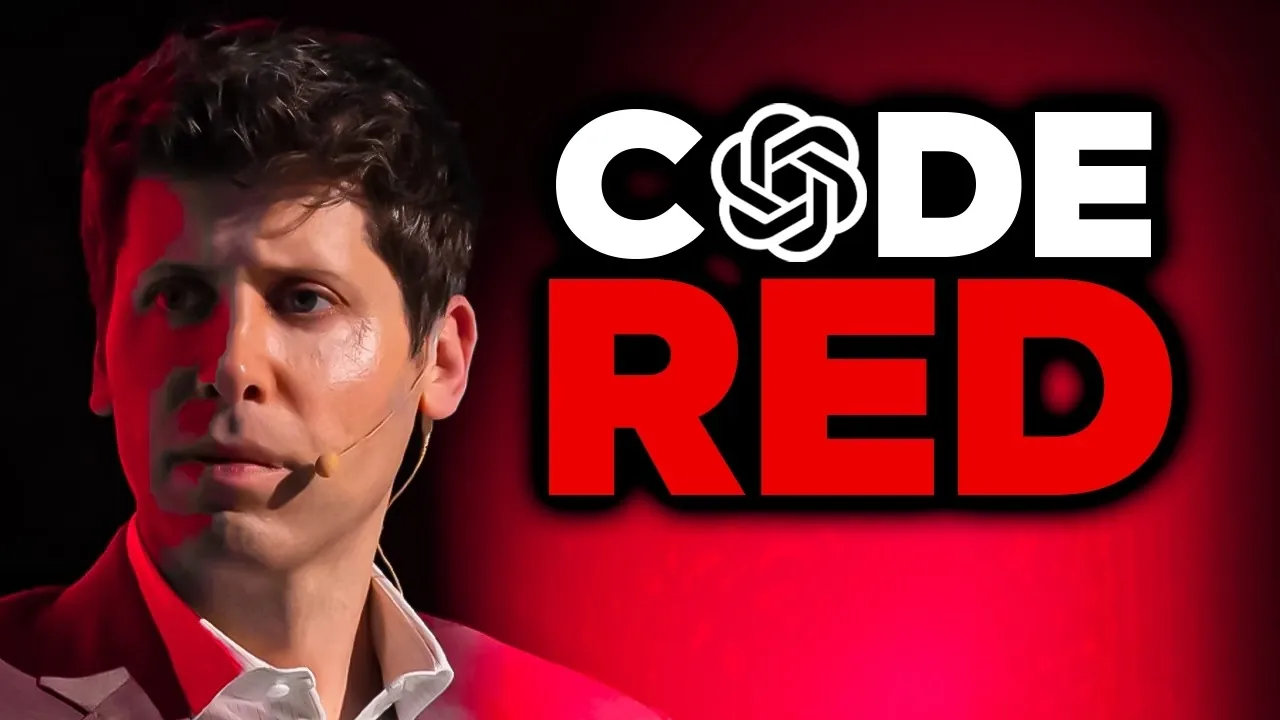
What happens when the leader of one of the world’s most influential AI companies declares a “code red”? For Sam Altman, CEO of OpenAI, this isn’t just a dramatic turn of phrase, it’s a battle cry in the escalating war for AI dominance. With Google’s Gemini 3 model setting new benchmarks in speed, accuracy, and scalability, OpenAI finds itself at a critical crossroads. The stakes couldn’t be higher: the future of artificial intelligence is being shaped in real time, and the competition is no longer about who can build the largest models, but who can deliver the most innovative, personalized, and efficient solutions. Altman’s bold declaration signals a pivotal moment, not just for OpenAI, but for the entire AI industry.
In this report, Matthew Berman explains the high-stakes rivalry between OpenAI and Google, exploring how Altman’s “code red” strategy is reshaping OpenAI’s priorities. From the development of a new model codenamed “Garlic” to the company’s decision to pause non-essential projects, OpenAI is doubling down on its mission to outpace Google’s Gemini 3. But this isn’t just a story of corporate competition, it’s a window into the rapidly evolving landscape of artificial intelligence. As these tech giants push the boundaries of what’s possible, the ripple effects will transform how we interact with AI in our daily lives. The question is no longer who will win, but how this race will redefine the future of technology.
OpenAI vs Google AI
TL;DR Key Takeaways :
- Google’s Gemini 3 model, powered by advanced TPU infrastructure, has set new benchmarks in speed, accuracy, and user experience, significantly outperforming OpenAI’s ChatGPT.
- OpenAI has declared a “code red” and is focusing on improving ChatGPT and developing a new model, codenamed “Garlic,” to counter Google’s advancements.
- The AI industry is shifting from merely scaling large language models to prioritizing innovative algorithms, pre-training techniques, and personalized user experiences.
- Google’s active user base has grown from 450 million to 650 million in a year, while OpenAI approaches 1 billion users but faces slowing growth due to intensifying competition.
- The rivalry between OpenAI and Google is driving rapid innovation, resulting in more powerful, reliable, and personalized AI tools that benefit consumers globally.
Google’s AI Breakthroughs
Google has made remarkable progress with the release of Gemini 3, a large language model that has set new standards in speed, accuracy, and user experience. This model represents a significant leap forward, outperforming OpenAI’s ChatGPT in key areas. A cornerstone of Gemini 3’s success is Google’s TPU infrastructure, which offers unparalleled computational efficiency and scalability. By using this advanced technology, Google has been able to deliver faster and more reliable AI services to its users.
The impact of these advancements is evident in Google’s user growth. Over the past year, the company’s active user base has surged from 450 million to 650 million, a testament to the widespread appeal of its AI tools. Google’s extensive resources and robust infrastructure have solidified its position as a dominant player in the AI market, allowing it to invest heavily in innovation and maintain a competitive edge.
OpenAI’s Strategic Shift
In the face of Google’s rapid progress, OpenAI has initiated a strategic realignment to address the growing competition. Sam Altman’s “code red” declaration reflects the urgency of this moment, as the company seeks to enhance its offerings and regain its competitive footing. OpenAI has temporarily paused initiatives such as ads and shopping integrations to concentrate on improving ChatGPT’s performance, reliability, and personalization.
At the heart of OpenAI’s strategy is the development of a new model, codenamed “Garlic.” This model is being designed to counter the capabilities of Google’s Gemini 3, with a focus on delivering superior speed and accuracy. Additionally, OpenAI is investing in advanced pre-training techniques and algorithmic innovations to push the boundaries of what its AI models can achieve. These efforts underscore the company’s commitment to staying at the forefront of the AI industry, even as the competitive landscape becomes increasingly crowded.
Sam Altman Goes Code Red

Below are more guides on OpenAI from our extensive range of articles.
- OpenAI o3 and o3-mini Introduced
- OpenAI Reveals How To Use GPT-4o More Effectively
- OpenAI Agent Builder: 8 AI Agent Use Cases with RAG & Widgets
- OpenAI Responses API: A Guide to Automating RAG Systems
- What Is OpenAI’s Index-Free RAG System and How Does It Work
- OpenAI Is Watching : The Quiet Risk Lurking Inside Your API Logs
- OpenAI Q Strawberry AI model everything we know so far
- New ChatGPT Memory feature now available to use
- How OpenAI Codex Transforms Natural Language into Code
- How to use OpenAI Assistants API
Challenges in Scaling AI
The AI industry is grappling with the limitations of scaling large language models, as researchers recognize that simply increasing model size is no longer sufficient to meet evolving user demands. Both OpenAI and Google are now exploring alternative approaches, including new algorithms and pre-training methods, to address these challenges and deliver more efficient AI solutions.
For OpenAI, this shift involves significant investments in research and development to overcome the diminishing returns associated with larger models. The company is also exploring ways to optimize its infrastructure and streamline the delivery of high-quality AI services. These efforts are essential for maintaining relevance in a market that is evolving at an unprecedented pace.
Shifting Market Dynamics
The competitive dynamics of the AI market are undergoing a transformation. While OpenAI approaches the milestone of 1 billion active users, its growth rate has begun to slow, reflecting the intensifying competition from Google and other emerging players. Google’s diversified revenue streams and robust infrastructure provide it with a strategic advantage, allowing substantial investments in AI research and development.
Despite these challenges, OpenAI remains a formidable competitor. Its established user base and the widespread familiarity of ChatGPT offer a strong foundation for sustaining its market position. The rivalry between OpenAI and Google is reshaping the AI industry, driving innovation and creating new opportunities for the development of consumer-focused AI tools.
What This Means for Consumers
For consumers, the competition between OpenAI and Google is a significant advantage. Both companies are striving to deliver faster, more reliable, and highly personalized AI solutions, resulting in a steady stream of advancements that enhance user experiences. Google’s Gemini 3 has set a new benchmark for performance, but ChatGPT continues to hold its ground due to its broad adoption and user-friendly interface.
This competitive environment is accelerating the pace of innovation in AI technology. As a result, consumers can expect more powerful and accessible tools that cater to their specific needs. Whether it’s through improved conversational AI, enhanced productivity features, or new applications, the benefits of this rivalry are already shaping the way you interact with technology in your daily life.
Media Credit: Matthew Berman
Disclosure: Some of our articles include affiliate links. If you buy something through one of these links, Geeky Gadgets may earn an affiliate commission. Learn about our Disclosure Policy.
