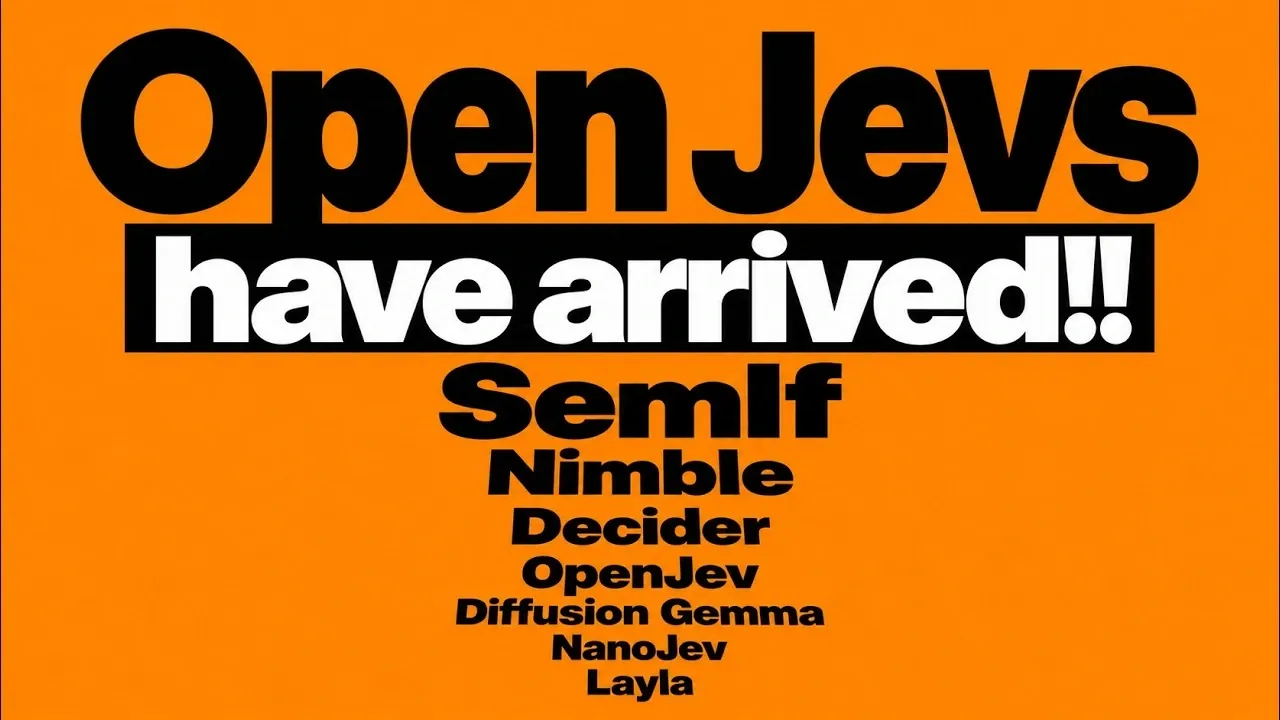
Open Jev models are making waves in AI classification, offering accessible alternatives to the widely respected Jev model. Known for its ability to generalize across datasets with minimal training, Jev has become a cornerstone for efficient and accurate classification tasks. Sam Witteveen explores how open source implementations, such as SEM and Nimble, are expanding on this foundation by introducing unique trade-offs in speed, cost and specialization. For instance, SEM prioritizes quick deployment, while Nimble excels in domain-specific tasks, showcasing the diversity of approaches within the open source community.
Dive into this guide to understand how these models can be applied to real-world scenarios. You’ll gain insight into the strengths and limitations of key open models, from SEM’s simplicity to diffusion-based approaches like Gemma, which thrive in high-concurrency environments. Discover how to align model selection with your operational needs, whether you’re optimizing for speed, precision, or scalability. This breakdown provides a practical lens for navigating the evolving landscape of AI classification.
What is the Jev Model?
TL;DR Key Takeaways :
- The Jev model is a universal classifier known for its ability to generalize across datasets, delivering fast and accurate results with minimal training, making it a cornerstone in AI classification tasks.
- The rise of open source alternatives, inspired by Jev, has led to over 20 implementations like SEM, Nimble, Decider, NanoJV, Lelaya and diffusion-based models, each offering unique trade-offs in speed, cost and accuracy.
- Open source models cater to specific needs, such as SEM for quick deployment, Nimble for domain-specific tasks and diffusion-based models like Gemma for high-concurrency environments.
- Key trade-offs in open source models include speed versus depth, concurrency demands and specialization versus generalization, requiring careful selection based on organizational needs.
- Future advancements in open AI models are expected to focus on enhanced reasoning capabilities, scalability and applicability to complex tasks, further expanding their role in diverse industries.
The Jev model is a universal classifier designed to handle a wide range of tasks with minimal setup. Its defining characteristic is its ability to generalize across datasets, making it a cornerstone for AI classification. Jev excels in delivering precise and rapid classifications, particularly in scenarios requiring straightforward decision-making. Its scalability and efficiency make it a valuable asset across industries such as technology, healthcare and finance. Moreover, its minimal need for fine-tuning allows organizations to streamline their AI operations, reducing both time and resource investments.
The Rise of Open source Implementations
The widespread adoption of the Jev model has catalyzed the development of open source alternatives. Within months of its release, over 20 to 30 projects emerged, each aiming to replicate or enhance Jev’s capabilities. These models are rigorously evaluated using the Jevbench framework, which assesses intelligence, calibration, speed and cost. Notable implementations include SEM, Nimble, Decider, NanoJV, Lelaya and diffusion-based approaches. Each model introduces distinct features and performance metrics, catering to specific operational needs and expanding the versatility of AI classification tools.

Gain further expertise in AI models by checking out these recommendations.
- Why Ilya Sutskever’s 2026 SSI Model Challenges Traditional AI
- Kimi K3 a 2.8 Trillion Parameter Open Source ChatGPT 5.6 and Fable 5 Rival
- Which Claude 3 AI model is best? All three compared and tested
- Alibaba Qwen 3.8 Runs Advanced AI Locally on 13.5GB RAM
- OpenAI Plans to Release Astra AGI System by the End Of 2026
- China May Lock Down Open-Source AI Models: Qwen, GLM 5.2 & DeepSeek?
- Kimi K3 Open Source AI Rivals GPT 5.6 Sol with 2.8T Parameters
- OpenAI Bans Cursor Access Over Alleged SpaceX Data Misuse
- New Moonshot Kimi K3 AI Challenges Fable 5 and ChatGPT 5.6
- Google Preps Gemini 4 Pro Content Creation for October 2026
Key Open Models and Their Features
Several open source models have gained prominence for their innovative approaches to classification tasks. Below is an overview of some of the most notable models:
- SEM (OpenJV): A logits-based classifier that is simple and effective, making it ideal for quick deployment in various environments.
- Nimble: Utilizes contrastive data curation for training, excelling in domain-specific tasks that require a narrow focus.
- Decider: A lightweight model featuring a 32k context window, optimized for speed and compatibility with Jev’s API format.
- Diffusion Gemma: Uses diffusion techniques for rapid decision-making, making it suitable for high-concurrency environments.
- NanoJV: A compact 600M-parameter model designed for lightweight applications such as gaming and simple tasks.
- Lelaya: A multilingual BERT-based model that excels in language-specific tasks, though it lacks the generalization capabilities of Jev.
These models demonstrate the diversity of approaches within the open source community, each addressing specific challenges while contributing to the broader AI ecosystem.
Strengths and Trade-Offs
While open source models have made significant strides, they often involve trade-offs that organizations must consider when selecting the right tool for their needs. Key trade-offs include:
- Speed vs. Depth: Models like SEM and Decider prioritize speed, making them ideal for simple, time-sensitive tasks, but they may lack the depth required for complex, multi-step reasoning.
- Concurrency: Diffusion-based models such as Gemma excel in high-concurrency environments, but their computational demands can be higher.
- Specialization: Nimble and Lelaya are tailored for specific domains or languages, offering precision at the expense of generalization across diverse datasets.
Despite these limitations, the Jev model remains the gold standard for generalization and confidence, particularly in scenarios requiring robust reasoning and adaptability.
Applications: Choosing the Right Model
The variety of open source models enables organizations to select tools that align with their specific requirements. Below are some practical recommendations for choosing the right model:
- Quick Deployment: SEM is a dependable choice for tasks that require minimal setup and training, offering simplicity and efficiency.
- Domain-Specific Tasks: Nimble is well-suited for policy decisions or applications involving custom data requirements.
- High-Speed Environments: Decider and diffusion-based models like Gemma are ideal for high-concurrency tasks, where rapid decision-making is critical.
- Cascade Modeling: For complex workflows, consider combining lightweight models for simple tasks with reasoning models for more intricate challenges.
By strategically integrating these models into your workflows, you can optimize performance and address a wide range of classification needs.
Future Directions in Open AI Models
The rapid development of open source alternatives to Jev signals a promising trajectory for AI classification technologies. Researchers and developers are likely to focus on enhancing reasoning capabilities and expanding the applicability of these models to more complex tasks. Larger models, such as mini CPM 52B, may also contribute to advancing the field by offering greater depth and scalability. As these technologies evolve, they are expected to unlock new possibilities for efficient and scalable AI solutions, further solidifying their role in modern workflows.
The emergence of open Jev models underscores the growing importance of accessible, versatile AI tools. By using these innovations, organizations can enhance their decision-making processes, improve efficiency and address challenges across a wide array of industries.
Media Credit: Sam Witteveen
Disclosure: Some of our articles include affiliate links. If you buy something through one of these links, Geeky Gadgets may earn an affiliate commission. Learn about our Disclosure Policy.
