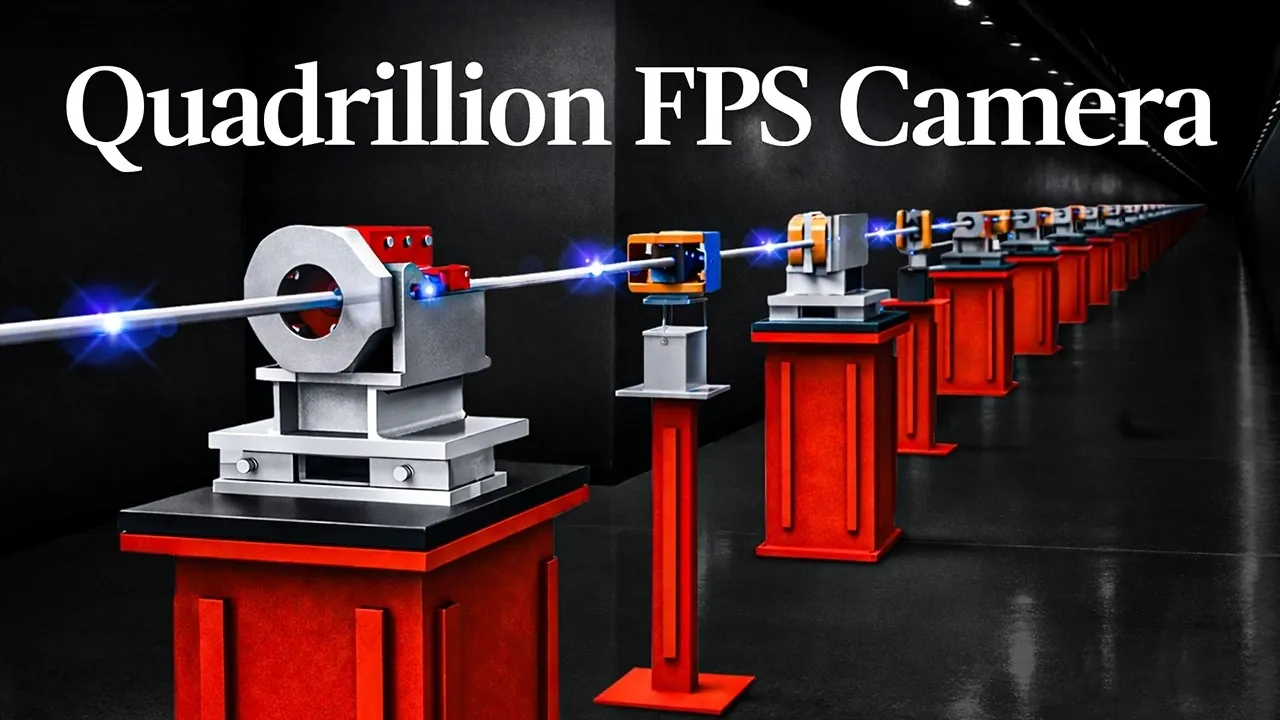
What if you could slow down time so much that the invisible became visible? Veritasium takes a closer look at how advancements in high-speed imaging have unlocked a hidden world, revealing phenomena that occur in mere fractions of a second. Imagine watching a bullet pierce an apple, not as a blur, but as a series of intricate, mesmerizing moments. Or witnessing light itself ripple through space, captured frame by frame. These aren’t just feats of technology, they’re windows into the extraordinary, reshaping how we understand motion, light, and even the dynamics of molecules. The ability to slow down video footage indefinitely has not only transformed science but also challenged the limits of what we thought was possible.
In this overview, we’ll explore the fascinating evolution of high-speed imaging, from Harold Edgerton’s iconic strobe photographs to today’s trillion-frame-per-second cameras. Along the way, you’ll uncover how this technology bridges the gap between art and science, offering both practical applications and breathtaking visuals. But it’s not without its challenges, balancing clarity and speed requires ingenious solutions, and the sheer volume of data produced is staggering. So, what can slowing down time teach us about the world we live in? The answers might surprise you, and they’re as much about beauty as they are about discovery.
The Evolution of High-Speed Imaging
TL;DR Key Takeaways :
- High-speed imaging began with Harold Edgerton’s invention of strobe photography, which captured motion with extraordinary clarity and had both artistic and practical applications, such as in wartime reconnaissance and industrial diagnostics.
- Modern high-speed cameras can capture millions to trillions of frames per second, allowing the study of phenomena like shockwaves, chemical reactions, and light propagation, though they face challenges in balancing temporal and spatial resolution.
- Advanced techniques in high-speed imaging allow researchers to capture light in motion and study molecular dynamics, offering new insights into optics, material science, and chemical reactions at femtosecond timescales.
- Challenges in high-speed imaging include managing the trade-off between resolution and frame rate, as well as handling the vast data volumes generated, requiring sophisticated computational tools for analysis.
- High-speed imaging bridges art and science, inspiring creativity while revealing the hidden beauty of the natural world, as seen in Harold Edgerton’s iconic work and modern visualizations of phenomena like water droplets and light waves.
The Origins: Harold Edgerton and Strobe Photography
The story of high-speed imaging begins with Harold Edgerton, a pioneer who transformed photography through the invention of the strobe light. By producing brief, intense flashes of light, strobe photography allowed motion to be captured with extraordinary clarity. Edgerton’s iconic images, such as a bullet piercing an apple or a drop of milk forming a crown, unveiled events that occur too quickly for the human eye to perceive. These photographs not only amazed audiences but also demonstrated the potential of technology to reveal hidden dimensions of the physical world.
Beyond their artistic allure, Edgerton’s innovations had practical applications. During World War II, strobe technology was employed for nighttime aerial reconnaissance, allowing clearer imaging in low-light conditions. In industrial settings, it became a diagnostic tool for analyzing machinery in motion, helping to identify inefficiencies and potential failures. Edgerton’s work laid the foundation for modern high-speed imaging, bridging the gap between art and science and proving that technology could serve both practical and creative purposes.
Modern High-Speed Cameras: Breaking Barriers
Today’s high-speed cameras have taken Edgerton’s legacy to unprecedented heights. These advanced devices can capture millions or even trillions of frames per second, allowing the observation of phenomena such as shockwaves, chemical reactions, and even the propagation of light itself. This capability has opened new frontiers in science, allowing researchers to study events that occur on timescales previously thought to be inaccessible.
However, achieving such extreme temporal resolution presents significant challenges. One of the primary issues is the trade-off between temporal and spatial resolution. Capturing more frames per second often reduces the level of detail in each individual frame, making it difficult to maintain image clarity. To address this, researchers have developed innovative solutions such as single-pixel cameras, which reconstruct images from minimal data. These systems allow scientists to visualize events at extraordinary speeds without sacrificing too much detail, pushing the boundaries of what is possible in high-speed imaging.
Ultra High-Speed Photography Explained

Gain further expertise in cameras by checking out these recommendations.
- How to Maximize Your Samsung Galaxy S25 Ultra Camera Settings
- Raspberry Pi 4 13MP 4K MIPI camera devkit $99
- Samsung Galaxy Z Fold 8: Full Specs, Camera Details & Display
- Caply Action Camera Returns To Kickstarter
- Hover Camera X1 compact camera drone
- Teslong TTS300 infrared thermal camera
- iPhone 17 vs. iPhone 17 Pro Camera Comparison
- How to Use iOS 26 Camera Features to Take Better Photos
- Caira AI iPhone Camera Launches on Kickstarter
Capturing Light and Molecular Dynamics
One of the most remarkable achievements in high-speed imaging is the ability to capture light in motion. Using advanced techniques such as laser pulses and ultra-fast cameras, researchers have created videos that depict light waves traveling through space. This capability has profound implications for fields like optics and material science, where understanding the behavior of light is essential for developing new technologies.
At an even smaller scale, high-speed imaging has enabled scientists to study molecular dynamics in unprecedented detail. By using X-ray pulses and other advanced methods, researchers can track changes in electron density within molecules, effectively creating molecular “movies.” These visualizations reveal how atoms and electrons interact during chemical reactions, offering insights into processes that occur in femtoseconds, quadrillionths of a second. Such discoveries are invaluable for fields like drug development, where understanding molecular interactions can lead to the creation of more effective treatments.
Scientific and Technological Challenges
While high-speed imaging has unlocked new realms of understanding, it also comes with significant challenges. One of the most pressing issues is balancing temporal and spatial resolution. Capturing more frames per second often requires compromises in image detail, forcing researchers to carefully design experiments to ensure meaningful results. This trade-off is particularly critical in fields like molecular imaging, where even slight variations in experimental conditions can lead to inconsistent data.
Another challenge lies in the sheer volume of data generated by high-speed cameras. Recording millions or trillions of frames per second produces vast amounts of information, requiring advanced computational tools for storage, processing, and analysis. Despite these hurdles, the potential applications of high-speed imaging are vast and varied. From studying combustion engines to analyzing biological processes, this technology offers insights that could lead to more efficient systems, improved medical treatments, and a deeper understanding of the natural world.
The Fusion of Art and Science
High-speed imaging is not only a scientific tool but also a source of artistic inspiration. Harold Edgerton’s new work, featured in publications like Life and National Geographic, demonstrated the beauty of phenomena that are invisible to the naked eye. His images blurred the line between art and science, inspiring generations of photographers and researchers to explore the hidden intricacies of the world.
This fusion of art and science continues to thrive in the modern era. High-speed videos of water droplets, explosions, and even light waves captivate audiences, showcasing the aesthetic appeal of scientific discovery. These visualizations remind us that science is not only a means of understanding the world but also a way to appreciate its inherent beauty. By revealing the unseen, high-speed imaging bridges the gap between technology, creativity, and human curiosity, offering a unique perspective on the forces that shape our reality.
Media Credit: Veritasium
Disclosure: Some of our articles include affiliate links. If you buy something through one of these links, Geeky Gadgets may earn an affiliate commission. Learn about our Disclosure Policy.
