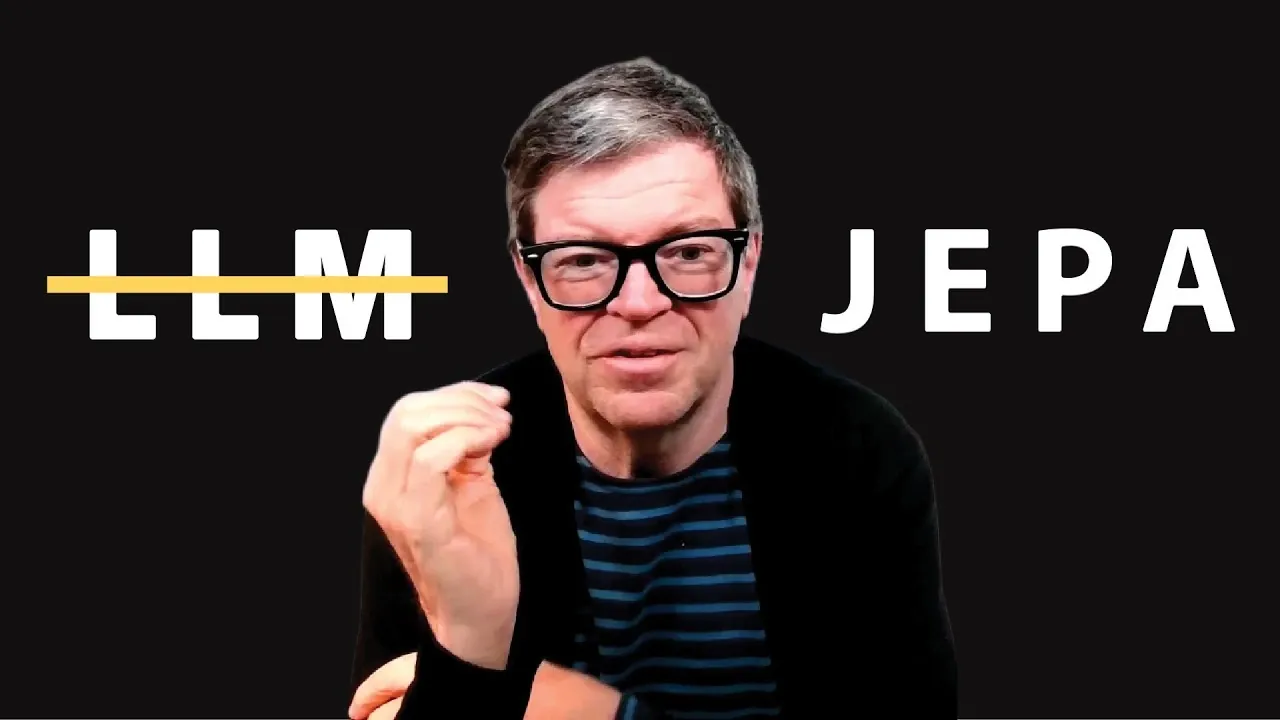
Yann LeCun, a prominent figure in artificial intelligence, has proposed a bold alternative to the dominance of large language models (LLMs) with his Joint Embedding Predictive Architecture (JEPA). Unlike generative models that focus on recreating data, JEPA emphasizes understanding and predicting the world through internal representations, offering a more efficient and precise approach. Welch Labs explores how JEPA’s predictive focus, such as modeling key features rather than generating exhaustive outputs, could make it particularly effective for applications like robotics and autonomous systems, where real-time decision-making is critical.
In this explainer, you’ll gain insight into the core principles of JEPA and how it addresses limitations of generative models, such as representation collapse and blurry predictions. Discover how techniques like contrastive learning and Barlow Twins enhance JEPA’s ability to learn robust representations and examine its potential role in predictive AI tasks like world modeling. This breakdown provides a clear view of why JEPA could reshape AI’s future in domains where precision and efficiency are paramount.
What is the JEPA Framework?
TL;DR Key Takeaways :
- Yann LeCun introduced the Joint Embedding Predictive Architecture (JEPA), a framework that emphasizes predictive capabilities over generative outputs, offering a new approach to AI systems.
- JEPA uses joint embedding architectures to encode inputs and outputs into meaningful representations, focusing on predicting critical features rather than recreating data at a granular level.
- JEPA addresses limitations of generative models, such as representation collapse and blurry predictions, making it more efficient and precise for real-time applications like robotics and autonomous systems.
- By integrating techniques like contrastive learning and Barlow Twins, JEPA enhances self-supervised learning, allowing robust and diverse data representations without relying on labeled datasets.
- JEPA’s predictive modeling, combined with world models, positions it as a fantastic tool for applications requiring an understanding of physical outcomes, potentially surpassing large language models in specific domains.
This article provide more insights into the core principles of JEPA, its advantages over traditional generative models and its potential to transform AI applications in fields such as robotics, autonomous systems and real-time decision-making.
At the heart of JEPA lies a distinctive approach to learning: joint embedding architectures. These architectures encode both inputs and outputs into embeddings, compact, meaningful representations of data, and connect them through a predictive model. Unlike generative models, which aim to recreate data at a granular level (e.g., pixel-by-pixel or token-by-token), JEPA focuses on identifying and predicting the most critical features of the data.
This streamlined approach offers significant advantages in terms of computational efficiency and precision. For example, instead of generating an entire video frame-by-frame, JEPA predicts the key features that define the next state of a system. This makes it particularly well-suited for applications requiring speed and accuracy, such as robotics, autonomous vehicles and other real-time systems. By prioritizing essential data over exhaustive generation, JEPA demonstrates a practical and efficient alternative to traditional AI methodologies.
Why Generative Models Fall Short
Generative models, while powerful and widely used, face several inherent challenges that limit their effectiveness in certain applications. These challenges include:
- Representation Collapse: Generative models often struggle to maintain meaningful distinctions between data points, leading to embeddings that fail to generalize effectively. This reduces their ability to learn robust patterns.
- Blurry Predictions: When faced with uncertainty, generative models frequently produce vague or averaged outputs, particularly in video generation tasks. This occurs because they attempt to account for multiple possible outcomes simultaneously, resulting in less precise predictions.
JEPA addresses these limitations by focusing on predictive tasks rather than generative ones. By mapping relationships between embeddings, JEPA avoids the pitfalls of pixel-level or token-level generation and instead captures the underlying structure of the data. This approach ensures more accurate and meaningful predictions, even in complex and dynamic scenarios. As a result, JEPA is better equipped to handle tasks requiring precision, such as predicting physical outcomes in robotics or real-world simulations.

Check out more relevant guides from our extensive collection on Yann LeCun that you might find useful.
- Yann LeCun is Spending $1 Billion to Replace LLMs with JEPA
- The AGI Debate That’s Currently Dividing Google & Meta
How Contrastive Learning and Barlow Twins Fit In
To overcome the problem of representation collapse, contrastive learning has emerged as a powerful technique. This method trains models to differentiate between positive and negative pairs of data, making sure that embeddings remain diverse and meaningful. For example, a contrastive learning model might associate different views of the same object while distinguishing them from unrelated objects, thereby enhancing its ability to generalize.
Building on this foundation, Barlow Twins, a self-supervised learning approach inspired by neuroscience, takes the concept further. It minimizes redundancy between the outputs of neurons, making sure that each contributes unique information to the learning process. This innovation has significantly improved the efficiency of self-supervised learning, particularly in computer vision tasks. By integrating these techniques, JEPA enhances its ability to learn robust and diverse representations, making it a versatile tool for a wide range of AI applications.
Self-Supervised Learning: Transforming Vision Tasks
Recent advancements in self-supervised learning have dramatically improved the performance of AI models in computer vision. Techniques like Barlow Twins and DINO (Distillation with No Labels) have achieved near state-of-the-art results without relying on human-labeled data. These models learn by identifying patterns and relationships within the data itself, making them highly scalable and adaptable.
For instance, a self-supervised vision model might recognize objects in images by analyzing shapes, textures and contexts, rather than relying on pre-labeled datasets. This aligns closely with JEPA’s philosophy of learning representations that capture the essence of the data, rather than attempting to recreate it. By using self-supervised learning, JEPA demonstrates its potential to excel in tasks requiring minimal human intervention, reducing the reliance on costly and time-consuming data annotation processes.
World Models and Predictive AI
A defining feature of JEPA is its integration with world models, systems designed to predict the consequences of actions based on current observations. This capability is particularly critical for applications like robotics, where understanding and anticipating future states is essential for effective planning and control.
For example, a robot equipped with a JEPA-based system could predict how its environment will change in response to its actions, allowing it to navigate complex tasks with greater autonomy. Unlike LLMs, which excel in language-based tasks, JEPA’s predictive modeling is better suited for domains requiring an understanding of physical outcomes. This distinction underscores the complementary strengths of the two approaches and highlights the importance of diversifying AI frameworks to address a broader range of challenges.
Historical Context and Future Prospects
Yann LeCun’s contributions to AI are extensive, from his pioneering work on convolutional neural networks (CNNs) to his advocacy for self-supervised learning. JEPA builds on this legacy by emphasizing the importance of learning representations with minimal reliance on labeled data. This approach not only reduces the need for costly data annotation but also enables AI systems to learn more flexibly and efficiently.
Looking ahead, JEPA’s potential applications span a wide range of fields. Future iterations, such as V-JEPA-2 for robotics and VL-JEPA for vision-language tasks, aim to expand its capabilities and demonstrate its superiority in specific domains. These advancements could position JEPA as a leading framework for predictive AI, particularly in areas where generative models fall short. By focusing on predictive accuracy and computational efficiency, JEPA has the potential to redefine the landscape of AI research and applications.
Stay tuned for Part 2, where we will explore JEPA’s real-world implementations and its potential to outpace LLMs in specific domains.
Media Credit: Welch Labs
Disclosure: Some of our articles include affiliate links. If you buy something through one of these links, Geeky Gadgets may earn an affiliate commission. Learn about our Disclosure Policy.
