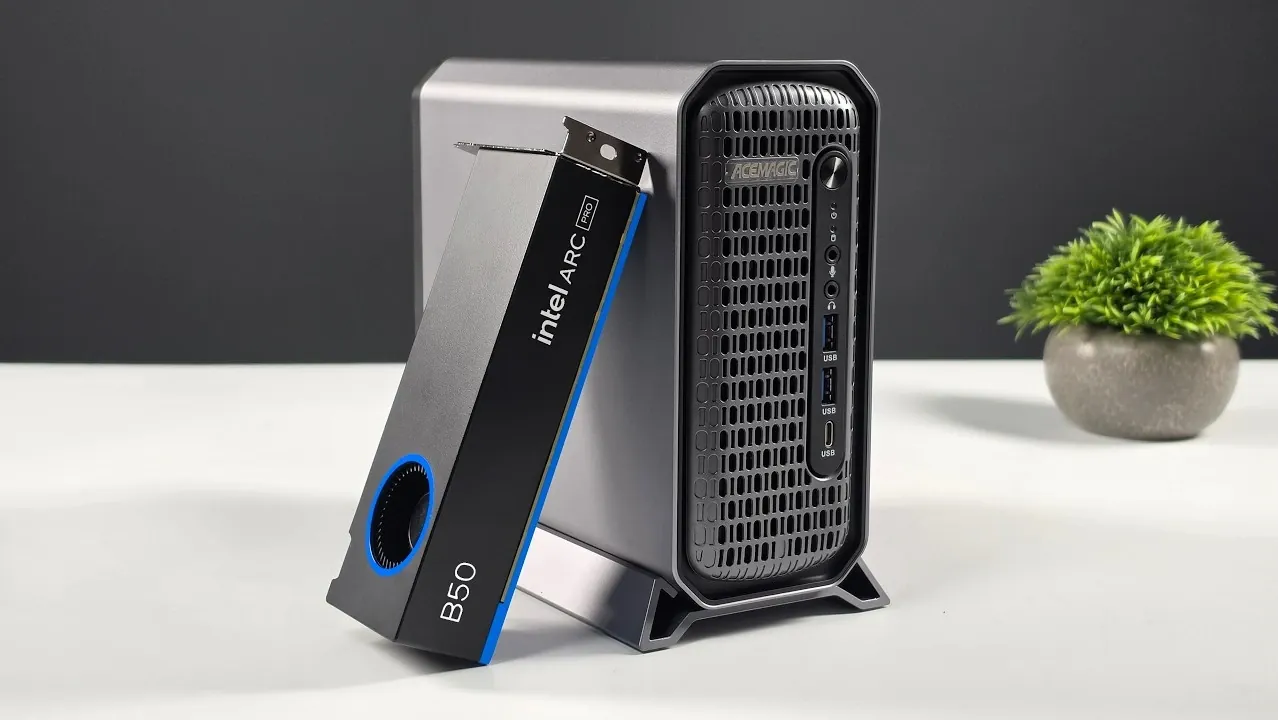
The Ace Magic G3 A pairs a 24-core processor with room for a low-profile graphics card. Replacing its NVIDIA RTX 2000 with an Intel Arc B50 produced mixed results: the NVIDIA card led most benchmarks, while the Intel card ran several games at 1440p high settings. Those results come from a hands-on comparison by ETA Prime.
This breakdown covers the single-screw GPU swap and the PCIe 4.0 connection, so you can see what fitting the card involves. It also compares AI and game results, including the Llama 3.1 and Red Dead Redemption 2 runs. Finally, it explains what the $359 bare-bones price excludes when planning a build.
TL;DR Key Takeaways :
- The G3 A has a 24-core processor and is available with an NVIDIA RTX GPU or as a $359 bare-bones system without a GPU, RAM or storage.
- The GPU can be swapped using a single screw, clip system and riser card. The Arc B50 supports PCIe 5.0 x8, while the G3 A provides PCIe 4.0 x8; the expected cost is only a couple of frames here and there.
- The RTX 2000 led the B50 by about 12% overall in Geekbench AI and scored 9,033 versus 8,765 in Time Spy. The B50 won in Llama 3.1, reaching 45.2 tokens per second versus around 36.8 for the RTX 2000.
- At 1440p high, Forza Horizon 6 averaged around 78 FPS on the RTX 2000 and around 73 FPS on the B50. In Red Dead Redemption 2, the B50 averaged in the mid-70s without FSR, while the RTX 2000 averaged around 66 FPS with DLSS quality.
- ETA Prime says the B50 works well in the G3 A, particularly for someone who already has the card, RAM and an extra M.2 drive. His tests favor keeping the RTX 2000 if already owned; he expects the more expensive RTX 4000 configuration to outperform both, though he did not test it.
Pricing and the GPU Swap
The G3 A is available with an RTX GPU or as a $359 bare-bones system without a GPU, RAM or storage. Its main specifications and configurations include:
- CPU: 24-core processor.
- NVIDIA RTX 2000: Ada-based workstation GPU with 16 GB of VRAM.
- Intel Arc B50: Low-profile, dual-slot GPU with 16 GB of VRAM.
- NVIDIA RTX 4000: Also offered as a G3 A configuration.
The RTX 2000 and Arc B50 use different architectures but share the same workstation form factor. The GPU assembly can be removed using a single screw and a clip system, with the replacement connected through a riser card. The creator calls the B50 his current favorite low-profile, dual-slot card and finds the G3 A’s mounting arrangement neat.
The machine is somewhat limited by its TDP given the CPU inside. Windows settings showed Resizable BAR and 4G decoding were already active, so the swap is expected to avoid problems associated with those settings.
The B50 supports an X8 PCIe 5.0 slot, while the G3 A supplies an X8 PCIe 4.0 slot. The expected cost is only a couple of frames here and there, because the card’s 16 GB of VRAM reduces the need to swap data back and forth.
AI and Graphics Benchmarks
In Geekbench AI, the RTX 2000 led the Arc Pro B50 by about 12% overall and about 10% in half precision. Its largest lead came in quantized testing, where it delivered a 31% uplift over the Intel card.
The language-model results were split. GPT OSS 20 billion ran at around 70 tokens per second on the RTX 2000 and around 44 on the B50. In Llama 3.1, the B50 reached 45.2 tokens per second, compared with around 36.8 for the NVIDIA card.
Both cards generated the same image. Their image-generation performance is expected to be fairly even if each runs it a few times. In Time Spy, the RTX 2000 scored 9,033 overall and 8,395 for graphics; the B50 scored 8,765 and 8,036 respectively.
Under GPU load, both cards drew around 68 to 70 watts, depending on the workload. The NVIDIA card came ahead overall across the benchmarks, with Llama 3.1 providing the B50’s win.

Here is a selection of related articles from our archive.
- Intel Arc Pro B50 16GB Low-Profile Review : A SFF Gaming Secret Weapon?
- Minisforum MS02 Packs Core Ultra 285HX & Intel Arc Pro B50 in a Tiny Form Factor
- Intel’s $349 GPU is Here to Crush NVIDIA and AMD : Budget-Friendly Powerhouse
- NVIDIA RTX 2000 Rivals RTX 4060 in Minisforum MS-A2 PC
Gaming at 1440p
At 1440p high, Forza Horizon 6 averaged around 78 FPS on the RTX 2000 and around 73 FPS on the B50, without DLSS or XeSS respectively. The game supports DLSS frame generation on the NVIDIA card, but not XeSS frame generation on the B50. The creator prefers not to use frame generation in racing games because of their pace, though he is comfortable using it in most other games.
Red Dead Redemption 2 favored the B50 in the runs shown. At 1440p high, the B50 averaged in the mid-70s without FSR; the game does not support XeSS. The RTX 2000 averaged around 66 FPS with DLSS set to quality.
Spider-Man 2 was closer: the B50 averaged around 72 FPS at 1440p high with XeSS quality, while the RTX 2000 reached the low to mid-70s with DLSS quality. Mortal Kombat 1 also ran well on the B50 at 1440p high without scaling.
VRAM and Frame Generation
Doom: The Dark Ages used more than 10 GB of VRAM on the B50 at 1440p high with XeSS quality. XeSS balanced or medium settings could also be options for that game.
Crimson Desert ran at 1440p high with ray tracing off and XeSS multi frame gen set to X3. The game felt good to the creator at that setting; X4 was also an option, while X2 was expected to bring it just over 60 FPS. For most of the games discussed, X3 worked well on the B50, whereas X4 often makes things feel less smooth on a card of this class.
ETA Prime says the B50 works well in the G3 A, particularly as a small system for someone who already has the card, RAM and an extra M.2 drive. The bare-bones machine costs $359, but that price excludes those components. For someone who already has the RTX 2000 configuration, his tests favor keeping the NVIDIA card. He expects the more expensive RTX 4000 configuration to outperform both, though he did not test it here.
Media Credit: ETA PRIME
Disclosure: Some of our articles include affiliate links. If you buy something through one of these links, Geeky Gadgets may earn an affiliate commission. Learn about our Disclosure Policy.
