What if the very method you rely on to simplify information is actually sabotaging your results? Imagine a Retrieval-Augmented Generation (RAG) system tasked with answering a critical question from a dense policy document. It retrieves a single clause, but without its surrounding context, the response is incomplete, or worse, misleading. This is the hidden flaw of traditional chunking methods: by breaking documents into smaller pieces, they often sever the connections that give information its true meaning. The result? Fragmented insights, hallucinated answers, and a system you can’t fully trust. If you’ve ever wondered why your RAG system struggles with accuracy, it’s time to rethink how you handle context.
In this deep dive, AI Automators explore why context expansion is the fantastic option your RAG workflows need. You’ll discover how this approach goes beyond chunking to preserve the integrity of your documents, making sure responses that are not only accurate but also faithful to the source material. From understanding the pitfalls of isolated chunks to learning advanced techniques like hierarchical splitting and metadata enrichment, you’ll gain actionable insights to transform how your system processes complex materials. By the end, you’ll see why context isn’t just an enhancement, it’s the foundation of reliable, scalable, and intelligent document retrieval. After all, when it comes to understanding, bigger pictures lead to better answers.
Enhancing RAG with Context Expansion
TL;DR Key Takeaways :
- Context expansion enhances Retrieval-Augmented Generation (RAG) systems by addressing the limitations of traditional chunking, making sure more accurate, reliable, and contextually complete responses.
- Challenges like fragmented document contexts and hallucinations in RAG systems are particularly problematic for structured documents such as technical manuals, policy reports, and legal texts.
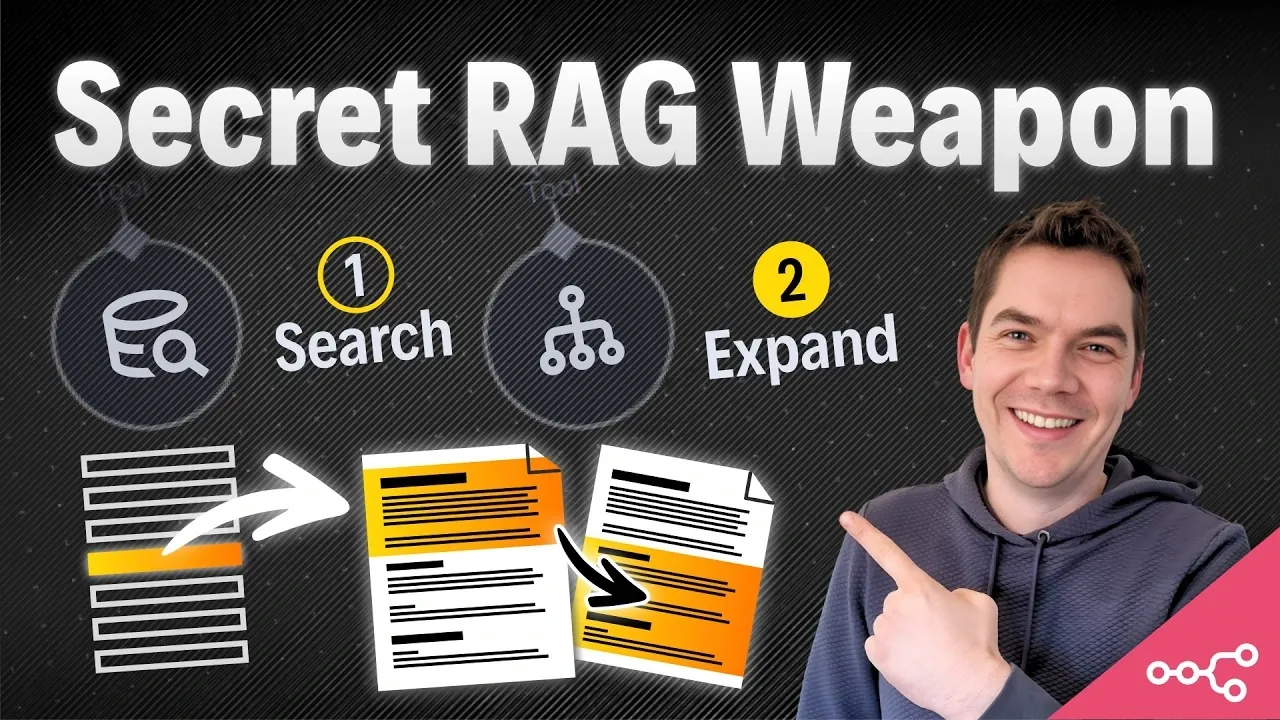
- Techniques for context expansion include neighbor, parent, agentic, and full document expansion, each tailored to specific document structures and use cases.
- Advanced document processing methods, such as hierarchical splitting, recursive splitting, and chunk merging, help maintain contextual integrity and improve retrieval accuracy.
- Metadata enrichment, including hierarchical indexes and contextual snippets, significantly enhances traceability and relevance, while workflow automation tools like n8n streamline the integration of context expansion techniques.
Understanding the Challenges of RAG Systems
RAG systems face significant challenges when working with fragmented document contexts. Chunking, while useful for dividing large documents into manageable pieces, often isolates critical information. This isolation increases the risk of generating hallucinations, responses that are not grounded in the source material. Such errors are particularly problematic in structured documents like technical manuals, policy reports, or legal texts, where understanding the relationships between sections is essential.
For instance, a RAG system might retrieve a single clause from a policy document without considering its surrounding sections. This lack of context can lead to misinterpretation or incomplete answers, undermining the system’s reliability and trustworthiness. Addressing these challenges requires a method that preserves the integrity of the document’s context while making sure accurate retrieval.
What is Context Expansion?
Context expansion is a method that enhances the retrieval capabilities of RAG systems by allowing them to access not just isolated chunks of text but also related sections, subsections, or even entire document hierarchies. By providing a broader view of the material, context expansion ensures that responses are more accurate, faithful to the source, and contextually complete.
For example, when answering a question about a policy document, context expansion enables the system to retrieve both the specific clause and its surrounding sections. This comprehensive approach reduces errors, enhances the quality of responses, and ensures that the generated output aligns with the original intent of the document.
Chunks Aren’t Enough … You Need Context Expansion!

Expand your understanding of RAG with additional resources from our extensive library of articles.
- What Is OpenAI’s Index-Free RAG System and How Does It Work
- AI Retrieval Augmented Generation (RAG) explained by IBM
- How LangExtract Uses Metadata Filtering to Improve RAG Systems
- Master AI Automation with ChatGPT-o1 Series and RAG
- Supercharge RAG Projects with DeepSeek R1 AI Reasoning Model
- Context Caching : The Cost-Saving Alternative to RAG Explained
- Top Benefits of Using RAG for File and Metadata Management
- RAG vs CAG : Solving Knowledge Gaps for Smarter AI Workflows
- Build a Custom RAG MCP Server to Boost AI Coding Workflows
- RAR vs RAG: Understanding Oxford’s Advanced AI Framework
Methods for Context Expansion
Several techniques can be employed to implement context expansion, each tailored to specific document structures and use cases. These methods ensure that RAG systems can retrieve information in a way that preserves the document’s context and structure:
- Neighbor Expansion: Retrieves adjacent chunks of text to provide additional context. This method is straightforward but may not always capture the full scope of the material.
- Parent Expansion: Focuses on retrieving entire sections under a parent heading, offering a more structured and comprehensive understanding of the content.
- Agentic Expansion: Allows the system to retrieve multiple sections or even entire documents, providing a holistic view of the material. This approach is particularly useful for complex queries.
- Full Document Expansion: Loads the entire document for processing. While ideal for smaller files, this method can be resource-intensive for larger documents.
Each of these methods has its strengths and limitations. The choice of technique depends on the specific requirements of your RAG system and the nature of the documents being processed.
Advanced Techniques for Document Processing
Effective context expansion relies on advanced document processing techniques that go beyond basic chunking. These strategies ensure that the integrity of the document’s context is maintained while optimizing retrieval accuracy:
- Hierarchical Splitting: Divides text based on headings and subheadings, preserving the document’s structure and logical flow.
- Recursive Splitting: Breaks text into smaller pieces based on character limits. While useful for large documents, this method may sacrifice structural coherence.
- Chunk Merging: Combines smaller, related chunks to prevent fragmentation and improve retrieval accuracy. This approach ensures that related information is processed together.
By combining hierarchical and recursive splitting, you can optimize chunking to retain contextual integrity. Additionally, intelligently merging smaller chunks ensures that your vector stores remain clean and efficient, reducing the risk of errors during retrieval.
The Role of Metadata Enrichment
Metadata enrichment plays a pivotal role in enhancing context expansion. By adding hierarchical indexes, document summaries, and contextual snippets to each chunk, you can significantly improve the traceability and relevance of retrieved information. Large Language Models (LLMs) can assist in extracting metadata, further enhancing the system’s ability to process complex materials.
For example, metadata can include details such as the document’s structure, key topics, or even page numbers. This additional layer of information helps the RAG system understand the broader context of the document, making sure that responses are both accurate and relevant.
Integrating Context Expansion in Workflow Automation
Workflow automation tools like n8n can be instrumental in integrating context expansion techniques into your RAG systems. For instance, Superbase, a Postgres-based database, is well-suited for storing and querying document hierarchies. Custom workflows can combine chunking, metadata injection, and retrieval processes to create scalable and efficient context expansion pipelines.
Additionally, OCR tools can extract headings, page numbers, and other structural elements from scanned documents. This enriched metadata improves the system’s ability to process structured materials, making it more effective at handling complex queries.
Benefits of Context Expansion
Adopting context expansion offers several key advantages for RAG systems:
- Improved Accuracy: Reduces errors by providing a broader and more comprehensive understanding of the material.
- Enhanced Traceability: Ensures that responses are grounded in the source material, increasing reliability.
- Scalability: Optimizes resource usage by reducing the need for excessive LLM calls, making the system more efficient.
Whether you’re working with policy documents, technical manuals, or research reports, context expansion ensures that your RAG system delivers reliable and precise results, even when processing complex or structured materials.
Limitations and Future Directions
Despite its numerous benefits, context expansion is not without its limitations. For example, tools like n8n currently lack native support for advanced chunking and metadata enrichment. Implementing these features often requires custom code nodes, which can be time-consuming and complex.
Looking ahead, advancements in workflow automation tools could address these gaps, making context expansion more accessible and efficient. Future developments may include built-in support for hierarchical chunking, metadata enrichment, and other advanced techniques, further enhancing the capabilities of RAG systems.
As these tools evolve, the integration of context expansion will become increasingly essential for handling complex document-based queries. By staying ahead of these advancements, you can ensure that your RAG system remains reliable, scalable, and effective in delivering high-quality results.
Media Credit: The AI Automators
Disclosure: Some of our articles include affiliate links. If you buy something through one of these links, Geeky Gadgets may earn an affiliate commission. Learn about our Disclosure Policy.
