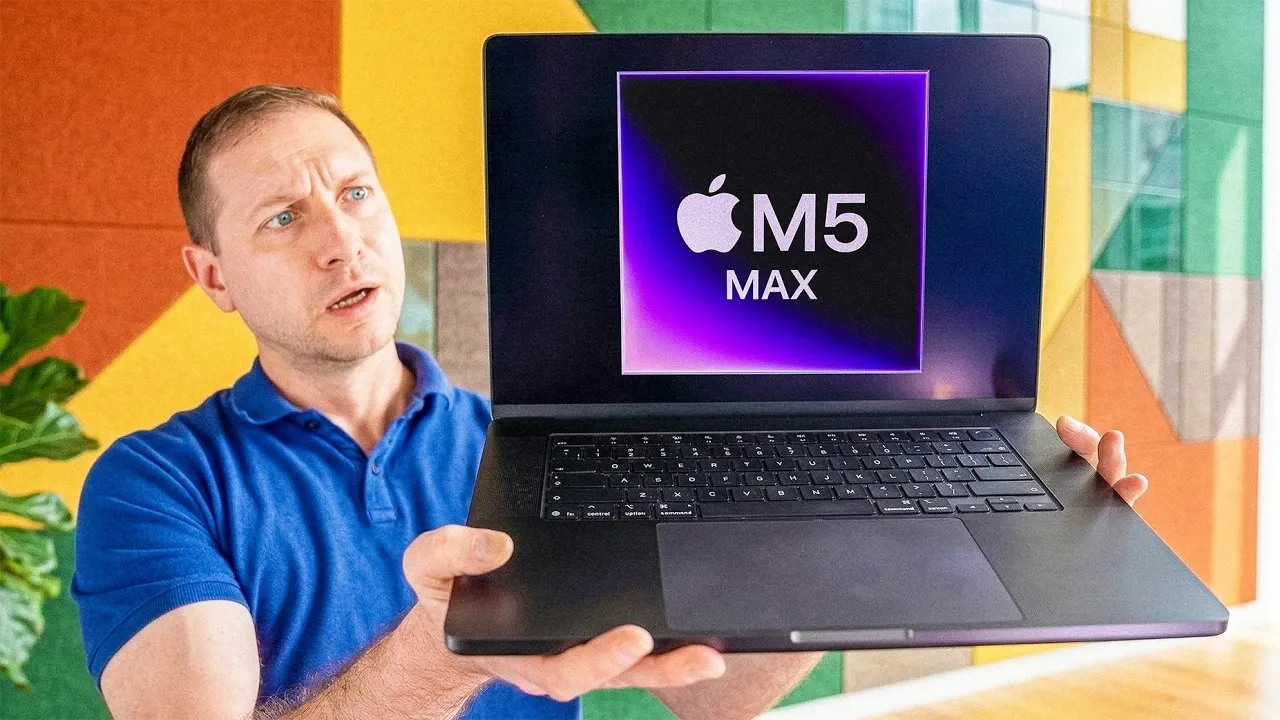
The Apple M5 Max introduces notable advancements over the M4 Max, focusing on performance improvements for demanding professional applications. Key upgrades include a redesigned GPU architecture with integrated neural accelerators, offering over four times the peak GPU compute capability for AI-related tasks. According to Alex Ziskind, these enhancements, combined with increased memory bandwidth and faster SSD performance, make the M5 Max particularly relevant for professionals working in areas like machine learning, software development and computational modeling.
Learn how the M5 Max’s 18-core configuration enhances parallel processing for tasks such as simulations and code compilation. The overview also examines the role of faster Gen 5 SSDs in improving data-intensive workflows and evaluates the system’s single-core performance for general responsiveness. These comparisons provide a detailed look at how the M5 Max performs relative to the M4 Max across specific technical benchmarks.
Apple M5 Max Specs
TL;DR Key Takeaways :
- The Apple M5 Max introduces a redesigned GPU architecture with integrated neural accelerators, delivering over four times the GPU compute capability for AI workloads compared to the M4 Max.
- Its new 18-core configuration, optimized for parallel processing, eliminates efficiency cores and enhances performance for compute-heavy tasks like code compilation and simulations.
- With a memory bandwidth of up to 614 GB/s and Gen 5 SSDs, the M5 Max significantly improves data processing, file handling and system responsiveness for professionals managing large-scale computations.
- Single-core performance enhancements ensure smoother everyday tasks and faster web-based applications, making it ideal for front-end developers and interactive software professionals.
- Despite its performance gains, the M5 Max maintains impressive power efficiency, consuming less energy than competitors like the M3 Ultra, making it a sustainable choice for demanding workloads.
GPU Architecture: Redefining AI Performance
The M5 Max debuts a redesigned GPU architecture that integrates neural accelerators directly into every GPU core. This innovation delivers over four times the peak GPU compute capability for AI workloads compared to the M4 Max, making it a significant upgrade for professionals working with machine learning and neural networks.
- Tasks such as neural network training and inference see substantial performance gains.
- Local AI model processing and machine learning algorithms run more efficiently, reducing processing times.
For professionals in AI, this leap in GPU performance translates to faster, more reliable results, allowing quicker iterations and improved productivity.
Core Configuration: Built for Parallel Processing
The M5 Max features a new 18-core configuration, consisting of six “super” cores and 12 performance cores, while eliminating efficiency cores entirely. This setup is optimized for multi-core performance, making it ideal for tasks requiring high levels of parallel processing, such as code compilation and intensive computations.
- Software developers experience faster execution of compute-heavy processes, reducing development cycles.
- Engineers working on simulations or large-scale computations benefit from smoother workflows.
Compared to the M4 Max, this configuration ensures a noticeable boost in productivity for professionals handling demanding workloads, offering a balance of power and efficiency.

Unlock more potential in Apple MacBook by reading previous articles we have written.
- Apple’s New MacBook Pro Redesign Leaked
- Apple’s OLED MacBook Pro Redesign: What to Expect
- Apple’s M5 Pro and M5 Max MacBook Pros Will Blow Your Mind
- Apple Delays M5 MacBook Pro Launch to February
- M5 Pro and M5 Max MacBook Pro: Release Date Speculation
- macOS 26.3 and M5 Max MacBook Pro: Key Features Expl
- Apple’s MacBook SE: Compact, Affordable, and Powerful
- M5 Max & Pro MacBook Pro Coming at March 4th Apple Event
- MacBook Air M5 2026: Features, Specs, and Release Date
- Apple MacBook E: Everything You Need to Know
Memory Bandwidth: Setting New Standards
With a memory bandwidth of up to 614 GB/s, the M5 Max delivers a 13% improvement over the M4 Max and even surpasses the M3 Ultra in this area. This enhancement is particularly impactful for applications requiring rapid data access, such as machine learning and large-scale data processing.
- Large-scale computations and machine learning models process data more efficiently, reducing bottlenecks.
- Lower latency improves overall system performance, making sure smoother operations during intensive tasks.
For professionals handling data-intensive workloads, this increase in memory bandwidth provides a tangible improvement in performance and efficiency.
SSD Performance: Gen 5 Speeds for Seamless Workflows
The M5 Max incorporates Gen 5 SSDs, nearly doubling the read/write speeds of the M4 Max and M3 Ultra. This improvement significantly enhances workflows that involve frequent file handling, large dataset management and model loading.
- Large datasets load faster, reducing wait times and improving productivity.
- AI model caching and retrieval become more efficient, streamlining workflows.
For professionals managing extensive data or working on projects requiring frequent file access, the faster SSD speeds ensure seamless and uninterrupted productivity.
Single-Core Performance: Enhanced Everyday Responsiveness
The M5 Max excels in single-core performance, delivering noticeable improvements in system responsiveness and web-based applications. In the Speedometer 3.1 test, it achieved a record-breaking score of 60.5, setting a new standard for single-core efficiency.
- Front-end developers benefit from faster performance in JavaScript-heavy applications, improving development efficiency.
- General system tasks, such as application launching and multitasking, feel smoother and more responsive.
This makes the M5 Max an excellent choice for professionals working on interactive software, web applications, or any tasks requiring high single-core performance.
AI Workloads: Faster Processing and Token Generation
AI-related tasks see substantial gains with the M5 Max, thanks to its neural accelerators and improved memory bandwidth. Prompt processing (PP) and token generation (TG) speeds are significantly faster than those of the M4 Max, making it a powerful tool for AI professionals.
- Local AI model deployment and real-time inference tasks are completed more efficiently, reducing turnaround times.
- Natural language processing applications benefit from faster token generation, improving the performance of chatbots and other AI-driven tools.
These advancements make the M5 Max a strong contender for professionals in AI and machine learning, offering faster results and improved workflow efficiency.
Power Efficiency: High Performance, Low Energy Consumption
Despite its significant performance gains, the M5 Max maintains impressive power efficiency, consuming up to 154 watts during intensive tasks. This is a notable improvement compared to the M3 Ultra’s 240-watt peak, making the M5 Max a more sustainable choice for professionals.
- Energy consumption is reduced without compromising performance, lowering operational costs over time.
- Professionals can handle demanding workloads sustainably, even during extended usage periods.
This balance between power and efficiency makes the M5 Max a practical and environmentally conscious choice for long-term use.
Applications: Designed for Professionals
The M5 Max is specifically tailored to meet the needs of professionals in software development, AI and large-scale computation. Its advancements in storage, memory and GPU architecture enhance workflows across a variety of domains, making it a versatile tool for demanding tasks.
- Software developers benefit from faster code compilation and execution, improving project timelines.
- AI professionals experience improved model training and inference speeds, allowing quicker iterations.
- Data scientists handle large datasets with reduced latency and increased efficiency, streamlining data analysis.
Whether you’re compiling code, training neural networks, or processing complex datasets, the M5 Max delivers the performance and reliability needed to excel in professional environments.
Media Credit: Alex Ziskind
Disclosure: Some of our articles include affiliate links. If you buy something through one of these links, Geeky Gadgets may earn an affiliate commission. Learn about our Disclosure Policy.
