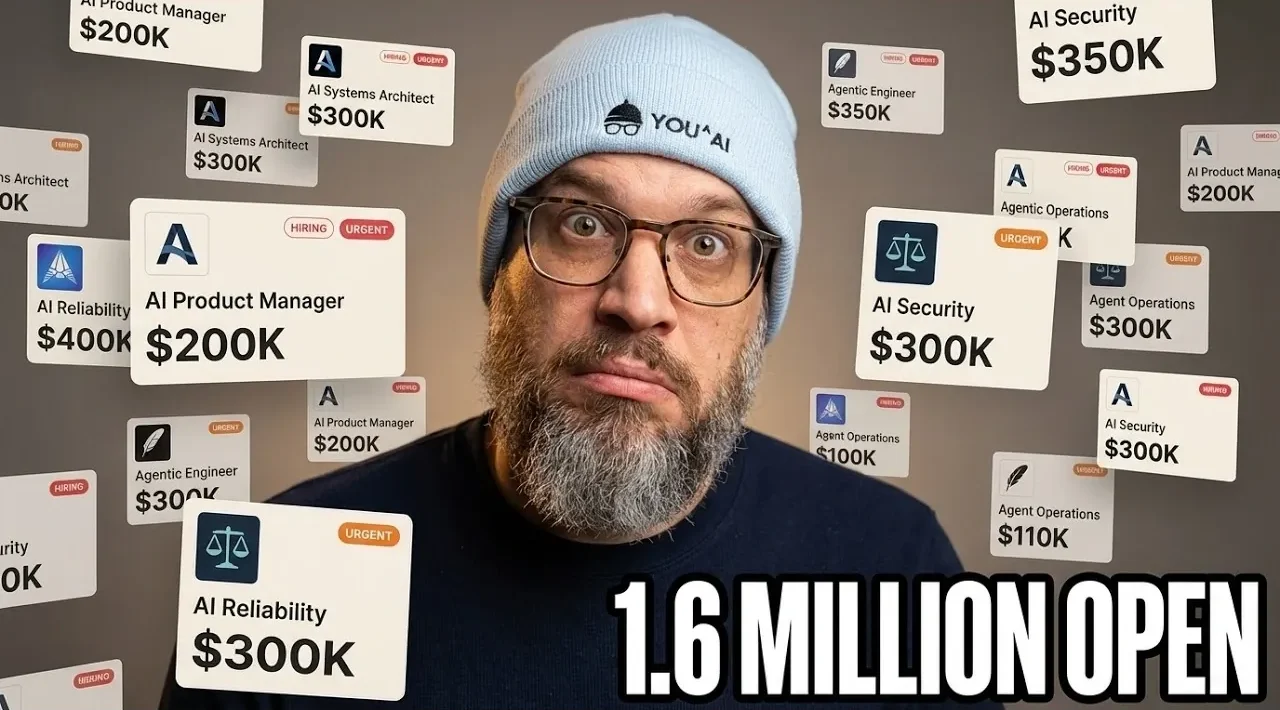
The AI job market is undergoing a dramatic shift, with a clear divide between traditional roles and specialized positions. As highlighted by Nate Jones, the demand for AI-specific expertise, such as multi-agent system management and failure pattern recognition, is skyrocketing, with salaries for these roles often exceeding $400,000 annually. Meanwhile, generalist roles like software engineering are seeing slower growth, reflecting a “K-shaped” trend in employment. This divergence underscores the importance of targeted skills development for professionals aiming to thrive in an increasingly AI-driven economy.
Explore how this evolving landscape is reshaping career opportunities and organizational priorities. Gain insight into the key competencies driving success in AI roles, from task specification precision to trust and security design. Additionally, discover how non-technical professionals can use transferable skills to transition into AI-related fields, such as project management and risk assessment. This breakdown offers a practical guide to navigating the challenges and opportunities of the AI job market’s rapid transformation.
The K-Shaped Divide in Employment
TL;DR Key Takeaways :
- The AI job market is experiencing a “K-shaped” transformation, with traditional roles stagnating while specialized AI positions, often paying over $400,000 annually, are thriving due to a widening skills gap.
- A severe AI talent shortage is projected, with 1.6 million job openings by 2026 but only 500,000 qualified candidates, leading to prolonged hiring times and delayed innovation.
- Key skills for AI professionals include task specification, output evaluation, multi-agent system management, failure pattern recognition, trust and security design, context structuring and cost optimization.
- Non-technical roles such as technical writers, project managers and risk assessors are becoming increasingly valuable in AI, offering opportunities for professionals from diverse backgrounds.
- New AI job families, including AI ethicists, system auditors and token economists, are emerging, emphasizing the need for continuous learning, upskilling and adaptability in the evolving job market.
The job market is no longer a level playing field. Traditional knowledge work is stagnating, while specialized AI roles are flourishing. Companies are increasingly prioritizing niche expertise in AI over broader technical skills. For instance, while software engineering remains a foundational competency, roles such as AI system designers and multi-agent system coordinators are growing at a much faster pace.
This divergence highlights a fundamental shift in workforce dynamics. Businesses are leaning heavily on advanced AI technologies to maintain their competitive edge, driving demand for professionals who can design, manage and optimize these systems. In this environment, specialization is not just an advantage, it has become a necessity. Organizations that fail to adapt to this shift risk falling behind, while those that embrace it are better positioned to thrive.
The Growing AI Talent Shortage
The rapid adoption of AI technologies has created a severe talent shortage. By 2026, projections indicate there will be 1.6 million AI job openings, but only 500,000 qualified candidates to fill them. This imbalance has pushed the average time to hire for AI roles to 142 days, delaying critical projects and slowing innovation across industries.
Employers face significant challenges in identifying and recruiting skilled professionals. Many companies struggle to define the specific expertise they require, often using interviews as a way to clarify their own needs. This lack of clarity further exacerbates the talent gap, as job descriptions frequently fail to align with the skills available in the market. For organizations, addressing this issue requires a more strategic approach to workforce planning, including clearer role definitions and targeted recruitment efforts.

Find more information on AI business by browsing our extensive range of articles, guides and tutorials.
- How to use Gemini AI for business using Google Workspace
- OpenAI’s Growing Pains: Legal Scrutiny, Rivals, and Public Trust
- OpenAI’s $1.4 Trillion Bet: Can It Survive the AI Race?
- DIY $8,500 Supercomputer Replaces Cloud and AI Costs
- Anthropic Data Highlights AI Automation Potential vs Real Use
- Perplexity vs Google AI Search: Why It Stayed a Niche Tool
- Best AI Tools for Work, from Gemini to OpenAI & More
- AI Runs a Business (Fully Automated) : From Chaos to Calm
- The best AI tools for small businesses
Key Skills for AI Professionals
To succeed in this competitive job market, professionals must develop specialized skills tailored to AI roles. These competencies are becoming essential for securing high-paying positions and making sure the effectiveness and safety of AI systems. Key skills include:
- Task Specification Precision: Clearly defining tasks for AI systems to ensure accurate and efficient outcomes.
- Output Evaluation: Designing mechanisms to assess AI outputs for accuracy, reliability and ethical compliance.
- Multi-Agent System Management: Coordinating multiple AI agents to handle complex tasks effectively and efficiently.
- Failure Pattern Recognition: Identifying and mitigating common AI failure modes, such as silent errors or cascading failures.
- Trust and Security Design: Establishing safeguards to ensure the safe and ethical deployment of AI systems.
- Context Structuring: Organizing data and contextual information to optimize AI system performance and decision-making.
- Cost Optimization: Managing token economics and calculating the cost-effectiveness of AI operations.
These skills are no longer optional, they are prerequisites for professionals aiming to secure roles in this lucrative and rapidly evolving field. For job seekers, acquiring these competencies through targeted education and hands-on experience is critical to staying competitive.
Opportunities Beyond Engineering
The AI revolution extends beyond technical roles, creating opportunities for professionals from diverse backgrounds. Non-engineering skills are increasingly valuable in AI-related fields, offering pathways for individuals without a technical background to contribute meaningfully. Key roles include:
- Technical Writers: Crafting clear and comprehensive documentation for AI systems to enhance usability and understanding.
- Project Managers: Overseeing AI initiatives and making sure the timely delivery of projects while coordinating cross-functional teams.
- Risk Assessors: Identifying and mitigating potential issues in AI deployment, including ethical, regulatory and operational concerns.
These roles highlight the growing importance of transferable skills in the AI workforce. By using expertise in communication, organization and risk management, professionals can transition into AI-related fields, helping to address the talent shortage while broadening the pool of qualified candidates.
The Future of AI Job Families
As AI technologies advance, new job families are emerging to address the growing complexity and societal impact of these systems. Roles such as AI ethicists, system auditors, and token economists are gaining prominence. These positions reflect the increasing need for oversight, accountability and efficiency in AI operations.
For organizations, this evolution underscores the importance of investing in upskilling programs and forming partnerships with educational institutions to cultivate the next generation of AI talent. For individuals, it highlights the necessity of continuous learning and adaptability in a rapidly changing job market. Staying informed about emerging roles and acquiring relevant skills will be key to long-term career success.
The AI job market is at a pivotal moment, defined by a sharp divide between traditional roles and high-demand, specialized positions. With a significant talent shortage and rising employer expectations, professionals must focus on developing niche skills such as task specification, output evaluation and failure recognition to remain competitive. For employers, addressing the skills gap through targeted training and recruitment strategies will be essential to thriving in an AI-driven economy. By understanding and adapting to these changes, both individuals and organizations can position themselves for success in this fantastic era.
Media Credit: AI News & Strategy Daily | Nate B Jones
Disclosure: Some of our articles include affiliate links. If you buy something through one of these links, Geeky Gadgets may earn an affiliate commission. Learn about our Disclosure Policy.
