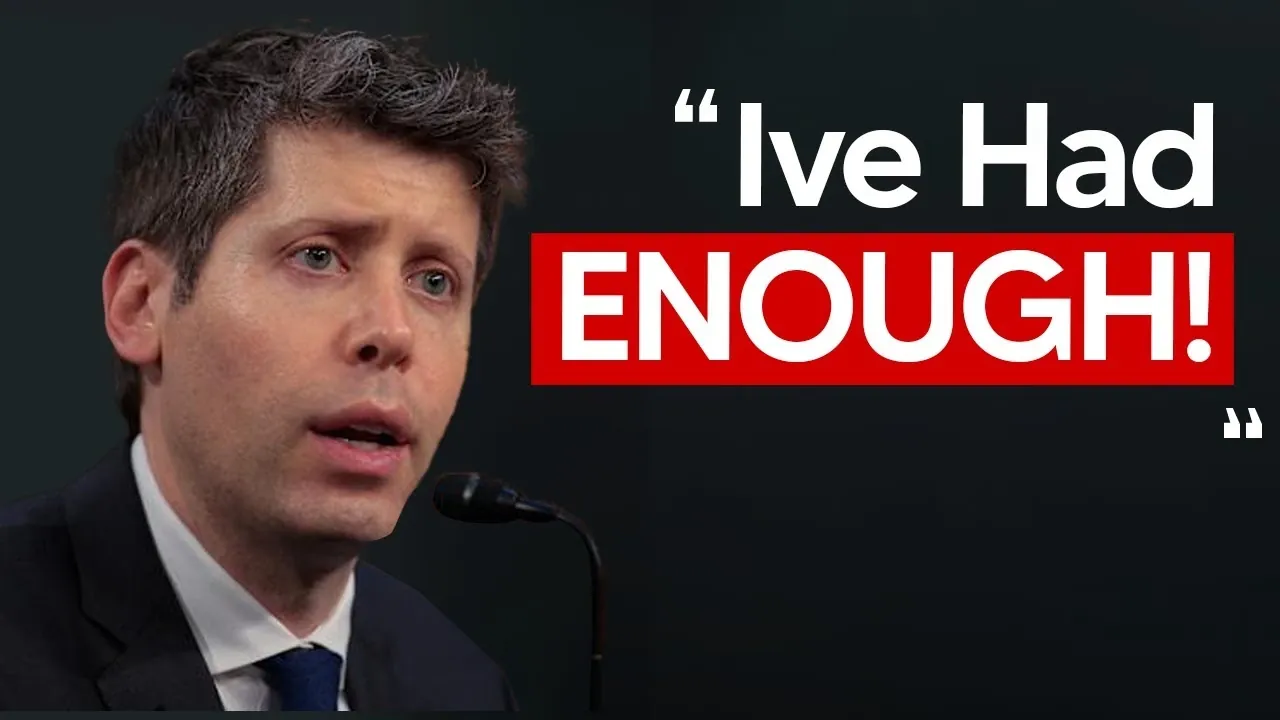
What happens when the face of one of the world’s most ambitious tech companies reaches his breaking point? In a recent high-profile interview, Sam Altman, CEO of OpenAI, delivered an unfiltered and emotionally charged response to mounting criticisms of his company’s financial strategy and vision. Known for his composed demeanor, Altman’s rare display of frustration, culminating in the emphatic declaration, “I’ve had ENOUGH!”—has sparked widespread debate about the pressures of leading in the high-stakes race toward Artificial General Intelligence (AGI). This moment wasn’t just a clash of ideas; it was a raw glimpse into the human side of navigating an industry defined by relentless competition and sky-high expectations. What drove one of AI’s most influential figures to this breaking point?
In this revealing overview AI Grid unpack the key moments from Altman’s viral interview, exploring the intense scrutiny surrounding OpenAI’s bold $1.4 trillion compute investment and its broader implications for the AI sector. From the mounting competition posed by tech giants like Google to the financial risks of scaling AGI development, this exchange sheds light on the precarious balance between ambition and sustainability. But beyond the numbers and rivalries lies a deeper question: can OpenAI maintain its mission to benefit humanity while navigating the unforgiving realities of the tech industry? Altman’s candid remarks offer a window into the challenges shaping not just OpenAI, but the future of artificial intelligence itself.
OpenAI’s Challenges and Risks
TL;DR Key Takeaways :
- OpenAI has committed to a bold $1.4 trillion investment in compute infrastructure, aiming to maintain a competitive edge in the AI industry, but this strategy raises concerns about financial sustainability.
- Rising competition from major players like Google and emerging rivals such as Anthropic is intensifying pressure on OpenAI, despite its strategic partnerships with Microsoft and Nvidia.
- OpenAI’s deep integration into the U.S. tech ecosystem has sparked debates about its strategic importance, with some speculating potential government intervention to prevent its collapse.
- The company faces significant economic risks, including reliance on favorable funding conditions, as it navigates the capital-intensive race to achieve Artificial General Intelligence (AGI).
- Sam Altman’s leadership and public perception are under scrutiny, with critics questioning whether OpenAI’s financial and operational strategies align with its mission to advance AI for humanity.
OpenAI’s Financial Strategy: A Bold but Risky Investment
OpenAI has committed to an extraordinary $1.4 trillion in compute spending, a figure that dwarfs its current annual revenue. Sam Altman defended this aggressive financial strategy by likening it to Amazon’s early investment in AWS, where significant upfront costs eventually led to long-term dominance in cloud computing. Altman argued that such bold investments are essential for OpenAI to remain competitive in the fast-paced AI landscape.
However, this approach has drawn criticism. Skeptics question whether OpenAI’s financial model is sustainable, especially given the current economic climate marked by rising interest rates and cautious investor sentiment. During the interview, Altman dismissed these concerns, urging doubters to sell their shares if they lacked confidence in the company’s trajectory. He emphasized that heavy investment in compute infrastructure is not just a choice but a necessity to maintain a competitive edge.
While this strategy positions OpenAI as a leader in AI innovation, it also exposes the company to significant risks. Rivals such as Google and Anthropic are rapidly advancing their own AI capabilities, intensifying the competition. OpenAI’s financial gamble, though potentially fantastic, underscores the precarious balance between ambition and sustainability in the AI industry.
Rising Competition in the AI Sector
The AI industry has become a fiercely competitive arena, with major players like Google using their vast resources to challenge OpenAI’s position. Google’s ability to operate at a loss to sustain its AI initiatives poses a direct threat to OpenAI, which has already experienced a decline in its market share for enterprise large language model (LLM) APIs. Meanwhile, emerging competitors such as Anthropic are steadily gaining traction, carving out their own niches in the market.
OpenAI’s strategic partnerships with Microsoft and Nvidia have provided critical support, granting access to advanced infrastructure and resources. These alliances have been instrumental in allowing OpenAI to scale its operations and maintain its competitive edge. However, they also highlight the company’s reliance on external collaborators, which could become a vulnerability if market dynamics shift. In an industry where financial endurance often determines success, OpenAI must carefully navigate these competitive pressures to secure its future.
OpenAI’s $1.4 Trillion Gamble: What It Means for the AI Industry
Explore further guides and articles from our vast library that you may find relevant to your interests in OpenAI.
- The Complete ChatGPT Artificial Intelligence OpenAI Training
- OpenAI DevDay 2025: Key Announcements and What They Mean
- OpenAI o3 and o3-mini Introduced
- OpenAI Reveals How To Use GPT-4o More Effectively
- How to Build AI Agents Without Coding Using OpenAI’s AgentKit
- New OpenAI Swarm Framework Designed to Simplify Multi-Agent AI
- How OpenAI’s Agent Builder Simplifies AI Development for All
- OpenAI DevDay 2025: Keynote Announcements and Innovations
- How to use OpenAI Assistants API
- OpenAI AI Model 03 Surpasses Human Reasoning – AGI?
The Debate Over OpenAI’s Strategic Importance
Some analysts argue that OpenAI’s deep integration into the U.S. tech ecosystem makes it “too big to fail.” With Microsoft embedding OpenAI’s models into its products and Nvidia supplying essential hardware, OpenAI has become a cornerstone of the broader AI landscape. This interconnectedness has fueled speculation that the U.S. government might intervene to prevent OpenAI’s collapse, given its strategic importance in the global AI race.
However, this perspective is not without controversy. Critics caution that government intervention could distort market dynamics, stifle competition, and discourage innovation. For OpenAI, the challenge lies in balancing its ambitious goals with the need for financial sustainability while navigating an increasingly interconnected and competitive industry. The company’s ability to maintain independence and adaptability will be critical as it seeks to solidify its position in the AI sector.
Economic Risks and the Road to Profitability
OpenAI’s reliance on substantial capital and favorable economic conditions makes it particularly vulnerable to shifts in the funding environment. Factors such as rising interest rates or a slowdown in investment flows could jeopardize the company’s ability to sustain its operations and achieve its vision of AGI. This financial fragility highlights the broader risks facing the AI industry, where companies are locked in a high-stakes race to outlast one another.
The current trajectory of the AI sector mirrors historical infrastructure investments, where early losses were often necessary to achieve market dominance. However, the capital-intensive nature of AI development amplifies the stakes. For OpenAI and its competitors, the ability to weather financial pressures will be a decisive factor in determining long-term success. The company’s leadership must carefully manage resources while maintaining the pace of innovation required to stay ahead in this competitive landscape.
Leadership and Public Perception
Sam Altman’s defensive tone during the interview reflects the growing scrutiny on OpenAI’s leadership and decision-making. As the public face of the company, Altman has faced criticism over OpenAI’s transition to a for-profit model and his financial ties to related partnerships. These controversies have sparked debates about whether OpenAI’s mission to advance AI for the benefit of humanity aligns with its operational and financial strategies.
The interview also underscored the tension between OpenAI’s lofty ambitions and the practical challenges of achieving them. Altman’s visible frustration highlighted the immense pressure on leaders in the AI industry to deliver results while navigating complex financial and competitive landscapes. For OpenAI, maintaining public trust and demonstrating transparency will be critical as it continues to pursue its ambitious goals.
Broader Implications for the AI Industry
The challenges facing OpenAI are emblematic of broader trends in the AI sector. As companies race to develop more advanced models and achieve AGI, the financial and operational risks associated with these efforts are becoming increasingly apparent. The reliance on massive compute infrastructure, coupled with the need to sustain short-term losses, has created a high-stakes environment where only the most resilient players are likely to succeed.
For policymakers, the rise of AI presents both opportunities and challenges. Governments must strike a delicate balance between fostering innovation and mitigating economic and strategic risks. As the AI industry evolves, the role of regulation and potential government intervention will likely become central to discussions about the future of technology and its societal impact.
Sam Altman’s viral interview serves as a lens through which to examine the complexities of the AI industry. From financial sustainability and competitive pressures to public perception and potential government involvement, the road ahead is fraught with challenges. OpenAI’s ability to navigate these obstacles will not only shape its own future but also influence the trajectory of the broader AI landscape.
Media Credit: AIGRID
Disclosure: Some of our articles include affiliate links. If you buy something through one of these links, Geeky Gadgets may earn an affiliate commission. Learn about our Disclosure Policy.
