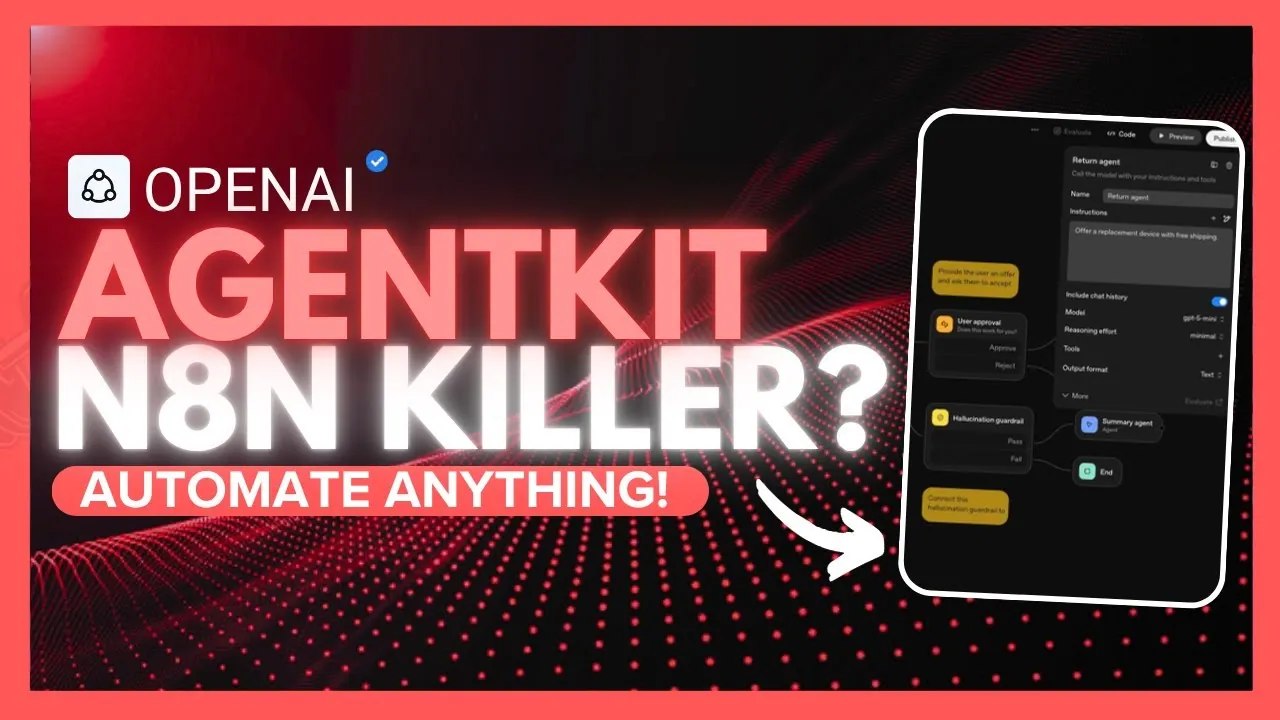
What if building your own AI agent was as simple as dragging and dropping a few blocks? Imagine automating tasks, enhancing customer interactions, or even streamlining entire workflows, all without writing a single line of code. With OpenAI’s new AgentKit, this vision is no longer a distant dream but a tangible reality. Designed to rival established platforms like n8n, AgentKit enables users of all skill levels to create intelligent, automated solutions with ease. Its no-code approach and seamless integration within OpenAI’s ecosystem promise to lower the barriers to AI adoption, making advanced automation accessible to everyone, from solo entrepreneurs to large enterprises.
Below World of AI explores how the new AgentKit has been designed to reshaping the landscape of AI development. You’ll discover its intuitive tools, like the Agent Builder and Connector Registry, that simplify the creation of AI-driven workflows, as well as its ability to embed real-time AI interactions into your products with the customizable Chat Kit. Whether you’re curious about how it stacks up against competitors like n8n or eager to see how it can transform your business operations, this deep dive will uncover the possibilities and limitations of this innovative platform.
- Agent Builder: a visual canvas for creating and versioning multi-agent workflows
- Connector Registry: a central place for admins to manage how data and tools connect across OpenAI products
- ChatKit: a toolkit for embedding customizable chat-based agent experiences in your product
What is AgentKit?
TL;DR Key Takeaways :
- OpenAI has introduced AgentKit, a no-code platform designed to simplify the creation and deployment of AI agents, making AI automation accessible to both technical and non-technical users.
- Key features include the Agent Builder (drag-and-drop workflow design), Connector Registry (API and data source management), and Chat Kit (customizable AI-powered chat interfaces).
- AgentKit enables businesses to automate tasks such as data analysis, customer support, and workflow optimization, with a focus on ease of use and customization.
- The platform integrates seamlessly with OpenAI’s models, offering high performance but limited flexibility for users requiring multi-provider support or advanced customization.
- While AgentKit is user-friendly and ideal for beginners, it faces competition from platforms like n8n, which offer greater flexibility and advanced features for complex automation needs.
AgentKit is a no-code solution that simplifies the process of building AI agents by offering a comprehensive suite of tools. These tools include the Agent Builder, Connector Registry, and Chat Kit, which allow users to design, manage, and deploy AI-driven workflows without requiring advanced programming skills. The platform is designed to cater to both technical and non-technical users, making it an ideal choice for businesses looking to integrate AI into their operations efficiently.
The platform’s no-code approach ensures that even users with minimal technical expertise can create AI agents capable of performing complex tasks. By focusing on accessibility and ease of use, AgentKit lowers the barriers to entry for AI adoption, allowing a broader audience to use the power of artificial intelligence.
Key Features of AgentKit
AgentKit offers a range of features that make it a powerful tool for AI development and automation. These features are designed to simplify the process of creating and deploying AI agents while making sure flexibility and functionality.
- Agent Builder: This visual drag-and-drop interface allows users to design workflows with built-in logic, guardrails, and live previews. By eliminating the need for coding, the Agent Builder enables users to focus on functionality and outcomes rather than technical complexities.
- Connector Registry: A centralized hub for managing APIs, data sources, and tools within OpenAI’s ecosystem. This feature ensures seamless integration and connectivity, allowing users to connect their AI agents to various platforms and data sources effortlessly.
- Chat Kit: A customizable chat interface that enables businesses to embed AI-powered interactions directly into their products or websites. This enhances customer engagement by providing real-time, intelligent responses to user queries.
These tools collectively make AgentKit a versatile platform for automating tasks and improving operational efficiency.
OpenAI DevDay 2025 : AgentKit Overview
Here is a selection of other guides from our extensive library of content you may find of interest on no-code platforms.
- How to Create an App Without Coding : No Code Beginner’s Guide
- How to Build Apps Without Coding Using Lovable 2.0
- No Code Automation Platforms Compared : Zapier vs Make vs n8n
- Convex Chef Review: The No-Code Platform for Real-Time App Dev
- Build AI Agents for Free Using Jotform’s No-Code Platform
- Eden AI: The Ultimate No-Code Platform for AI Development
- Google Opal : No-Code AI App Creation Made Easy
- Automate Your Inbox with this No-Code Email Management System
- How to Build a Marketing Team Using AI and No-Code Tools
- Opal by Google : The No-Code AI Tool for Building Apps in 2025
Capabilities and Use Cases
AgentKit is designed to handle a wide range of tasks, making it a valuable tool for businesses across various industries. Its capabilities include:
- Processing and analyzing data, such as comparing documents or extracting insights from datasets.
- Conducting knowledge base searches and performing web research to gather relevant information.
- Optimizing database queries and improving data management processes.
For example, a business could use AgentKit to create an AI agent that summarizes lengthy reports, automates customer support through a chat interface, or streamlines internal workflows by automating repetitive tasks. The platform also supports workflow customization, offering nodes for logic, data reshaping, and user approvals. This level of customization ensures that users have control over how tasks are executed, allowing them to tailor workflows to their specific needs.
Integration with OpenAI Models
AgentKit is powered by OpenAI’s models, making sure compatibility and high performance within OpenAI’s ecosystem. This integration allows users to use state-of-the-art AI capabilities for their workflows. However, the reliance on OpenAI’s models may pose limitations for users who require multi-provider model support or advanced customization options that extend beyond the OpenAI framework.
While this dependency ensures a seamless experience for users within the OpenAI ecosystem, it may not fully meet the needs of businesses seeking broader flexibility or integration with other AI providers.
AgentKit vs. n8n: A Comparison
AgentKit’s no-code approach and user-friendly design make it an attractive option for beginners and businesses with simpler automation needs. However, when compared to established platforms like n8n, there are notable differences:
- Flexibility: n8n supports multi-provider models and offers advanced tools for managing complex workflows. In contrast, AgentKit is currently limited to OpenAI’s ecosystem, which may restrict its appeal to users with more diverse requirements.
- Features: While AgentKit focuses on simplicity and accessibility, n8n provides a broader range of features for intricate automation processes, making it a better choice for advanced users.
- Accessibility: AgentKit’s no-code platform and free availability make it an excellent starting point for businesses new to AI automation. Its intuitive design ensures that even non-technical users can create functional AI agents with ease.
Although n8n may be better suited for users with complex automation needs, AgentKit’s simplicity and integration with OpenAI’s ecosystem make it a compelling option for those seeking an easy-to-use solution.
Future Potential
AgentKit represents a significant step toward making AI development more accessible to a broader audience. While it currently lacks some of the advanced features and flexibility offered by competitors like n8n, its user-friendly design and seamless integration with OpenAI’s ecosystem position it as a valuable tool for businesses exploring AI automation.
As the platform evolves, it is likely to gain additional features and capabilities, potentially addressing some of its current limitations. This growth could strengthen its position in the no-code AI development space, making it an even more attractive option for businesses and developers alike.
AgentKit’s focus on accessibility and ease of use highlights its potential to provide widespread access to AI development, allowing more organizations to harness the power of artificial intelligence to improve their operations and customer experiences.
Media Credit: WorldofAI
Disclosure: Some of our articles include affiliate links. If you buy something through one of these links, Geeky Gadgets may earn an affiliate commission. Learn about our Disclosure Policy.
