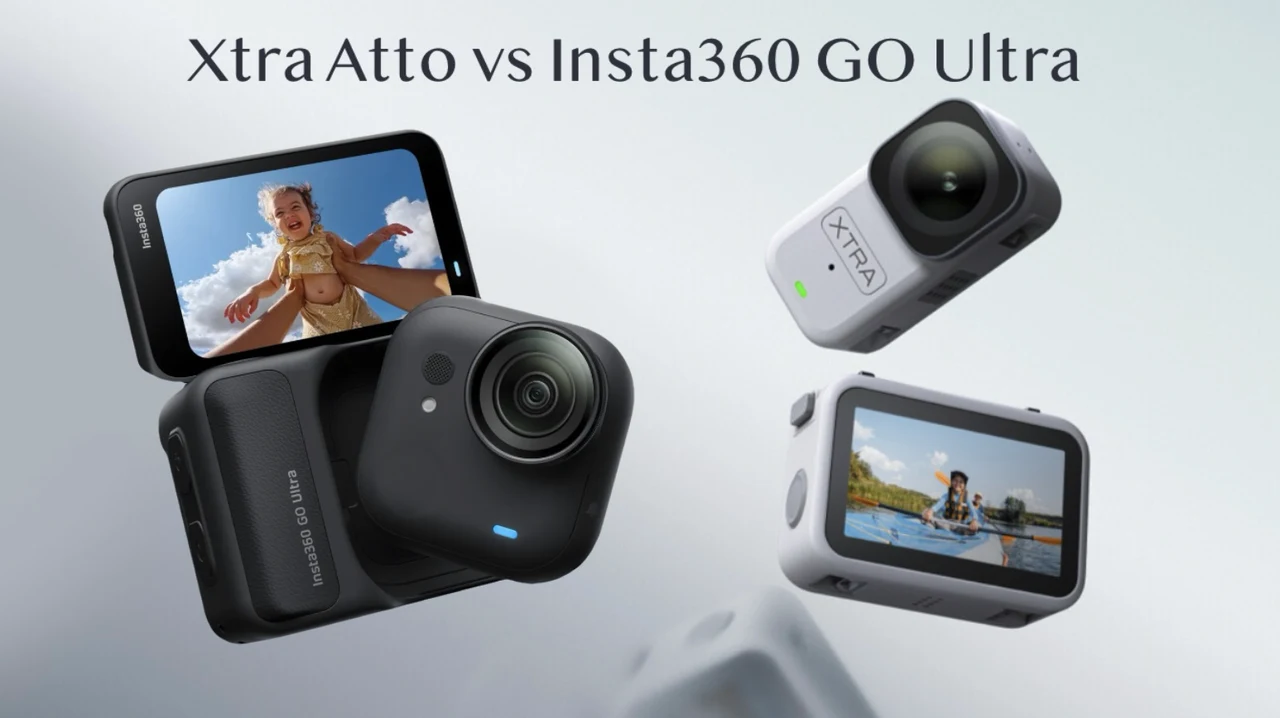
The mini action camera market just got a serious challenger. In this action camera comparison, we put the budget-defying Xtra Atto vs Insta360’s flagship GO Ultra to find out which compact camera actually wins where it counts. The mini action camera space has always been a battle between price and performance, and for years, Insta360 has owned it. But the Xtra Atto arrives at $299 with a spec sheet that should make any GO Ultra buyer stop and ask a hard question: what exactly am I paying $150 more for? We put both cameras through their paces across every meaningful dimension: image quality, battery life, storage, durability, and real-world usability, to give you a definitive answer. The results are more surprising than you might expect.

Let’s address the obvious first. The Xtra Atto retails at $299 on Amazon (as of March 2026). The Insta360 GO Ultra costs $449. That’s a 33% price difference, not a rounding error, but a meaningful gap that shapes every comparison that follows. The Insta360 GO 3S sits at $379, and DJI’s Osmo Nano checks in at $329. The Atto undercuts all of them. But price alone doesn’t win reviews, specs do. And that’s where things get interesting.

Image Quality: Sensor, Video & Photo Compared
Sensor Size
The imaging sensor is the hardware foundation on which everything else is built on, and the Xtra Atto refuses to compromise here. It packs a 1/1.3-inch CMOS sensor, essentially identical to the GO Ultra’s 1/1.28-inch CMOS. Larger sensors capture more light, produce less noise, and generally deliver more cinematic results. Matching the GO Ultra at $150 less is the single most compelling spec on the Atto’s sheet. For reference, the Insta360 GO 3S only manages a 1/2.3-inch sensor, a substantially smaller piece of silicon that shows in real-world low-light performance.
Video Resolution
Both cameras cap out at 4K resolution at 60 frames per second. That’s the sweet spot for action footage, high enough resolution to crop in post without losing detail, and high enough frame rate to produce genuinely smooth motion whether you’re skiing, cycling, or skateboarding. There is no video resolution argument to be made for spending $150 more on the GO Ultra. They are identical in this department.
Photo Resolution: The GO Ultra’s Strongest Card
This is where the GO Ultra pulls away. At 50 megapixels, it substantially outguns the Atto’s 35MP. For creators who shoot as many stills as they do video, events, travel photography, product content, that difference is real. More megapixels mean more detail, more room to crop, and sharper print-quality output.
If photography is central to your workflow, the GO Ultra earns some of its premium here. If you’re primarily a video creator, 35MP is more than sufficient for any thumbnail, social post, or editorial use.

Color Science and Dynamic Range
Both cameras offer logarithmic color profiles for post-production flexibility, professional-grade territory that separates mini action cameras from toy-grade hardware. The Atto shoots in X-Log with 10-bit color encoding; the GO Ultra offers I-Log.
Ten-bit color encodes over a billion possible color values versus 8-bit’s 16 million, giving colorists far more headroom to grade without banding or clipping. Both cameras are ready for a professional editing pipeline, but it’s worth noting that the Atto delivers 10-bit color at $299.
Low-Light Performance
The Atto’s large 1/1.3-inch sensor does the heavy lifting in low-light environments, delivering exceptional performance in challenging lighting conditions. The GO Ultra counters with AI-powered noise reduction and dynamic range enhancement, a software-driven approach that can be impressively effective. In practice, both cameras are credible low-light performers; the Atto relies on raw sensor physics, the GO Ultra on computational photography.
Image quality scorecard at a glance:
- Sensor size: Tie – 1/1.3-inch (Atto) vs 1/1.28-inch (GO Ultra)
- Video resolution: Tie – both 4K/60fps
- Photo resolution: GO Ultra wins – 50MP vs 35MP
- Color profiles: Tie – both offer log profiles for pro post-production
- Low-light: Tie – different approaches, comparable results

Storage: Built-in vs Expandable
This is the most underappreciated difference between these two cameras, and in day-to-day use, it may matter more than any imaging spec.The Xtra Atto ships with 128GB of built-in storage, with 107.6GB available to the user. The Insta360 GO Ultra has zero internal storage. None. You are entirely dependent on a microSD card.
Think about what that means in practice. Forget your card, leave it in your laptop after offloading footage, or have it fill up mid-shoot. With the GO Ultra, you’re done. With the Atto, you have over 100GB of safety net built into the camera body itself. For travel creators, event shooters, or anyone who has ever experienced the sinking feeling of a full card at the wrong moment, this is not a minor footnote.

Both cameras support microSD expansion, the Atto up to 1TB, the GO Ultra up to 2TB. For most creators, 1TB of card storage combined with 107.6GB of internal memory is more than enough. The GO Ultra’s 2TB ceiling is a legitimate advantage only for extremely long-duration or unattended recording applications.
Storage summary:
- Xtra Atto: 107.6GB built-in + up to 1TB microSD
- Insta360 GO Ultra: No built-in storage + up to 2TB microSD
- Winner: Atto – internal memory is a meaningful field advantage
Battery Life: Runtime Compared
On paper, the GO Ultra’s Action Pod carries a larger battery at 1,450mAh versus the Atto’s Multifunctional Vision Dock at 1,300mAh. You might expect that to translate into longer total runtime. It doesn’t.

Xtra Atto standalone runtime: 90 minutes. Insta360 GO Ultra standalone runtime: 70 minutes (at 1080p/24fps). The Atto outlasts the GO Ultra by 29% on a single camera charge.
Combined with their respective docks: Atto hits 220 minutes. GO Ultra reaches 200 minutes (again at 1080p/24fps). The Atto delivers 10% more total shooting time despite having a smaller accessory battery, a result of more efficient power management in the camera itself.
 One caveat worth noting: Insta360’s published runtime figures are at 1080p/24fps, not 4K/60fps. Real-world shooting at maximum quality settings will reduce these numbers for both cameras, but the gap between them is unlikely to reverse.
Battery runtime at a glance:
- Standalone (Atto): 90 minutes vs GO Ultra’s 70 minutes – 29% longer
- Combined with dock/pod (Atto): 220 minutes vs GO Ultra’s 200 minutes
- Camera battery capacity: Atto 530mAh vs GO Ultra 500mAh
- Dock/Pod capacity: Atto 1,300mAh vs GO Ultra 1,450mAh (larger pod, shorter total runtime)
- Winner: Atto – more efficient power management delivers more shooting time
Waterproofing & Durability
Neither camera gives ground here. Both the Xtra Atto and the GO Ultra are rated to 10 meters (33 feet) without any additional housing, appropriate for snorkeling, surfing, and rain or splash conditions without a second thought. Both accessories (the Atto’s Dock and GO Ultra’s Action Pod) share an IPX4 splash-resistance rating, meaning they can handle rain and splashing but aren’t designed for submersion. This is consistent across the category and represents no differentiation between the two.

Software & Ecosystem
Insta360’s software ecosystem is the industry gold standard for mini action cameras. The companion app offers AI-powered auto-editing, highlight reels, subject tracking, and a streamlined mobile workflow that has been refined across years and multiple product generations. For creators who want to shoot, tap, and share without ever opening a desktop editor, there is simply nothing else on the market that matches the depth and polish of Insta360’s editing suite. If you’re already invested in the Insta360 ecosystem, existing mounts, accessories, workflow habits, the GO Ultra slots in without friction.
The Xtra Atto is a newer entrant, and its companion app is still maturing. For creators who do most of their editing in DaVinci Resolve, Premiere Pro, or Final Cut Pro and don’t rely on in-app editing, this gap matters less. But for mobile-first creators who live in their camera’s app and depend on AI-powered shortcuts to turn around content quickly, Insta360’s established software is a genuine and significant advantage that deserves serious weight in any buying decision.
On the accessories front, the Atto’s Multifunctional Vision Dock and the GO Ultra’s Action Pod serve the same purpose, extending battery life, providing a handheld grip, and enabling playback. Neither camera is a standalone-only device; the dock or pod is an essential part of a complete kit. Third-party mount compatibility is worth verifying before purchase if you’re planning to use existing GoPro-style mounts or cage systems.

Which Camera is Right for You?
Rather than declaring an outright winner, the better question is which camera fits your shooting style. Both are excellent mini cameras, but they serve different priorities.
Choose the Insta360 GO Ultra if you:
- Shoot stills as heavily as video and need the 50MP resolution advantage
- Depend on industry-leading AI editing features and want the most polished mobile app experience available
- Are already invested in the Insta360 ecosystem and want seamless continuity with your existing gear
Choose the Xtra Atto if you:
- Shoot primarily video and want 4K/60fps with 10-bit color at the best price
- Want the peace of mind of built-in storage, always ready, no card required
- Prioritize battery life and runtime for all-day shooting
- Are a power-user looking for the strongest hardware value in the under-$300 space

The Insta360 GO Ultra makes its strongest case on software and still photography. 50MP versus 35MP is a meaningful specification advantage, and the AI-powered editing app remains unmatched in this category. For creators who value that ecosystem, the premium is justified.
The Atto makes its strongest case on hardware value. It matches the GO Ultra on sensor size, video resolution, color depth, and waterproofing, then edges ahead on battery life and built-in storage, all while keeping $150 in your pocket. For video-first creators who grade their own footage and want maximum runtime, the specs speak for themselves.
Xtra Atto Features
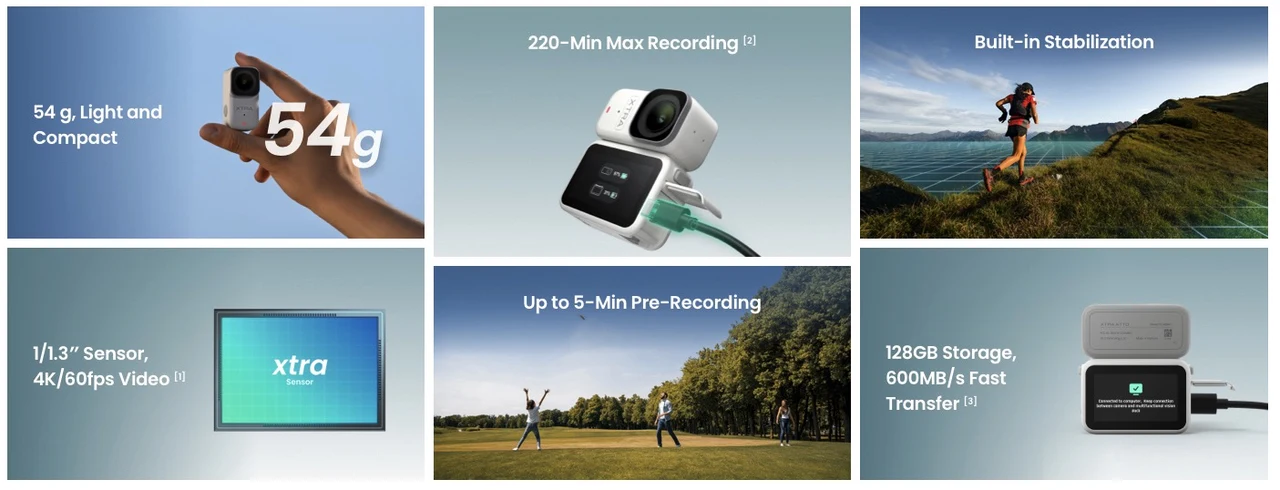
The mini camera market tends to reward brand loyalty and ecosystem lock-in. Insta360 has benefited from that dynamic for years, and rightfully so. They built a genuinely great product line with software that sets the bar for the entire category. But the Xtra Atto signals that hardware competition is heating up. When a challenger matches flagship sensor size, video resolution, color depth, and waterproofing, and then edges ahead on battery life and built-in storage at a significantly lower price, buyers have a real choice to make. Both cameras deserve a place on your shortlist. The right one depends on whether you prioritize software polish or hardware value.
Xtra Atto vs Insta360 GO Ultra at a Glance
| Xtra Atto | Insta360 GO Ultra | |
|---|---|---|
| Price | $299 | $449 |
| Sensor | 1/1.3-inch CMOS | 1/1.28-inch CMOS |
| Video Resolution | 4K/60fps | 4K/60fps |
| Photo Resolution | 35MP | 50MP |
| Color Profile | X-Log, 10-bit | I-Log |
| Built-in Storage | 107.6GB | None |
| microSD Support | Up to 1TB | Up to 2TB |
| Waterproof Rating | 10m | 10m |
| Standalone Battery | 90 min | 70 min |
| Combined Battery (with Dock/Pod) | 220 min | 200 min |
| Camera Battery Capacity | 530mAh | 500mAh |
| Dock/Pod Battery Capacity | 1,300mAh | 1,450mAh |
| Low-Light | Large sensor physics | AI noise reduction |
| Dock/Pod Splash Rating | IPX4 | IPX4 |
You can find out more details about both cameras at the links below.
Xtra Atto on Amazon
Insta360 GO Ultra on Amazon
Xtra Official Website
Media Contact: info@xtra-us.com
Xtra Social Media
Image Credit : Roger Seng
Disclosure: Some of our articles include affiliate links. If you buy something through one of these links, Geeky Gadgets may earn an affiliate commission. Learn about our Disclosure Policy.
