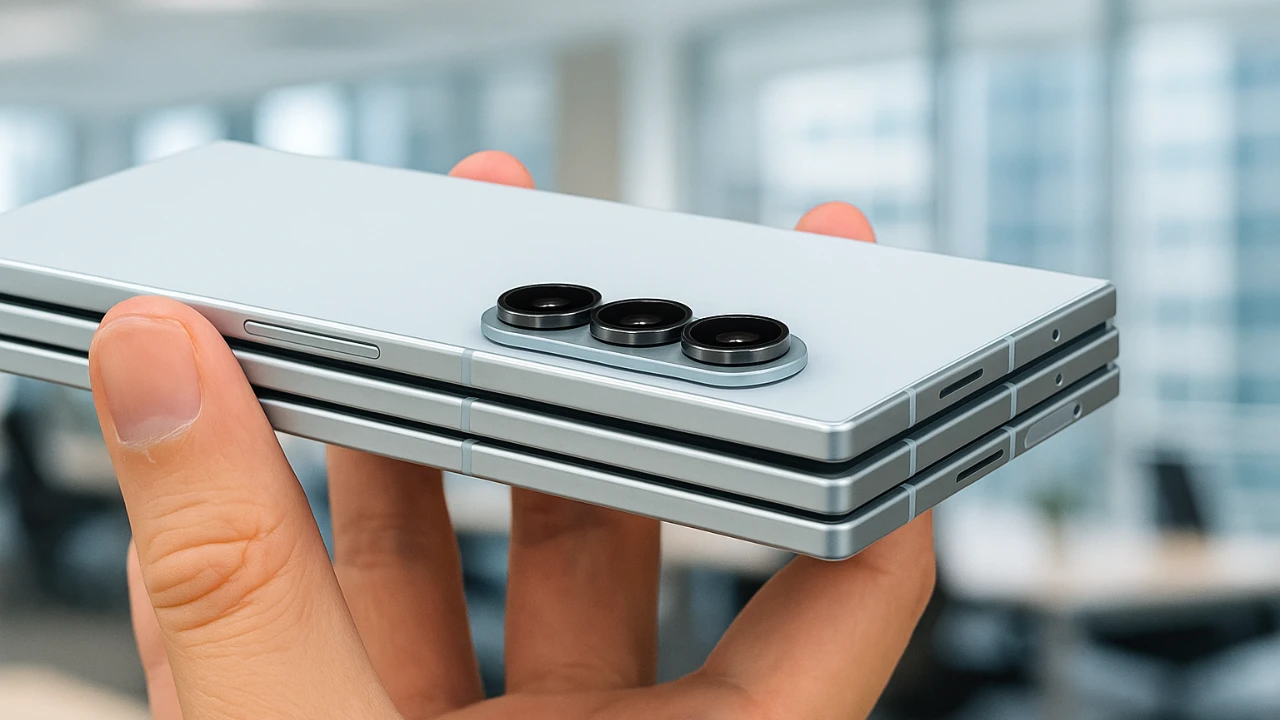
When we last covered the Samsung Galaxy Z Tri-Fold, the rumor mill was spinning at full velocity with predictions of an October release. It was meant to be the autumn surprise that would steal the spotlight from the iPhone 17 and answer Huawei’s aggressive moves in the foldable space. However, October came and went, and November is nearly over, leaving many enthusiasts wondering: Where is the device?
The silence from Seoul has finally been broken—not by an official press release, but by a deluge of supply chain leaks, firmware sightings, and analyst reports that paint a much clearer picture of Samsung’s strategy. The device is real, it is ready, but you might not be able to buy it tomorrow.
Here is the comprehensive update on the Galaxy Z Tri-Fold’s new phased release timeline, its unique “G-Fold” design, and why Samsung is making us wait until 2026 for the global rollout.
The “Paper Launch” Strategy: December vs. 2026
The most significant update concerns the release schedule. Originally tipped for a simultaneous global drop, Samsung appears to be shifting toward a “phased rollout”—a strategy often reserved for experimental or ultra-high-end hardware where yield rates are lower than standard flagship phones.
Phase 1: The December Debut. Multiple sources now point to December 5, 2025, as the official unveiling date. However, this is expected to be a highly exclusive “soft launch.” Availability will likely be restricted to South Korea and potentially to strictly limited numbers in China. This allows Samsung to claim the title of “launching in 2025” and debut the technology on its home turf, generating massive buzz without the pressure of stocking global retail channels immediately.
Phase 2: The Global Expansion. For buyers in the US, UK, and Europe, the wait will extend slightly longer. The Galaxy Z Tri-Fold is now slated for a wider release in early 2026, possibly arriving alongside the Galaxy S26 Ultra at the annual Unpacked event in January or February.
This isn’t just speculation; it is backed by hard data. Firmware builds SM-F968U (carrier-locked) and SM-F968U1 (unlocked) have been spotted on Samsung’s development servers. The existence of these specific US builds confirms that the device is currently undergoing carrier testing for the West. It is coming—just a few months later than the domestic Korean model.
Design Deep Dive: The “G-Fold” vs. Huawei’s Mate XT
Since our last report, we have gained clarity on the physical engineering of the device, and it differs fundamentally from its main competitor, the Huawei Mate XT.
Huawei’s tri-fold uses a “Z-shape” configuration, where one hinge folds in and the other folds out. While this allows the device to be thinner (as it doesn’t need a separate cover screen), it leaves one-third of the delicate OLED panel constantly exposed to scratches and drops, even when the phone is in your pocket.
Samsung has reportedly chosen a different path: the “G-shape” or inward-folding design. In this configuration, the two side panels fold inward toward the center, acting like a gate.
- The Advantage: When the device is closed, the massive internal screen is completely protected by the device’s body.
- The Consequence: Because the main screen is hidden, Samsung has added a separate, traditional cover display on the front (approx. 6.5 inches).
While this makes the Galaxy Z Tri-Fold slightly thicker than the Mate XT, it addresses the number one complaint regarding foldables: durability. Samsung is betting that Western consumers, in particular, will prefer a slightly bulkier phone that doesn’t require babying the screen every time it goes into a pocket.
The Specs: A True Laptop Replacement?
The term “flagship” gets thrown around loosely, but the leaked specs for the Tri-Fold suggest it is in a league of its own. This isn’t just a phone; it’s a 10-inch Android tablet that folds into a candy bar.
- The Display: The main attraction is the ~10-inch OLED panel. To put that in perspective, that is roughly the size of a standard iPad. This necessitates a change in how we use Android, likely utilizing the new “Desktop Mode” features rumored for One UI 8.
- The Engine: Powering this beast will be the Qualcomm Snapdragon 8 Elite. This is crucial because running three simultaneous apps on a three-paneled screen requires immense processing overhead. The “For Galaxy” variant of this chip will likely feature higher clock speeds to handle the thermal load of such a large display canvas.
- Battery Life: The device is rumored to house a 5,600 mAh battery, split across three separate thin cells. While this is large for a phone, it is average for a tablet. Users should expect “all-day” battery life, but heavy multitasking on the 10-inch screen will likely drain it faster than a standard S25 Ultra.
- Cameras: In a surprising move, Samsung is not compromising on optics. Leaks suggest the inclusion of the 200MP main sensor from the S25 Ultra line. Usually, foldables get downgraded cameras to save space, so this indicates Samsung is positioning this as a “no-compromise” device.
The Price of Innovation
We must address the elephant in the room: the price. Estimates remain firm between $3,000 and $3,500. This pricing strategy serves two purposes. First, it covers the immense R&D and manufacturing costs of the dual-hinge Ultra Thin Glass (UTG) panels, which are notoriously difficult to produce. Second, it maintains the device’s exclusivity. At this price point, the Galaxy Z Tri-Fold is not competing with the iPhone; it is competing with high-end laptops and luxury goods. It is a statement piece for the tech elite, aimed at early adopters who want to experience the absolute bleeding edge of mobile computing.
Conclusion: Worth the Wait?
If you are disappointed that you won’t be unwrapping a Galaxy Z Tri-Fold this Christmas (unless you live in Seoul), take comfort in the fact that the delay likely ensures a better product. The shift to a 2026 global launch gives Samsung extra time to refine the software experience—crucial for a device with this many screen configurations—and ensure the durability of that complex “G-Fold” hinge.
The era of the tri-fold is undoubtedly beginning this December, but for most of the world, the revolution truly arrives in 2026.
Find more information on Samsung Galaxy Z TriFold by browsing our extensive range of articles, guides and tutorials.
- Samsung Galaxy Z Trifold: Everything You Need to Know
- Samsung Galaxy Z Tri-Fold Price, Features, and Release Date
- Samsung Galaxy Z Tri-Fold: Release Date Revealed
- Samsung Galaxy Z Tri-Fold: Features, Specs, and Price
- Samsung Galaxy Z Tri-Fold: Will It Launch This Year?
Disclosure: Some of our articles include affiliate links. If you buy something through one of these links, Geeky Gadgets may earn an affiliate commission. Learn about our Disclosure Policy.
