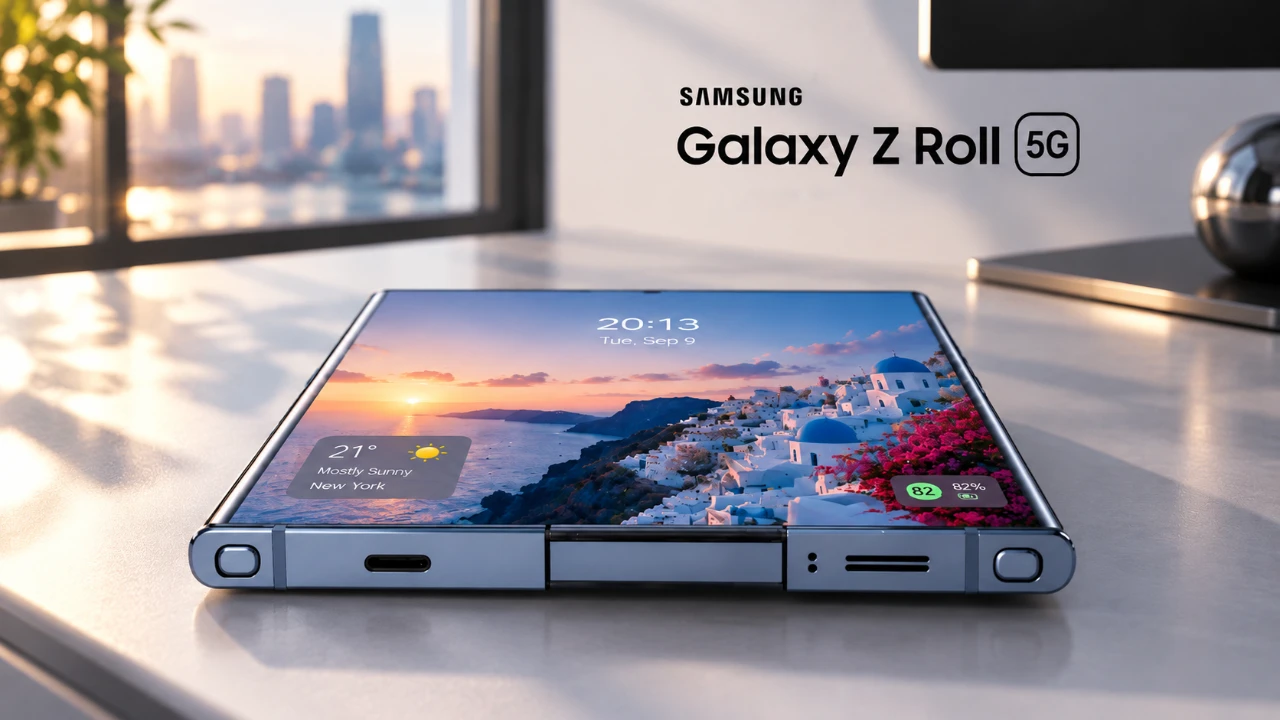
Following reports on Samsung’s motorized dual-roller mechanism and the targeted 2027–2028 release window, newly uncovered patent documentation and display industry leaks offer a closer look at the engineering under the hood. As Samsung continues to refine its next-generation form factor alongside the Galaxy Z Fold series, the Galaxy Z Roll 5G (also referred to in patent filings as the Galaxy Z Slide) is shaping up to be far more than just an unrolling screen—it represents a complete overhaul of internal smartphone architecture.
Here is an in-depth breakdown of the latest technical leaks, mechanical workarounds, and how Samsung plans to tackle the rollable form factor.
The Shifting Chassis: A Movable Camera System
One of the biggest hurdles with rollable smartphones is internal component arrangement. When a display expands, the internal volume shifts, creating uneven weight distribution and vacant internal space.
Recent patent filings reveal how Samsung intends to solve this:
- Sliding Rear Camera Island: Rather than leaving a fixed camera bump that gets swallowed by expanding glass, Samsung’s patent diagrams show an internal rail system where the primary camera module physically slides along the sub-frame as the screen unrolls.
- Rear Cutout Alignment: When contracted into standard smartphone mode, the triple-lens array nests flush against the primary chassis (closely mirroring the clean vertical stack of current Ultra flagships). When extended, the camera island glides outward, maintaining center balance and preventing the device from becoming lopsided in tablet mode.
- Dynamic Antenna Tuning: As the internal metal chassis stretches, RF signal reception can degrade. The patent outlines micro-actuators coupled with sensors that detect millimeter-level changes in display width, dynamically recalibrating the internal 5G antennas and Wi-Fi modules in real time.
One UI for Rollables: Dynamic Scaling Beyond Fixed Ratios
Foldable devices like the Galaxy Z Fold rely on two fixed display states: folded (narrow outer cover) and unfolded (squarish inner panel). A rollable screen presents a very different software challenge: variable aspect ratios.
Samsung’s software team is reportedly testing a dedicated build of One UI engineered specifically for smooth, real-time aspect ratio transitions:
- Stepless Resizing: Instead of a simple snap-to-size animation, One UI’s rollable framework dynamically scales active application windows as the motor expands the display from a standard 6.4-inch smartphone width up to the full 10-inch 16:9 canvas.
- Continuous Multi-Window Docking: Expanding the screen automatically shifts active foreground tasks into flexible split-screen zones. For example, a 16:9 YouTube video stays anchored at full aspect ratio at the top right, while productivity apps or a floating keyboard fill the newly revealed screen area.
- Motor Control Gestures: The motorized track is rumored to support multi-stage stops. A quick swipe along the haptic frame triggers a half-expansion (optimized for reading or split-column web browsing), while an automated double-tap or app launch triggers full expansion.
The Ingress Protection & Battery Dilemma
While rolling glass completely eliminates the deep center crease that continues to plague traditional foldables, it introduces two major design trade-offs: dust protection and battery capacity.
| Engineering Challenge | Current Foldable Status (Z Fold) | Galaxy Z Roll 5G Solution |
|---|---|---|
| Display Crease | Visible groove along the central hinge | Zero crease; OLED slides on a wide internal radius |
| Ingress Protection | IP48 water resistance (no fine dust rating) | Micro-sweeper bristles & positive internal air pressure |
| Hinge / Movement | Dual-rail mechanical hinge | High-torque micro-gearbox with dual brushless motors |
| Battery Architecture | Dual split cells across two rigid halves | Segmented cell array with high-density silicon-carbon anodes |
Sealing the Rolling Edge
Unlike fixed hinge gears, an unrolling display constantly draws an exposed flexible sheet in and out of the phone’s chassis. To prevent grit from puncturing the ultra-thin rolling glass or fouling the micro-gears, Samsung is designing high-density internal micro-sweepers paired with internal rubber gaskets. Reports also indicate the device may use minute airflow channeling driven by the roller movement itself to blow loose particulate matter outward.
Powering the Motorized Display
Powering both a 10-inch 120Hz high-PPI display and high-torque dual electric motors requires significant power delivery. Samsung is reportedly looking at silicon-carbon battery chemistries—which offer significantly higher energy density per cubic millimeter than traditional lithium-ion packs. This allows engineers to keep the non-moving half of the chassis thin while packing roughly 5,500 to 6,000 mAh into segmented internal cells.
Where Does the Z Roll Fit in Samsung’s Lineup?
With tri-fold concepts also surfacing across the market, the Galaxy Z Roll 5G is not expected to replace the Galaxy Z Fold series immediately. Instead, Samsung is positioning it at the very top of its mobile portfolio:
- The Crease-Free Super-Flagship: Aimed squarely at creative pros, executives, and display purists who avoided foldables due to screen dips and bulky dual-layer hinge thickness.
- Pricing Expectations: Given the motorized mechanical complexity and ultra-low initial yields of rolling glass, early estimates place the Z Roll at a starting price between $2,200 and $2,500, sitting well above conventional foldables.
- Rollout Roadmap: The initial commercial launch remains on track for the first half of 2028, with pilot production and developer preview events likely surfacing throughout 2027 to ensure third-party Android apps properly adapt to fluid, motor-driven aspect changes.
Key Takeaways
- Form Factor: Expands from a standard slab into a crease-free 10-inch (16:9) tablet via an internal motorized track.
- Camera Mechanism: Employs a patented sliding rear island that shifts dynamically to maintain ergonomic balance.
- Software: One UI rollable framework designed for fluid, real-time aspect ratio scaling without stutter.
- Target Debut: H1 2028, positioned as Samsung’s halo ultra-premium device.
Have a look at some of our previous articles on the rumored Samsung Galaxy Z Roll 5G that you might find useful.
- The Crease is Dead: How the Samsung Galaxy Z Roll 5G Finally Perfects the 12.4-Inch Display
- What Could Have Been: The LG Rollable Still Looks Futuristic
- Galaxy Z Roll 5G: Samsung’s Motorized Display Solves the Foldable Crease
- Samsung Galaxy Z Roll 5G: The 2025 Leak We’ve Been Waiting For
- 12.4 Inches in Your Pocket: The Galaxy Z Roll 5G Release Timeline Leaks
Disclosure: Some of our articles include affiliate links. If you buy something through one of these links, Geeky Gadgets may earn an affiliate commission. Learn about our Disclosure Policy.
