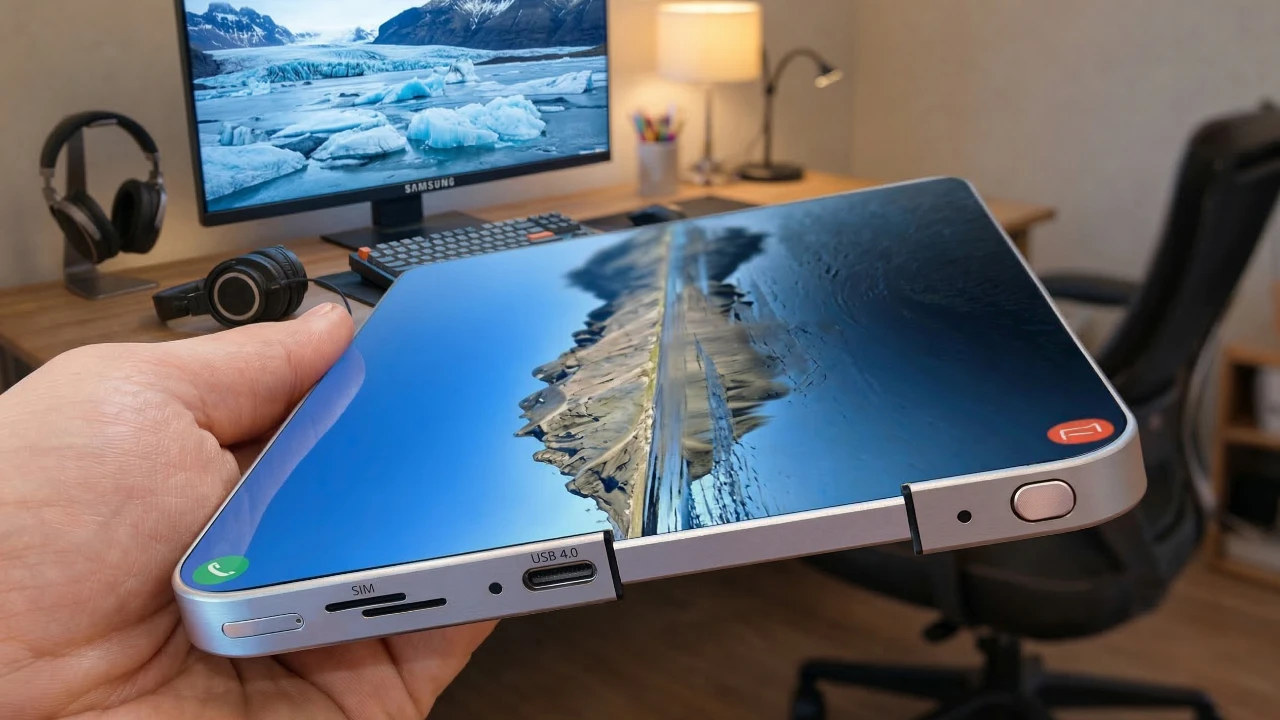
The smartphone industry has reached a plateau of glass slabs and incremental camera updates. While foldable devices like the Galaxy Z Fold series have successfully carved out a niche for power users, they have long been haunted by two primary engineering compromises: the visible display crease and the bulky, “sandwich” thickness of a hinged device. Samsung’s rumored Galaxy Z Roll 5G, whispered to debut in late 2026, is not merely an evolution of the foldable; it is a total structural reimagining of mobile computing. By replacing the hinge with a motorized scrolling mechanism, Samsung is attempting to merge the portability of a standard smartphone with the expansive canvas of a 12.4-inch workstation.
The Engineering Marvel: The Rollable Breakthrough
At the heart of the Galaxy Z Roll 5G lies a 12.4-inch Dynamic AMOLED 2X panel that does not fold, but glides. Unlike traditional foldables that stress the screen at a sharp 180-degree angle, the Z Roll utilizes a motorized “Rack and Pinion” system. The flexible OLED substrate wraps around a small-diameter internal roller hidden within the chassis. When activated, the motor smoothly unfurls the display, supported by a reinforced internal lattice that ensures the screen remains rigid and flat when fully extended.
This approach solves the “crease” problem that has plagued foldables since their inception. Because the screen is never subjected to a hard fold, the visual continuity is flawless. Furthermore, the motorized system allows for Adaptive Aspect Ratios. Imagine a device that rolls out slightly to a 21:9 ratio for a cinematic movie experience, but extends fully to a 4:3 or 16:10 ratio for intense multitasking or spreadsheet management. This fluidity represents a new era of “shape-shifting” hardware that responds to the user’s intent.

Visual Excellence: 3,000 Nits and Beyond
The display technology is expected to be a masterclass in optics. Rumors suggest a peak brightness of 3,000 nits, a necessity for a device marketed as a “pro-tablet” replacement that will inevitably be used in high-glare outdoor environments. Utilizing an LTPO 4.0 backplane, the refresh rate will dynamically scale from 1Hz to 144Hz, ensuring that high-octane gaming feels fluid while static text remains energy-efficient.
One of the more intriguing leaks involves an Integrated Privacy Layer. As the screen expands to a massive 12.4 inches, privacy becomes a concern in public spaces. Samsung is reportedly testing a “Micro-Louver” optical layer that can be electronically toggled. When active, it narrows the viewing angles so that the person sitting next to you on a plane sees only a black screen, while you enjoy a full-color, private workstation.
Performance: The 2nm “Elite” Architecture
To drive such a massive display and manage the power requirements of the motorized rollers, Samsung is expected to employ the Qualcomm Snapdragon 8 Elite Gen 6 Pro. Built on an advanced 2nm process, this chipset is designed for extreme thermal efficiency. This is critical because the Z Roll’s internal space is occupied by the rolling mechanism and a large battery, leaving less room for traditional cooling vapor chambers.
The device is rumored to ship with 16GB of LPDDR6 RAM, a move necessitated by Samsung’s push for “Standalone DeX.” In previous generations, DeX required an external monitor to provide a desktop-like experience. With the Z Roll, the 12.4-inch screen is large enough to run a native desktop environment directly on the device. This turns the phone into a legitimate laptop replacement, capable of running professional-grade video editors and CAD software without breaking a sweat.
Rumored Specifications
| Feature | Specification (Aggregated Rumors) |
| Main Display | 12.4-inch Rollable Dynamic AMOLED 2X (Extended) |
| Mechanism | Motorized “Zero-Crease” Scrolling System |
| Processor | Qualcomm Snapdragon 8 Elite Gen 6 Pro (2nm) |
| RAM | 12GB / 16GB LPDDR6 |
| Storage | 512GB / 1TB / 2TB UFS 5.0 |
| Primary Camera | 324MP Wide (ISO HR1 Sensor) |
| Telephoto | 50MP Periscope (10x Optical Zoom) |
| Ultrawide | 12MP with Macro Capabilities |
| Battery | 8,000mAh Dual-Cell Silicon-Anode |
| Charging | 100W Wired / 25W Wireless |
| Build Material | Grade 5 Titanium Alloy |
| Stylus | Built-in S Pen (2.1ms Latency) |
| Durability | IP68 Rated (Advanced Nano-coating) |
Photography: The 324MP “Super-Sensor.”
Samsung is not letting the innovative form factor distract from its photography heritage. The Z Roll is rumored to debut the 324MP ISO HR1 sensor. This sensor uses high-level pixel binning to combine 16 pixels into one “Super-Pixel,” allowing for incredible detail in daylight and massive light intake in near-total darkness.
For professionals, this means the ability to record 8K video at 60fps with virtually no crop, and the 50MP periscope lens offers 10x true optical zoom. When the screen is fully unrolled, the camera UI is expected to take advantage of the extra real estate, providing a “Director’s View” that shows the live feed alongside a full-screen editing timeline or previous shots for instant comparison.
Design, Durability, and the S Pen
A common concern with rollable technology is the fragility of the moving parts. To combat this, Samsung is utilizing Grade 5 Titanium for the chassis, providing a high strength-to-weight ratio. While the motorized tracks are susceptible to debris, leaks suggest that Samsung has developed a “sweep” mechanism—tiny internal brushes that clean the display as it retracts—similar to the technology used in the hinges of early Fold devices.
The S Pen also sees a significant upgrade. To match the premium nature of the Z Roll, the stylus will feature a record-low 2.1ms latency. Writing on a 12.4-inch rollable surface, which lacks the structural “gap” of a folding hinge, will provide the most paper-like digital writing experience to date.
Conclusion: Redefining the Smartphone
The Galaxy Z Roll 5G is more than a luxury toy; it is an answer to the question of what comes after the smartphone. By offering a device that can function as a discrete phone for quick messages and a full-sized tablet for deep work, Samsung is effectively consolidating three devices—phone, tablet, and laptop—into one pocketable frame.
While the rumored $2,799 price tag will keep it out of the hands of the average consumer at launch, the Z Roll serves as a “halo” product that proves Samsung’s dominance in display innovation. As we look toward late 2026, the Z Roll stands as a testament to the idea that the future of technology isn’t just about faster chips or better cameras, but about fundamentally changing how we interact with the digital world.
Source Mirror Pro
Disclosure: Some of our articles include affiliate links. If you buy something through one of these links, Geeky Gadgets may earn an affiliate commission. Learn about our Disclosure Policy.
