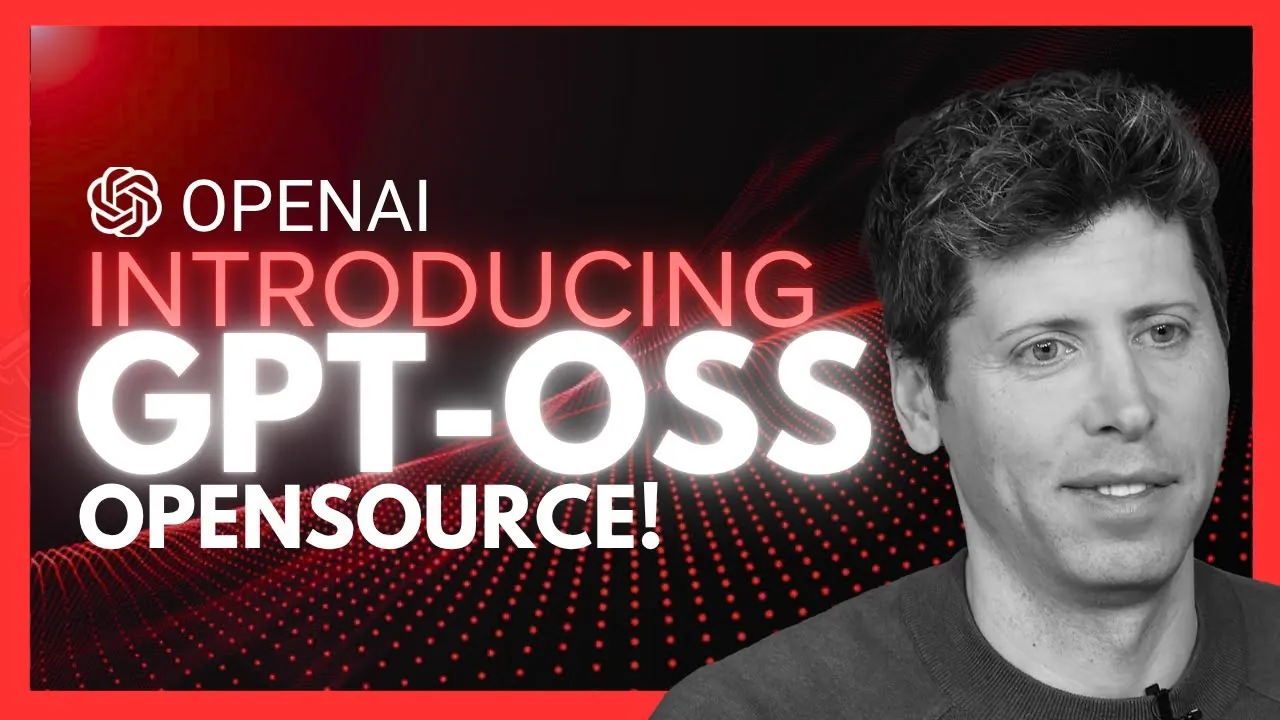
What if the future of AI wasn’t locked behind proprietary walls but instead placed in the hands of everyone? OpenAI’s bold release of GPT-OSS 120B and GPT-OSS 20B, two new open weight models, has sparked a wave of excitement—and debate—across the AI community. With their unparalleled reasoning capabilities and scalability, these models promise to redefine what open source AI can achieve. Yet, their creative limitations and the shadow of leaked competitors like Horizon Alpha raise tough questions about innovation and accessibility. Are these models a true gift to the open source world, or do they fall short of their potential?
In this overview, World of AI explore the unique strengths and trade-offs of OpenAI’s GPT-OSS models, from their Apache 2.0 license freedoms to their performance in logic-driven tasks. You’ll discover how these models stack up against alternatives, why their scalability makes them accessible to a diverse range of users, and where they might leave you wanting more. Whether you’re a developer seeking cost-effective solutions or a researcher pushing the boundaries of AI, this deep dive will help you decide if OpenAI’s latest release is the right fit for your needs. Sometimes, the most exciting innovations come with a twist—what will you make of this one?
OpenAI’s GPT-OSS AI Models
TL;DR Key Takeaways :
- OpenAI has released two open source AI models, GPT-OSS 120B and GPT-OSS 20B, under the Apache 2.0 license, allowing unrestricted experimentation, customization, and commercial use.
- The models excel in logical reasoning and mathematical problem-solving, with a 128k context length for handling extensive text inputs, but underperform in creative tasks like design and code generation.
- GPT-OSS 120B is optimized for high-performance systems with 120 billion parameters, while GPT-OSS 20B is designed for broader accessibility on everyday devices with 20 billion parameters.
- Deployment options include local environments, API integration, and platforms like Open Router, making sure flexibility and scalability for diverse use cases.
- The models use a mixture-of-experts architecture for cost-efficient performance, with token-based pricing tailored to accommodate various budgets and applications.
Key Features and Specifications
The GPT-OSS models are tailored to meet a variety of computational requirements, offering distinct advantages based on their scale and design. Below is a detailed comparison of their core features:
- GPT-OSS 120B: A large-scale model with 120 billion parameters, optimized for high-performance systems such as data centers and enterprise-level applications.
- GPT-OSS 20B: A medium-scale model with 20 billion parameters, designed for broader accessibility, including use on desktops and laptops.
- Reasoning Capabilities: Both models excel in logical reasoning and mathematical problem-solving, using advanced chain-of-thought techniques.
- Context Length: Support for a 128k context length enables efficient handling of extensive text inputs, making them suitable for complex tasks.
- Open source License: Distributed under Apache 2.0, allowing unrestricted experimentation, modification, and commercial use.
These features make the GPT-OSS models versatile tools for developers and researchers, catering to a wide range of computational needs.
Performance, Scalability, and Deployment
The GPT-OSS models are designed to accommodate varying hardware capabilities, making sure scalability for users with different resource constraints.
- GPT-OSS 120B: This model is optimized for high-end systems, offering unparalleled performance for data-intensive tasks. With its 120 billion parameters, it is best suited for environments requiring significant computational power, such as enterprise-level data centers and advanced research facilities.
- GPT-OSS 20B: A more accessible alternative, this model is designed for everyday devices, including desktops and laptops. It provides a cost-effective solution for developers and researchers with limited hardware resources.
Both models demonstrate exceptional reasoning capabilities, particularly in logic-driven tasks such as financial analysis, academic research, and mathematical computations. However, their creative outputs, including design and code generation, are inconsistent and often underperform when compared to other open source models.
To enhance accessibility, OpenAI offers multiple deployment options:
- Local deployment for offline environments, making sure data privacy and security.
- API access for seamless integration into existing workflows and applications.
- Availability through platforms like Open Router, providing added flexibility for users.
These deployment options, combined with the Apache 2.0 license, make the models adaptable to a wide range of use cases.
OpenAI GPT-OSS AI Models 120B & 20B Tested

Take a look at other insightful guides from our broad collection that might capture your interest in OpenAI AI models.
- OpenAI Horizon Alpha: Open Source ChatGPT-5 AI Model Details
- OpenAI o3 and o3-mini Introduced
- OpenAI Reveals How To Use GPT-4o More Effectively
- New OpenAI Swarm Framework Designed to Simplify Multi-Agent AI
- OpenAI GPT-5 Lobster : The Future of Smarter, Faster Coding
- The world is not ready for ChatGPT-5 says OpenAI
- OpenAI AI Model 03 Surpasses Human Reasoning – AGI?
- OpenAI Stargate Megafactory Tour with Sam Altman
- OpenAI Codex: Transforming Software Development with AI
- OpenAI’s ChatGPT-5 Roadmap: What to Expect from the Next AI
Technical Architecture and Cost Efficiency
The GPT-OSS models employ OpenAI’s proprietary training techniques and a mixture-of-experts architecture, which dynamically activates subsets of parameters to optimize efficiency. This architecture enables the models to balance performance with resource utilization, making them suitable for various applications.
- GPT-OSS 120B: Features 117 billion total parameters, with 5.1 billion active parameters per token, making sure high performance for complex tasks.
- GPT-OSS 20B: Comprises 21 billion total parameters, with 3.6 billion active parameters per token, offering a more resource-efficient alternative.
The pricing structure for these models is designed to accommodate a variety of budgets, making them accessible to a broad audience:
- GPT-OSS 120B: Input tokens are priced at $0.15 per million, while output tokens cost $0.60 per million.
- GPT-OSS 20B: Input tokens are priced at $0.05 per million, with output tokens costing $0.20 per million.
This token-based pricing model allows users to scale their usage based on specific requirements, making sure cost efficiency for both small-scale and large-scale applications.
Strengths, Limitations, and Ideal Use Cases
The GPT-OSS models are particularly well-suited for logic-intensive applications, offering robust performance in areas such as:
- Financial planning and analysis, where precise calculations and logical reasoning are critical.
- Academic research and data interpretation, allowing researchers to process and analyze large datasets efficiently.
- Offline AI applications, providing functionality in environments where internet access is unavailable.
Despite their strengths, the models have notable limitations:
- Creative Performance: Their outputs in creative tasks, such as design and code generation, are inconsistent and often fall short of expectations when compared to other open source alternatives.
- Content Restrictions: Fine-tuned to block malicious or restricted content, the models may lack adaptability in certain scenarios, limiting their flexibility for unrestricted applications.
These limitations may affect their suitability for projects requiring high-quality creative outputs or unrestricted adaptability. However, their strengths in reasoning and logic-driven tasks make them valuable tools for developers and researchers.
Impact on the Open source AI Community
The release of the GPT-OSS 120B and 20B models represents a significant milestone for the open source AI community. By offering these models under the Apache 2.0 license, OpenAI has empowered developers and researchers to innovate without the constraints of proprietary systems. This move has the potential to foster greater collaboration and innovation within the AI ecosystem.
However, the reception has been mixed. While many applaud OpenAI’s commitment to open source accessibility, others express disappointment over unmet expectations, particularly when comparing these models to leaked alternatives like Horizon Alpha. This highlights the ongoing debate within the AI community regarding the balance between accessibility, performance, and innovation.
The GPT-OSS models mark a pivotal step in the evolution of open weight AI, offering developers and researchers a robust foundation for a wide range of applications. Their strengths in reasoning and mathematical tasks, combined with their open source nature, make them valuable assets for advancing AI research and development.
Media Credit: WorldofAI
Disclosure: Some of our articles include affiliate links. If you buy something through one of these links, Geeky Gadgets may earn an affiliate commission. Learn about our Disclosure Policy.
