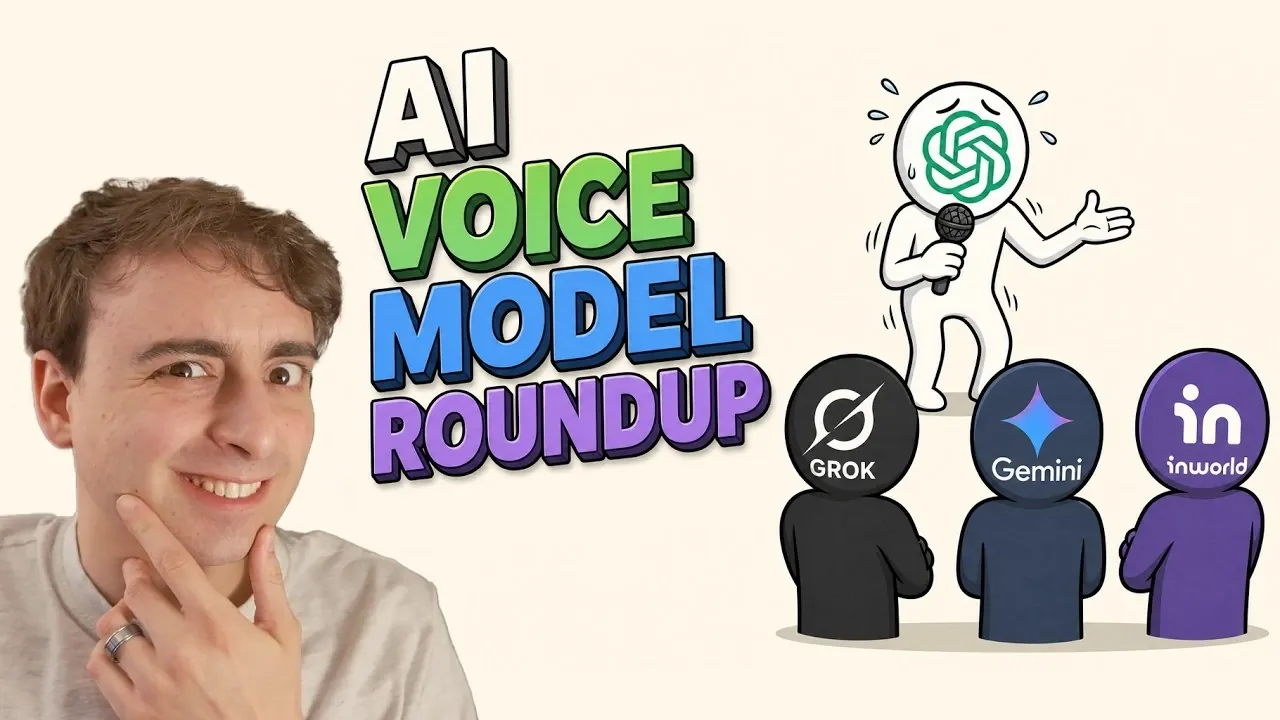
AI voice models are evolving rapidly, offering breakthroughs in communication and automation across industries. In a recent analysis by MattVidPro, the focus shifts to some of the most prominent players in this space, including OpenAI, Google, XAI and InWorld AI. OpenAI’s GPT Realtime-2, for instance, demonstrates remarkable multilingual capabilities, supporting over 70 languages while maintaining conversational flow through robust context retention. However, challenges such as hallucinations and rigid safety constraints highlight the ongoing trade-offs in balancing precision and flexibility. These nuances underscore the complexity of refining AI voice systems for real-world applications.
Dive into this breakdown to uncover how these models excel in distinct areas. You’ll gain insight into Google’s expressive text-to-speech outputs, XAI’s voice cloning for branded experiences and InWorld AI’s focus on immersive, fast-paced interactions. Additionally, the analysis addresses critical challenges like steerability and response quality, providing a well-rounded view of the current landscape. Whether you’re interested in real-time translation, interactive gaming, or customer support, this guide offers practical takeaways to help you understand the strengths and limitations of today’s leading AI voice technologies.
OpenAI GPT Realtime-2: Multilingual Precision
TL;DR Key Takeaways :
- OpenAI’s GPT Realtime-2 excels in real-time multilingual translation and conversational flow but faces challenges with hallucinations and safety guardrails limiting flexibility.
- Google’s TTS model delivers highly expressive and customizable voice outputs, ideal for emotional and personalized applications, though slower response times hinder real-time use.
- InWorld AI’s TTS-2 focuses on immersive, fast-paced interactions for gaming but lacks refined emotional delivery and steerability for complex scenarios.
- XAI’s Groon Voice Agent API balances speed and versatility, offering voice cloning for personalized applications but struggles with hallucinations and instruction adherence.
- AI voice models are transforming industries with applications in real-time translation, customer support, interactive gaming and task automation, while facing challenges like hallucinations, context misinterpretations and steerability limitations.
OpenAI’s GPT Realtime-2 stands out for its exceptional real-time translation capabilities, supporting over 70 languages. Designed with voice agents in mind, it excels in reasoning, task execution and maintaining conversational flow through robust context retention. This makes it a powerful tool for multilingual communication and intelligent voice interactions. However, like many AI models, it is not without flaws. The phenomenon of hallucination, where the model generates inaccurate or fabricated responses, can occasionally undermine its reliability. Additionally, its safety guardrails, while essential for preventing harmful outputs, sometimes limit flexibility in certain use cases. Despite these challenges, GPT Realtime-2 remains a strong contender for applications requiring intelligent, multilingual voice capabilities.
Google’s TTS Model: Expressiveness Redefined
Google’s text-to-speech (TTS) model is widely recognized for its natural and expressive voice outputs. It offers advanced customization options, allowing you to adjust pacing, tone and persona to suit specific needs. Integrated into the Gemini live mode, it separates reasoning tasks from TTS functions, making sure clarity and precision in its outputs. Its ability to deliver emotionally rich and lifelike speech makes it ideal for applications where expressiveness and personalization are critical. However, slower response times may limit its effectiveness in real-time scenarios, such as live customer support. Even so, Google’s TTS model is a top choice for projects prioritizing emotional delivery and tailored user experiences.

Here is a selection of other guides from our extensive library of content you may find of interest on AI Voice Models.
InWorld AI TTS-2: Immersive Interactions
InWorld AI’s TTS-2 model is tailored for creating immersive experiences, particularly in interactive environments like video games. Its rapid response times make it well-suited for dynamic, fast-paced scenarios where immediate feedback is essential. However, its voice quality and emotional range are less refined compared to Google’s TTS model, which may limit its appeal in applications requiring nuanced emotional delivery. Additionally, its steerability, your ability to guide the model’s behavior, is somewhat restricted, reducing its adaptability in complex or highly customized scenarios. Despite these limitations, InWorld AI TTS-2 excels in entertainment and gaming contexts, where speed and engagement are paramount.
XAI’s Groon Voice Agent API: Balancing Speed and Versatility
XAI’s Groon Voice Agent API offers a balanced approach, combining speed and expressiveness to cater to a variety of use cases. One of its standout features is voice cloning, available in enterprise plans, which allows you to replicate specific voices for personalized applications. This capability is particularly valuable for businesses seeking to create unique, branded voice experiences. However, the model occasionally struggles with hallucinations and adherence to bracketed instructions, leading to inconsistencies in certain outputs. Positioned between InWorld AI and Google in terms of performance, XAI’s Groon API is a versatile solution for businesses looking for reliable and adaptable voice agent technologies.
Key Applications of AI Voice Models
AI voice models are driving innovation across a wide range of industries, allowing fantastic applications that enhance efficiency and user experiences. Some of the most impactful use cases include:
- Real-time translation: Breaking down language barriers to assist seamless global communication.
- Customer support: Improving user experiences with AI-powered chatbots and virtual receptionists capable of handling complex queries.
- Interactive gaming: Enhancing storytelling and engagement by bringing video game characters to life with dynamic voice interactions.
- Task automation: Streamlining daily activities through personal voice assistants that execute commands efficiently.
Beyond these applications, AI voice technologies are being explored for use in education, healthcare and creative content generation. For example, they are being integrated into language learning tools, medical communication platforms and automated scriptwriting systems, showcasing their versatility and potential to transform various sectors.
Challenges Facing AI Voice Models
Despite their impressive capabilities, AI voice models face several challenges that impact their performance, reliability and adoption. Addressing these issues is crucial for their continued development and broader application. Key challenges include:
- Hallucinations: The generation of inaccurate or fabricated responses, which can erode trust and usability in critical applications.
- Context misinterpretations: Difficulty in maintaining accuracy during complex or nuanced conversations, leading to errors in understanding or response.
- Trade-offs: Balancing speed, expressiveness and precision often requires prioritizing one feature at the expense of others, depending on the application.
- Steerability limitations: Challenges in aligning models to specific instructions or nuanced directives, which can limit their adaptability in specialized use cases.
As demand for human-like voice interactions continues to grow, overcoming these challenges will be essential for unlocking the full potential of AI voice technologies.
The Future of AI Voice Models
The future of AI voice models is marked by rapid advancements aimed at enhancing reasoning, emotional delivery and task execution. As these technologies become more reliable and versatile, their applications are expected to expand across industries, driving innovation and improving user experiences. Increased competition among providers such as OpenAI, Google, XAI and InWorld AI will likely accelerate progress, resulting in more sophisticated and accessible solutions for businesses and individuals alike.
AI voice models are poised to redefine how you engage with technology, offering smarter, more intuitive interactions that bridge the gap between human and machine communication. By addressing current limitations and building on their strengths, these technologies are set to play a pivotal role in shaping the future of human-computer interaction.
Media Credit: MattVidPro
Disclosure: Some of our articles include affiliate links. If you buy something through one of these links, Geeky Gadgets may earn an affiliate commission. Learn about our Disclosure Policy.
