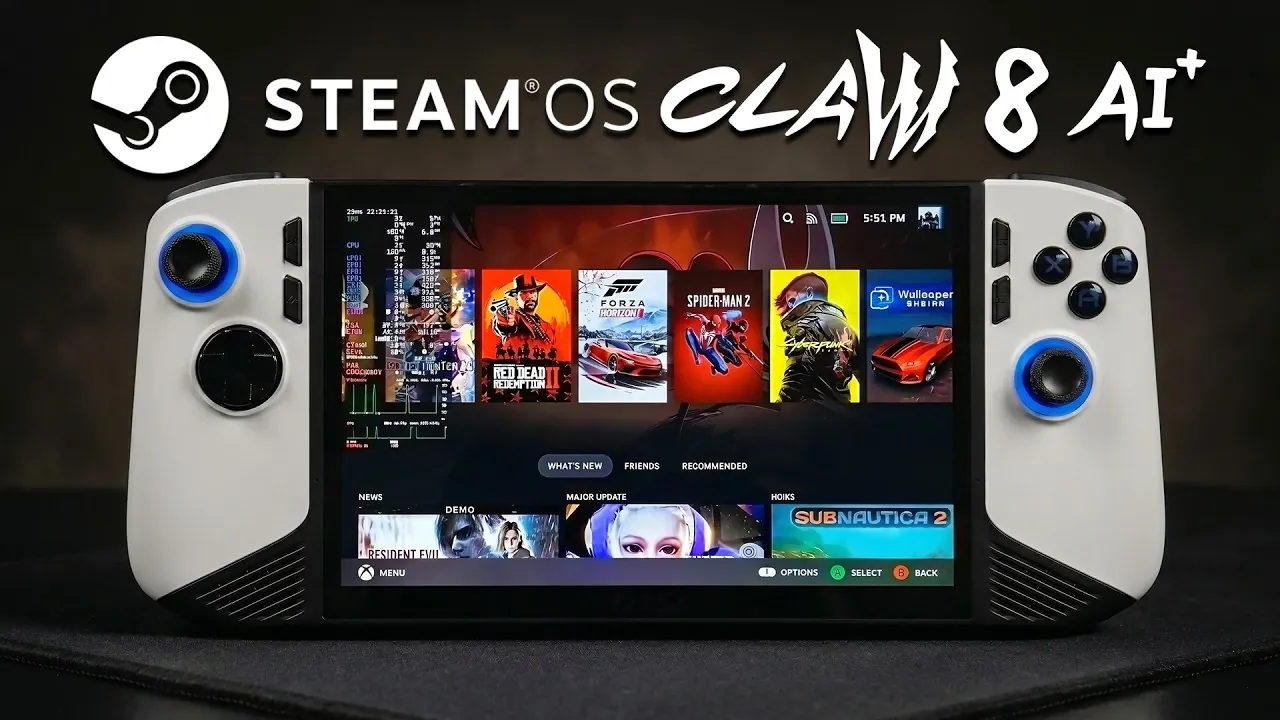
Valve’s release of the SteamOS 3.8.7 beta introduces official support for the MSI Claw 8 AI Plus, marking a significant step in expanding compatibility with Intel-powered handheld devices. As highlighted by ETA Prime, this update brings key improvements such as enhanced controller support, smoother gyro functionality and better SD card reliability. These changes reflect Valve’s effort to optimize SteamOS for a wider range of hardware, moving beyond its traditional AMD focus. However, the update also reveals ongoing challenges, particularly in performance and functionality when compared to Windows, especially for graphically demanding games.
In this breakdown, you’ll explore how SteamOS performs on the MSI Claw 8 AI Plus, including its strengths in low-TDP scenarios and its efficiency with older game titles. Gain insight into the limitations users may face, such as inconsistent power management and the need for third-party solutions to adjust TDP settings. Additionally, the discussion will cover battery life considerations and how SteamOS compares to Windows for gaming on Intel systems. These details provide a balanced view of what to expect from SteamOS on Intel-powered handhelds.
SteamOS 3.8.7 Beta
TL;DR Key Takeaways :
- Valve’s SteamOS 3.8.7 beta update introduces official support for Intel-powered devices, particularly the MSI Claw 8 AI Plus, marking a shift from its AMD-focused ecosystem.
- Key improvements include enhanced controller support, better SD card reliability and smoother gyro functionality, aimed at refining the gaming experience on Intel-based systems.
- Performance on SteamOS shows strengths in less demanding games and lower TDP settings but struggles to match Windows in graphically intensive titles due to superior driver optimization on Windows.
- Challenges such as limited native TDP control, inconsistent power management and menu button functionality issues highlight areas for further development on Intel devices.
- Future advancements in Intel hardware and driver updates, combined with Valve’s ongoing updates, could narrow the performance gap between SteamOS and Windows, offering a more competitive alternative for handheld gaming.
The SteamOS 3.8.7 beta introduces a range of updates tailored to improve the gaming experience on MSI Claw devices, particularly the Claw 8 AI Plus. These updates include:
- Enhanced controller support: Compatibility has been expanded to cover MSI Claw models, including the A1M, 8 AI Plus and A8 with Z2 Extreme configurations, making sure seamless gameplay.
- Improved SD card reliability: Previous issues with data stability and transfer speeds have been addressed, offering a more dependable storage solution for gamers.
- Gyro functionality fixes: Motion controls are now smoother and more accurate, enhancing gameplay for titles that rely on gyro input.
These updates reflect Valve’s dedication to refining SteamOS for a wider range of hardware, particularly Intel-based systems, as it seeks to establish itself as a viable alternative to Windows for handheld gaming.
MSI Claw 8 AI Plus: A Hardware Overview
The MSI Claw 8 AI Plus serves as the centerpiece for testing the SteamOS 3.8.7 beta. This device is powered by Intel’s Core Ultra 258V CPU, paired with the ARC 140VIG GPU and 32GB of RAM. Historically, Valve’s focus has been on AMD hardware, but this update highlights a shift toward supporting Intel-powered devices. The inclusion of Intel’s ARC 140VIG GPU demonstrates SteamOS’s growing versatility, though achieving optimal performance on Intel systems remains a challenge.
The hardware configuration of the MSI Claw 8 AI Plus positions it as a capable device for portable gaming. However, the performance of SteamOS on this platform reveals both strengths and limitations, particularly when compared to Windows.

Here are more guides from our previous articles and guides related to SteamOS that you may find helpful.
- Why Valve’s New Steam OS Update Completely Changes How You Use Your Deck
- Why Valve’s Latest SteamOS Update Changes Everything for Your Steam Machine
- Valve Finally Solves Long-Standing SteamOS Bugs in New Update
- Steam Machine Update : Valve Outlines Proton, FEX and Leptin Plan for One Game Build
- Official SteamOS 3.8 Builds a Powerful Gaming Tablet with 165Hz Display
- Forza Horizon 6 on SteamOS : Steam Deck vs Z2 Go vs Z1 Extreme Tested
- Valve’s 2026 Steam Machine is Almost Here
- Steam Gaming On ROG Flow Z13 13-inch 180 Hz Tablet Running SteamOS
- Don’t Wait for Valve: Build Your Own Steam Machine in 2026
- SteamOS Anti-Cheat Update : Anti-cheat is coming to Steam Hardware in 2026
Performance Insights: Strengths and Limitations
SteamOS 3.8.7 delivers notable performance improvements in specific scenarios, particularly at lower TDP (Thermal Design Power) settings between 15W and 30W. Popular titles such as Cyberpunk 2077, Spider-Man 2, and Forza Horizon 6 are playable, albeit with compromises in resolution and graphical settings. Meanwhile, older games like Left 4 Dead 2 and Half-Life 2 perform exceptionally well, even at higher settings, showcasing SteamOS’s efficiency with less demanding titles.
Despite these improvements, SteamOS struggles to match Windows in graphically intensive games. The primary reason lies in Windows’ superior driver optimization, particularly for Intel’s ARC GPUs. As a result, users may experience lower frame rates and reduced visual quality on SteamOS, making it less appealing for gamers seeking peak performance in demanding titles.
Challenges and Potential Workarounds
While the SteamOS 3.8.7 beta introduces valuable features, several limitations persist that hinder the overall gaming experience on Intel-powered devices. Key challenges include:
- Menu button functionality: On MSI Claw devices, the menu button requires switching to desktop mode, interrupting gameplay and reducing convenience.
- Limited native TDP control: SteamOS lacks built-in tools for adjusting power settings, forcing users to rely on third-party plugins like Simple Decki TDP for power management.
- Inconsistent power management: Resource allocation between the CPU and GPU remains uneven, leading to performance bottlenecks in graphically demanding games.
These challenges highlight areas where further development is needed to improve the usability and performance of SteamOS on Intel-powered handhelds.
Battery Life Considerations
The MSI Claw 8 AI Plus is equipped with an 80Wh battery, offering impressive runtime under certain conditions. At lower TDP settings, the device can achieve over seven hours of battery life, making it a strong choice for portable gaming with less demanding titles. However, higher TDP settings required for graphically intensive games significantly reduce battery life, often limiting sessions to just a few hours. This underscores the need for more efficient power management solutions to balance performance and battery longevity.
Future Prospects for SteamOS on Intel Devices
The future of SteamOS on Intel-powered devices appears promising, with several advancements on the horizon. Intel’s upcoming G3 series processors and Panther Lake architecture are expected to deliver enhanced performance, potentially narrowing the gap between SteamOS and Windows. Additionally, future driver updates and optimizations for Intel ARC GPUs could further improve gaming performance on SteamOS.
Valve’s continued updates to SteamOS, combined with Intel’s hardware advancements, may position SteamOS as a more competitive platform for handheld gaming. While challenges remain, these developments suggest a brighter future for SteamOS as an alternative to Windows, particularly for users who value an open source platform with a focus on portability and efficiency.
SteamOS vs Windows: A Practical Comparison
At present, Windows remains the dominant platform for gaming on Intel-powered devices, thanks to its advanced ARC driver support and broader compatibility with demanding games. SteamOS, while making significant strides, still requires further refinement to match Windows in terms of performance and functionality. For gamers seeking the best possible experience on Intel systems, Windows remains the preferred choice.
However, SteamOS offers a compelling alternative for those who prioritize an open source platform. Its focus on portability, efficiency and ongoing updates makes it an attractive option for users willing to navigate its current limitations. As Valve continues to refine SteamOS and Intel improves its hardware and software ecosystem, the gap between the two platforms may narrow, offering gamers more viable choices for their handheld gaming needs.
Media Credit: ETA PRIME
Disclosure: Some of our articles include affiliate links. If you buy something through one of these links, Geeky Gadgets may earn an affiliate commission. Learn about our Disclosure Policy.
