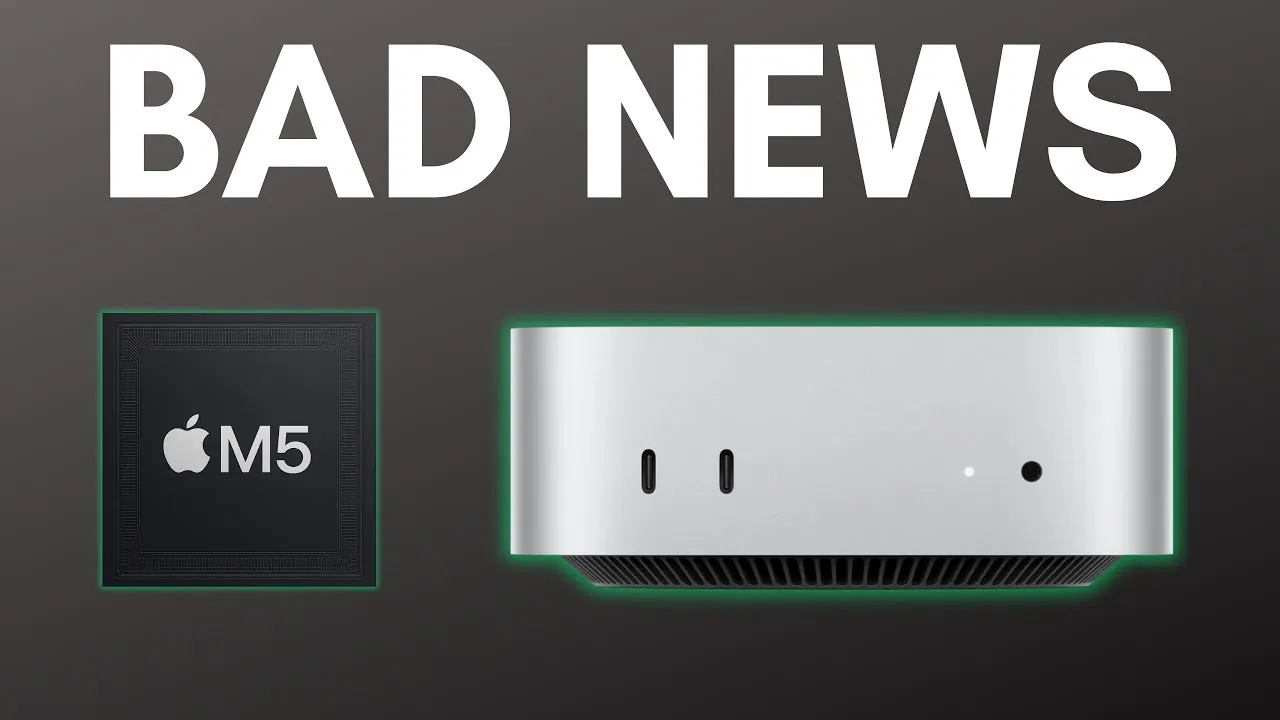
Apple has officially confirmed that its highly anticipated M5-powered Mac Mini, along with other desktop models, will not debut in 2025. Instead, these devices are now scheduled for release in 2026. This decision reflects Apple’s strategic approach to synchronize the launch of its desktop lineup—including the Mac Mini, Mac Studio, and potentially a new iMac—with the introduction of the advanced M5 Pro, Max, and Ultra chipsets. While the base M5 Mac Mini could theoretically launch earlier, Apple appears to prioritize a cohesive and unified rollout for its desktop ecosystem, making sure consistency in its product offerings. The video below from SaranByte gives us more details about when we might see the new M5 Mac Mini.

Why Is Apple Delaying the M5 Mac Mini?
During a recent earnings call, Apple’s Chief Financial Officer clarified that no new Mac models are planned for release in 2025. This announcement confirms that the M5 Mac Mini, Mac Studio, and iMac will launch together in 2026. The delay is not attributed to technical difficulties with the base M5 chip itself. Instead, it stems from Apple’s decision to align the release of its desktop lineup with the debut of the higher-tier M5 Pro, Max, and Ultra processors. This synchronized launch strategy allows Apple to streamline its marketing efforts, refine its modular chip architecture, and deliver a more cohesive product experience.
By delaying the release, Apple ensures that its desktop lineup benefits from the full potential of the M5 family of processors, offering users a seamless upgrade path and a consistent performance standard across devices.
What Makes the M5 Chip Stand Out?
The M5 chip represents a significant evolution in Apple Silicon, using innovative 3nm technology to deliver substantial performance improvements. Its advancements are expected to redefine the capabilities of Apple’s desktop lineup, offering users a more powerful and efficient computing experience. Key highlights of the M5 chip include:
- Enhanced GPU performance: Delivering up to 45% faster graphics processing, the M5 chip is ideal for demanding tasks such as video editing, 3D rendering, and gaming.
- Improved CPU speeds: Multi-core performance is 15% faster, allowing smoother workflows for resource-intensive applications.
- Advanced AI capabilities: The chip features faster machine learning operations and improved on-device intelligence, enhancing productivity and efficiency.
- Better memory performance: With reduced latency and improved efficiency, the M5 chip ensures smoother multitasking and faster data handling.
Despite these advancements, the M5 chip retains the hallmark unified architecture of Apple Silicon, making sure seamless integration between hardware and software. This combination of power and efficiency positions the M5 chip as a cornerstone of Apple’s future desktop lineup.
Understanding the Delay: Key Factors at Play
Apple’s decision to delay the release of its M5-powered desktop lineup is influenced by several critical factors:
- New modular architecture: The M5 Pro and Max chips introduce a more complex design, requiring additional development and testing to ensure optimal performance and reliability.
- Unified product launch: Apple aims to release its desktop lineup simultaneously, simplifying consumer adoption and maximizing the impact of its marketing efforts.
- 3nm production challenges: Scaling up production for 3nm chip technology is a technically demanding process, potentially contributing to extended timelines.
By taking the time to address these challenges, Apple can refine its products and ensure they meet the high standards expected by its users. This approach underscores Apple’s commitment to delivering a polished and optimized desktop lineup.
Should You Wait for the M5 Mac Mini?
Deciding whether to wait for the M5 Mac Mini depends on your current computing needs and priorities. Here are some factors to consider:
- The M4 Mac Mini remains a strong contender: With frequent discounts and robust performance, the M4 Mac Mini offers excellent value for most users, making it a practical choice for those who need an upgrade now.
- Waiting may not be essential: While the M5 promises significant performance gains, these improvements may not justify waiting until 2026, especially if your current device is struggling to meet your needs.
- Potential price drops: The M4 Mac Mini is likely to see further price reductions following the launch of the M5 lineup, making it an even more attractive option for budget-conscious buyers.
For most users, the M4 Mac Mini remains a reliable and cost-effective solution today. However, if you prioritize innovative performance and are willing to wait, the M5-powered devices are expected to deliver a significant leap forward in desktop computing.
What to Expect from Apple’s 2026 Desktop Lineup
When Apple unveils its refreshed desktop lineup in 2026, several exciting updates are anticipated:
- M5-powered devices: The Mac Mini, Mac Studio, and potentially a new iMac will feature the next-generation M5 chip, offering substantial performance and efficiency improvements.
- Second-generation Studio Display: Apple is expected to introduce an updated display alongside its desktop lineup, enhancing the overall user experience.
- Incremental upgrades: While major design changes for the Mac Mini are unlikely, Apple may enhance base storage and memory configurations to provide better value for users.
These updates will position Apple’s desktop lineup as a benchmark for performance, efficiency, and innovation in the computing industry. For users seeking the latest advancements, the 2026 lineup is poised to deliver a compelling upgrade opportunity.
Master M5 Mac Mini with the help of our in-depth articles and helpful guides.
- M5 Mac Mini Release Delayed to 2026: What You Need to Know
- Apple M5 Mac Mini Release Date, Specs, and Features
- M5 Mac Mini Pricing, Specs, and Release Timeline Revealed
- Mac Mini M5 Leaks: Features, Release Date, and More
- M5 Mac Mini 2025: Features, Upgrades, and Design Changes
Source & Image Credit: SaranByte
Disclosure: Some of our articles include affiliate links. If you buy something through one of these links, Geeky Gadgets may earn an affiliate commission. Learn about our Disclosure Policy.
