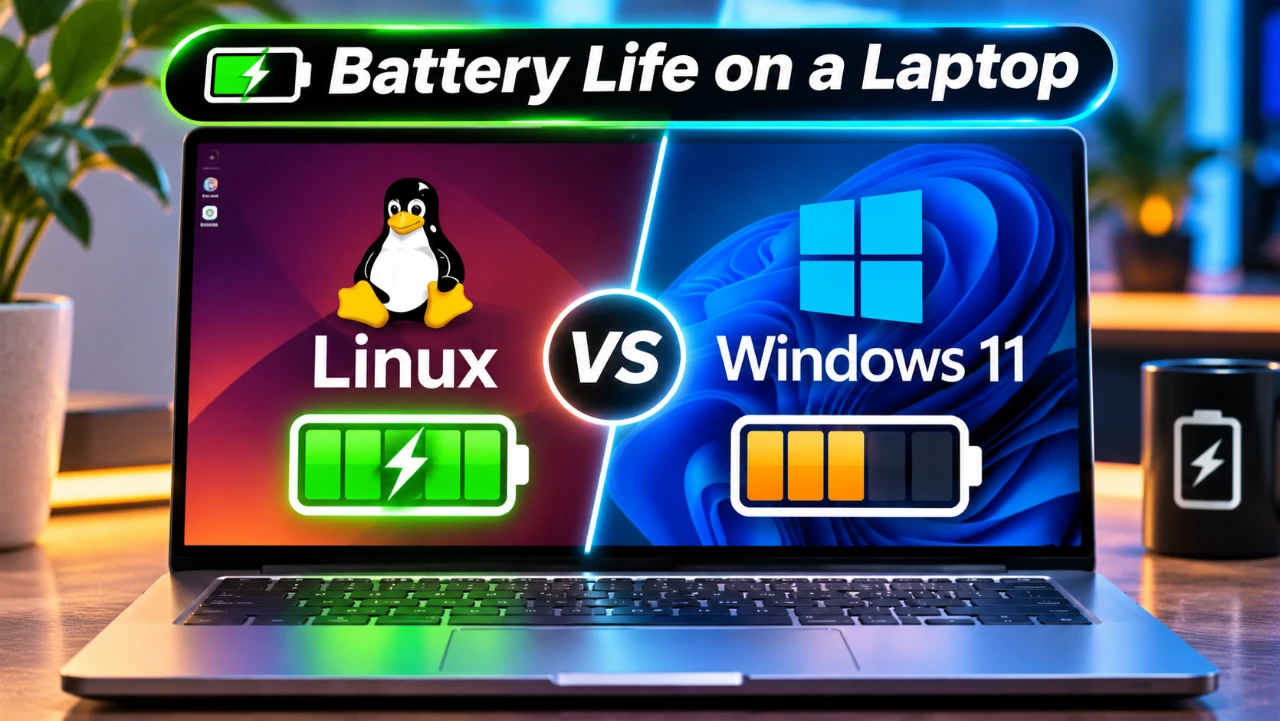
A 78% battery-life lead went to Linux Fedora when pitted against Windows 11 on the Dell XPS 13 during Minecraft testing, though that unusually wide gaming gap prompted skepticism even from the tester. Code compilation offered another stark contrast: Windows 11 shut down on low battery while Fedora still had roughly 40% charge left, whereas everyday web browsing and standby drain came out virtually neck and neck. As detailed in a lab-style comparison video from PhoneBuff below, how your operating system affects unplugged runtime depends heavily on your daily workload—and on specific system tweaks made behind the scenes.
TL;DR Key Takeaways :
- Web browsing: Two hours in Chrome left Fedora at 80% battery and Windows 11 at 81%.
- Standby drain: Both laptops dropped six percentage points over 16 hours with lids closed.
- Video streaming: Two hours of YouTube used 21 percentage points on Fedora versus 23 on Windows.
- Minecraft runtime: Fedora was calculated to last 78% longer, though PhoneBuff questioned the size of the difference.
- Code compilation: Fedora still had ~40% battery when Windows ran out, then ran for another two hours and five minutes.
Linux Fedora lasted considerably longer than Windows 11 during Minecraft and Visual Studio Code workloads across two identically configured Dell XPS 13 laptops. In lighter tasks like browsing and overnight standby, power draw was nearly identical, while Fedora held a modest advantage during video playback.
The test paired two physically separate Dell XPS 13 (DX13260) units—one running Windows 11 and the other running Fedora—equipped with a 52 Wh battery and matching core specifications:
- Processor: Intel Core 5 320 (Wildcat Lake series)
- Memory: 8 GB of RAM
- Storage: 512 GB SSD
Dell rates the XPS 13 for up to 17 hours of battery life on Core Series 3 configurations and up to 20 hours on Core Ultra Series 3 models, though manufacturer estimates differ from multi-day benchmark loops. Both test machines ran their default Balanced power profiles with displays locked to 200 nits, auto-brightness disabled, speakers matched by decibel level, equal distance from a Wi-Fi router, and controlled room temperature.
Browsing and Productivity Drain Were Nearly Identical
Web browsing showed virtually no practical difference between the two operating systems. After two hours of automated scrolling across random websites in Chrome, Fedora sat at 80% remaining battery while Windows 11 sat at 81%.
That tight parity continued across two additional hours of productivity multitasking, where both systems played Spotify while switching between a document and a spreadsheet, copying data, and typing on the keyboard, finishing within one percentage point of each other.
On Fedora, speaker amplifiers required manual adjustment because they were not active out of the box; once tuned, audio output sounded close to Windows 11. A 30-minute Zoom call also ended evenly at 54% on both machines, with Fedora using one percentage point less—well inside normal test variance while both ran subject framing and background blur.
| Test Scenario | Windows 11 Result | Linux Fedora Result | Takeaway |
|---|---|---|---|
| Chrome Browsing (2 hrs) | 81% remaining | 80% remaining | Virtually identical drain in light web use |
| Standby (16 hrs lid closed) | -6 percentage points (~15s wake) | -6 percentage points (near-instant wake) | Equal battery drop; Fedora woke much faster |
| YouTube Streaming (2 hrs) | -23 percentage points | -21 percentage points | Slight Fedora edge with RPM Fusion VA-API codecs |
| Minecraft (30 FPS cap) | Depleted around 3 hrs 40–41 mins | ~46% left at 3 hrs 40 mins; +78% overall | Large Fedora lead, though gap drew skepticism |
| VS Code Compile & Tests | Shut down after ~3 hrs 44 mins | ~40% left at Windows shutdown (+2h 05m) | Major Fedora endurance lead under heavy load |
Standby Drain Matched, While Fedora Led in Streaming
Over 16 hours with the lid closed, both laptops lost six percentage points. The difference showed up upon waking: Fedora resumed almost instantaneously when opened, whereas the Windows 11 laptop required a power button press and roughly 15 seconds to become responsive.

During two hours of YouTube playback, Fedora edged ahead by losing 21 percentage points compared with 23 percentage points on Windows 11. Both supported 4K YouTube streams, whereas Disney+ remained capped at 720p in desktop browsers across platforms.
To give Fedora fair media acceleration, RPM Fusion’s full-codec Intel VA-API driver was installed to enable hardware-accelerated H.264 and HEVC decoding missing from the stock driver stack.
Fedora Lasted Longer in Minecraft, Despite a Crash
Minecraft Java Edition produced the biggest percentage gap in the test, even after Fedora crashed immediately on the initial run and needed a reboot. Both laptops used identical graphics settings and a 30 FPS frame cap that both systems could exceed.
In the first run, Windows 11 powered down at 44 minutes while Fedora had an estimated 14% charge remaining and ran for another 40 minutes. A fresh run starting from 100% on both units tracked the divergence across the session:
- At 1 hour: Fedora dropped 14 percentage points versus 25 percentage points on Windows 11.
- At 3 hours: Fedora held 56% battery remaining compared with 20% on Windows 11.
- At 3 hours, 40 minutes: Windows 11 exited the game at 2% battery while Fedora still had 46% remaining.
Windows 11 entered hibernation after dropping out of the game, while Fedora kept running for nearly three more hours. Calculations put Fedora’s runtime 78% longer in Minecraft—a figure PhoneBuff noted felt surprisingly large even accounting for per-unit hardware variance.
Code Compilation Produced Another Large Fedora Lead
Sustained developer workloads in VS Code also favored Fedora. Each laptop repeatedly scanned an open-source whiteboard project for errors, compiled it, and ran nearly 1,900 tests in loops scheduled to complete the same number of cycles per hour—building on earlier speed testing where Fedora finished the task faster overall.
After one hour, Windows 11 had lost 24 percentage points while Fedora had lost 15 percentage points. By the three-hour mark, Fedora still had 53% charge left against 23% on Windows 11.
Windows 11 ran out of battery 45 minutes later, at which point Fedora still showed roughly 40% remaining and continued running for another 2 hours and 5 minutes before shutting down.
Turning Off Windows Defender Changed Little
Because Fedora did not run an equivalent real-time background file scanner in this test setup, background antivirus activity on Windows 11 was a prime suspect. Rerunning the Windows 11 battery test with Windows Defender disabled gained only about 10 extra minutes—a minor shift likely within testing margin rather than the main cause of the gap.
What stands out most in this test is how sharply the battery gap shifts depending on workload intensity. In Chrome and office multitasking, Windows 11 and Fedora are nearly indistinguishable on battery; under sustained compilation or gaming load, Fedora stretches runtime dramatically further.
PhoneBuff’s takeaway points heavy-workload users on this XPS 13 toward Fedora, while everyday browsers and office workers see little battery reason to switch operating systems. Even with skepticism around the 78% Minecraft figure, the compilation result shows that how you push your hardware—and app or driver compatibility—matters far more than any blanket operating-system claim.
Deep dive into the latest in Dell XPS 13 and OS comparisons by exploring our other resources and articles.
- How to Install Fedora Linux: A Step-by-Step Beginner’s Guide for 2025
- How to optimize Windows 11 for ultimate performance
- Tiny11 Builder Shrinks Windows 11 ISO from 8.9 GB to 5.5 GB
- New Windows 11 26H2 Features to Improve Your Daily Workflows
- Remove Windows 11 Bloatware & Tracking For a Faster, Private and More Efficient PC
Source: PhoneBuff
Disclosure: Some of our articles include affiliate links. If you buy something through one of these links, Geeky Gadgets may earn an affiliate commission. Learn about our Disclosure Policy.
