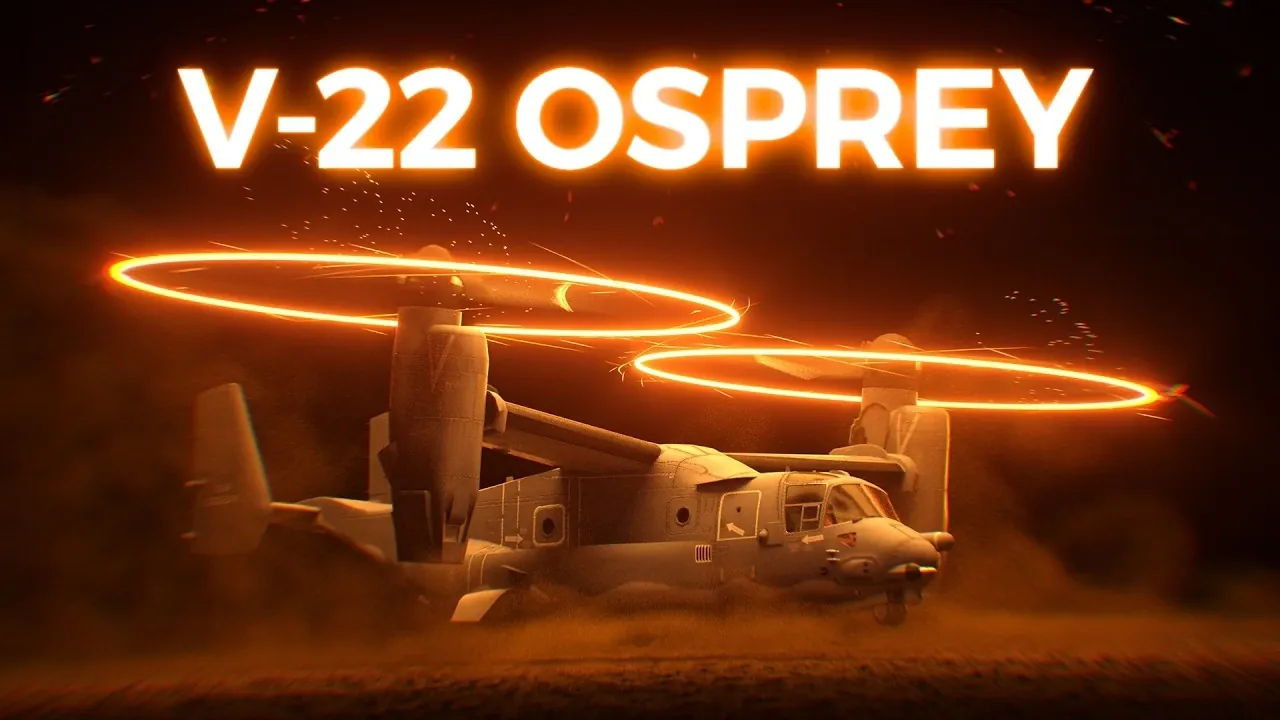
The V-22 Osprey is a tiltrotor aircraft that merges the vertical takeoff and landing abilities of a helicopter with the speed and range of a fixed-wing plane. Real Engineering breaks down the mechanics of this hybrid design, focusing on the conversion actuator, a key system that enables seamless transitions between vertical and horizontal flight. This capability is further supported by a fly-by-wire control system and the use of advanced materials like carbon epoxy composites and titanium, which help the aircraft endure the demanding conditions of its diverse missions, including military operations and disaster response.
Explore how the Osprey’s engine synchronization system ensures stability during mode transitions and uncover the aerodynamic role of its blade twist profile in improving flight efficiency. Learn about the operational challenges caused by its intense downwash during landings and the rigorous testing protocols that have informed its safety standards. This breakdown provides a closer look at the engineering decisions that define the Osprey’s performance.
The Strategic Importance of the V-22 Osprey
TL;DR Key Takeaways :
- The V-22 Osprey combines vertical takeoff and landing (VTOL) capabilities of a helicopter with the speed and range of a fixed-wing airplane, making it highly versatile for military and humanitarian missions.
- Its innovative tiltrotor mechanism, supported by advanced materials like carbon epoxy composites, S2 fiberglass and titanium, enables seamless transitions between helicopter and airplane modes.
- Developed in response to operational needs highlighted by the failed Operation Eagle Claw, the Osprey overcame technical and budgetary challenges to become a critical asset for rapid-response and deep-target missions.
- While offering high-speed horizontal flight and extended range, the Osprey faces tradeoffs such as reduced hover efficiency and powerful downwash, requiring careful operational planning.
- Despite early safety concerns, the Osprey has evolved into a reliable platform through rigorous testing, enhanced training and system refinements, showcasing the importance of persistence and innovation in aerospace engineering.
The V-22 Osprey was developed to meet a critical operational need: the ability to perform vertical takeoffs and landings while achieving high-speed horizontal flight. This dual capability allows the aircraft to operate effectively across a wide range of scenarios, from rapid-response rescue missions to deep-target military operations. For instance, during a high-stakes rescue mission in Libya, the Osprey’s speed and extended range enabled a swift and effective response, highlighting its operational versatility. Its ability to transition seamlessly between helicopter and airplane modes makes it an invaluable asset for missions requiring both agility and endurance.
Beyond military applications, the Osprey’s design has implications for humanitarian aid, disaster relief and search-and-rescue missions. Its ability to access remote or hostile environments quickly and efficiently underscores its strategic importance in both combat and non-combat scenarios.
Innovative Engineering and Materials
At the heart of the Osprey’s design is its tiltrotor mechanism, a new system that enables the aircraft to switch between helicopter and airplane configurations. This is achieved through a conversion actuator, which tilts the rotors to allow for vertical or horizontal flight. Supporting this system is a fly-by-wire control system, which integrates shared controls for both flight modes, making sure smooth transitions and precise handling.
The Osprey’s performance is further enhanced by its use of advanced materials, which are critical to its dual-mode functionality. These include:
- Carbon epoxy composites: Lightweight yet strong, these materials reduce the aircraft’s overall weight while maintaining structural integrity.
- S2 fiberglass: Provides additional durability and vibration damping, essential for the stresses of dual-mode flight.
- Titanium components: Enhances durability and resistance to vibration, making sure reliability during demanding operations.
These materials not only contribute to the Osprey’s structural resilience but also enable it to withstand the unique stresses associated with its tiltrotor design.
Advance your knowledge of the latest vehicle technology by reading more of our detailed content.
- Volkswagen ID.3 Neo Launches Next Month
- Meet the DJI Lito : a Drone Built for Absolute Beginners
- Donut Labs Solid-State Battery Tests : VTT Data & Doubts
- New Hyundai Tuscan SUV gets official
- EVED Explained: Everything You Need to Know About EVED
- UrmO urban electric vehicle created by ex-Tesla and ex-BMW engineers
- Real-World Donut Lab Solid-State Battery Charging Performance
- Sony Honda Afeela EV unveiled at CES
- Genie 3: Google DeepMind’s AI World Generator Explained
- DIY Raspberry Pi car computer using AutoPi
The Development Journey
The origins of the V-22 Osprey can be traced back to the mid-20th century, with the development of the XV-3 and XV-15 prototypes, which laid the groundwork for tiltrotor technology. However, the urgency to develop such an aircraft became evident after the failed Operation Eagle Claw in 1980. This mission highlighted the need for a versatile aircraft capable of rapid deployment and vertical access to remote or hostile environments. The Osprey was designed to fill this critical gap, combining the operational flexibility of a helicopter with the speed and range of a fixed-wing aircraft.
The development process was not without challenges. The Osprey faced technical hurdles, budget constraints and skepticism from various stakeholders. However, these obstacles were overcome through persistent innovation and collaboration, resulting in an aircraft that has redefined what is possible in military aviation.
Mechanical Complexity and Precision Engineering
The V-22 Osprey’s intricate mechanical systems are a testament to its engineering sophistication. Key components include:
- Conversion actuator: Facilitates the tiltrotor functionality, with built-in redundancy to ensure reliability during critical transitions.
- Engine synchronization system: Balances rotor operation, which is vital for stability and performance in both flight modes.
- Drivetrain and coupling systems: Manage the immense rotational forces and alignment challenges inherent in tiltrotor designs.
These systems work in harmony to deliver the Osprey’s unique capabilities. However, their complexity requires meticulous maintenance and operational expertise to ensure consistent performance. The precision engineering behind these components reflects the aircraft’s dual-mode functionality and its ability to adapt to diverse mission requirements.
Performance Capabilities and Operational Tradeoffs
The Osprey excels in high-speed horizontal flight, reaching speeds of up to 500 km/h, far surpassing traditional helicopters. This capability significantly reduces mission times, making it ideal for operations where speed is critical. However, this performance comes with tradeoffs. The Osprey’s high disc loading reduces hover efficiency, resulting in powerful downwash velocities that can exceed hurricane-force winds. This complicates ground operations, particularly during takeoffs and landings and requires careful planning to mitigate risks.
Despite these challenges, the Osprey’s speed, range and versatility make it an indispensable tool for missions where time and adaptability are paramount. Its ability to operate in diverse environments, from urban settings to remote battlefields, underscores its operational value.
Safety and Reliability
The Osprey’s safety record has been a subject of scrutiny, particularly during its early years of operation. Initial incidents were attributed to mechanical issues and pilot errors, raising concerns about its reliability. However, as the aircraft’s systems matured and operational experience increased, its safety metrics improved significantly. Today, the Osprey’s safety record aligns with that of other military aircraft, reflecting its evolution into a dependable platform for complex missions.
This improvement is a result of rigorous testing, enhanced training programs and ongoing refinements to its mechanical systems. The Osprey’s journey from a controversial prototype to a reliable operational asset highlights the importance of persistence and innovation in aerospace engineering.
Aerodynamic Design and Dual-Mode Efficiency
Aerodynamics play a crucial role in the Osprey’s ability to function as both a helicopter and an airplane. The aircraft’s blade twist profile is optimized for efficiency in both hover and high-speed flight, striking a balance between the competing demands of its dual configurations. Additionally, the engine inlet design is engineered to separate debris and protect the compressors, making sure reliable performance even in harsh environments.
These aerodynamic features are not just technical achievements but essential elements of the Osprey’s ability to perform under extreme conditions. They enable the aircraft to adapt to a wide range of operational scenarios, from high-altitude missions to low-level flights in challenging terrains.
A Legacy of Innovation
The V-22 Osprey stands as a testament to the power of engineering ingenuity and the relentless pursuit of innovation. Its tiltrotor mechanism, advanced materials and dual-mode functionality enable it to perform missions that would be impossible for traditional aircraft. While its development and operation have faced challenges, the Osprey’s unique capabilities make it an indispensable tool for modern military and humanitarian missions.
The story of the V-22 Osprey is one of persistence, collaboration and the drive to push the boundaries of what is possible in aerospace engineering. It remains a symbol of how innovation can transform operational capabilities, meeting the demands of an ever-changing world.
Media Credit: Real Engineering
Disclosure: Some of our articles include affiliate links. If you buy something through one of these links, Geeky Gadgets may earn an affiliate commission. Learn about our Disclosure Policy.
