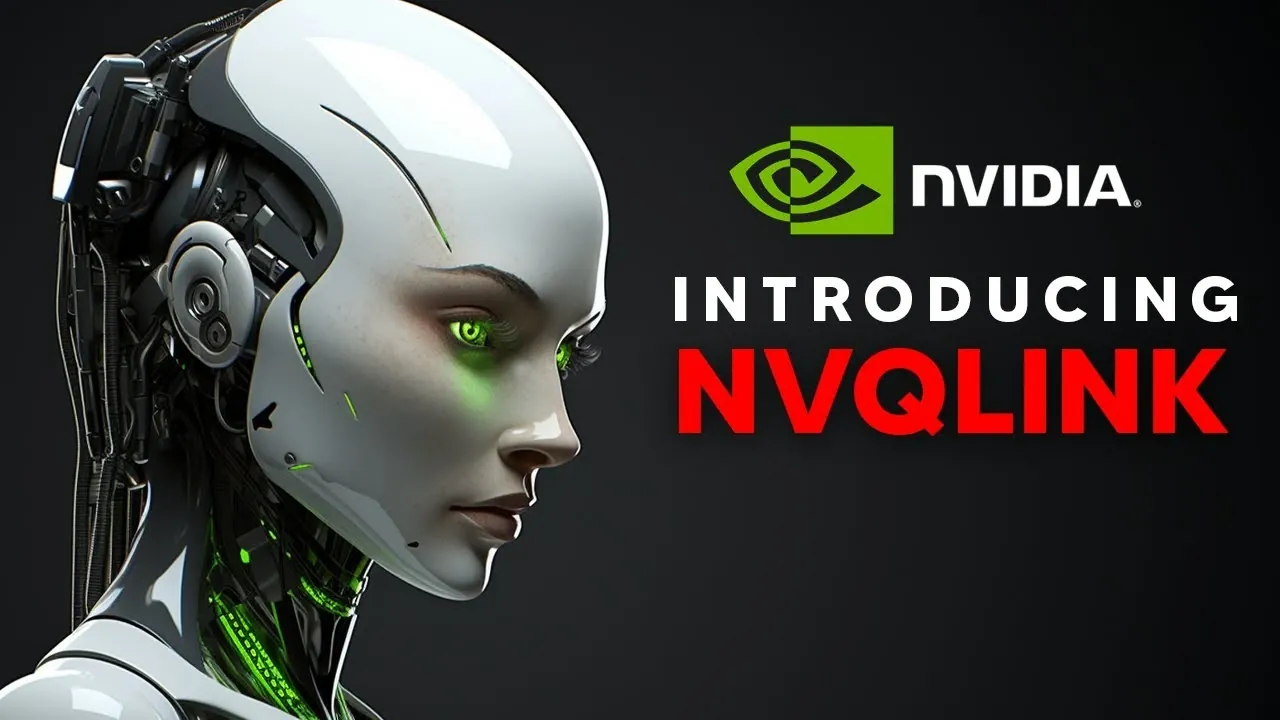
What if the future of artificial intelligence wasn’t just faster or smarter, but fundamentally redefined? NVIDIA’s latest breakthrough, the NVQLink, promises exactly that. By creating a high-speed bridge between quantum computers and AI supercomputers, NVIDIA has unlocked a new era of computational synergy. Imagine AI systems capable of processing vast datasets in real time, powered by the unparalleled speed and precision of quantum mechanics. This isn’t just an incremental step forward, it’s a seismic shift in how we approach problem-solving, from drug discovery to climate modeling. Yet, as with any fantastic technology, this leap raises profound questions about accessibility, security, and the ethical boundaries of innovation.
In this explanation, the AI Grid uncover how NVQLink is poised to reshape industries and redefine the limits of AI. You’ll discover how quantum computing’s unique properties, like superposition and entanglement, are being harnessed to tackle challenges previously deemed unsolvable. We’ll also delve into the hybrid potential of quantum-AI systems, from allowing personalized medicine to transforming financial systems. But this isn’t just a story of promise, it’s one of responsibility. As we stand on the brink of a quantum-AI revolution, the stakes have never been higher. What does this mean for society, and are we ready for the profound changes it will bring?
NVIDIA’s NVQLink Unveiled
TL;DR Key Takeaways :
- NVIDIA has introduced NVQLink, a new technology that connects quantum computers with AI supercomputers, allowing seamless collaboration and advancing computational science.
- Quantum computing uses qubits and superposition to perform complex calculations, offering fantastic applications in drug discovery, climate science, financial optimization, and AI development.
- NVQLink enhances quantum computing by integrating it with NVIDIA’s GPUs, providing real-time error correction, hybrid computing support, and improved energy efficiency for diverse industries.
- The integration of quantum computing and AI through NVQLink accelerates AI training, reduces energy consumption, and expands applications in personalized medicine, public health, and financial systems.
- Challenges such as workforce disruption, economic inequality, data security risks, and overhyped expectations must be addressed to ensure responsible and equitable adoption of quantum-AI technologies.
Understanding Quantum Computing
Quantum computing introduces a innovative approach to processing information. Unlike classical bits, which exist in binary states of 0 or 1, quantum bits, or qubits, can exist in multiple states simultaneously due to the phenomenon of superposition. This unique property allows quantum computers to perform complex calculations at speeds unattainable by traditional systems.
For instance, quantum computing can:
- Optimize intricate systems: Applications include improving supply chain logistics, traffic flow management, and resource allocation.
- Advance scientific research: Simulating molecular interactions can accelerate drug discovery and material innovation.
- Analyze massive datasets: Quantum systems can process large-scale data with unparalleled speed and precision.
Despite its potential, quantum computing faces significant challenges. Qubits are highly sensitive to environmental factors, leading to errors that require sophisticated correction mechanisms. Maintaining qubit stability demands highly controlled environments, making scalability a complex endeavor. Nevertheless, the potential applications of quantum computing remain vast, offering solutions to problems previously deemed insurmountable.
Innovative Applications of Quantum Computing
Quantum computing is poised to transform numerous industries by addressing challenges that classical computers cannot efficiently solve. Some of the most promising applications include:
- Drug Discovery: Quantum simulations enable researchers to model molecular interactions with unprecedented accuracy, expediting the development of treatments for diseases such as cancer and Alzheimer’s.
- Climate Science: Enhanced climate models powered by quantum systems can improve predictions, aiding in the development of strategies to mitigate climate change.
- Financial Optimization: Quantum algorithms can optimize investment portfolios in real time and provide more accurate risk assessments.
- Artificial Intelligence: Faster data processing and model training can unlock new possibilities in machine learning and AI development.
These applications highlight the fantastic potential of quantum computing, particularly when integrated with advanced AI systems.
NVIDIA’s Quantum Link Connecting Qubits to GPUs
Learn more about Quantum computing by reading our previous articles, guides and features :
- Microsoft’s Majorana 1 Chip: A Quantum Computing Breakthrough
- Quantum Computing Breakthroughs in 2025 Explained
- How Quantum Computing is Transforming AI and Cybersecurity
- Artificial Intelligence vs Quantum Computing
- Quantum computing Hype vs Reality explained
- How Google’s Willow Chip is Advancing Quantum Computing
- Intel Quantum Computing SDK released
- How Quantum Computers Threaten to Break Modern Encryption
- Google’s Willow Chip Sets a New Standard in Quantum Computing
- Google’s Verifiable Quantum Advantage: What It Means for Science
NVIDIA’s NVQLink: Bridging Quantum and Classical Computing
NVIDIA’s NVQLink is a high-speed connectivity platform that bridges the gap between quantum processors and NVIDIA’s advanced GPUs. This hybrid system uses the strengths of both quantum and classical computing, addressing their respective limitations to create a more robust computational framework. By allowing real-time error correction through AI algorithms, NVQLink enhances the reliability and scalability of quantum systems.
Key features of NVQLink include:
- Versatility: Compatibility with multiple quantum computing technologies ensures broad applicability across industries.
- Hybrid Computing Support: The integration of quantum and classical systems optimizes workflows for diverse applications.
- Energy Efficiency: Improved energy utilization reduces the computational cost of solving complex problems.
This innovation is expected to accelerate advancements in fields such as healthcare, material science, and environmental sustainability. For example, researchers can simulate protein folding with greater precision, leading to the development of novel medical treatments. Similarly, NVQLink can aid in designing energy-efficient materials, addressing global challenges like resource scarcity and climate change.
Implications for Artificial Intelligence
The integration of quantum computing with AI through NVQLink has profound implications for the future of technology. AI training, which often requires immense computational resources, can become significantly faster and more efficient. This not only reduces operational costs but also minimizes energy consumption, contributing to more sustainable AI development.
The ability to process vast datasets in real time expands the scope of AI applications. For example:
- Personalized Medicine: AI systems could analyze genetic data to tailor medical treatments to individual patients.
- Public Health: Predictive models could forecast disease outbreaks with greater accuracy, allowing proactive responses.
- Financial Systems: Real-time risk assessments and market predictions could enhance decision-making in the financial sector.
By combining the computational power of quantum systems with the analytical capabilities of AI, NVQLink has the potential to redefine how industries approach problem-solving, driving innovation across multiple domains.
Challenges and Risks
While NVQLink represents a significant technological advancement, it also introduces challenges and risks that must be carefully managed. These include:
- Workforce Disruption: The automation of tasks traditionally performed by humans could lead to job displacement in certain sectors.
- Economic Inequality: The high cost of quantum technologies may limit access to large corporations and wealthy nations, exacerbating the digital divide.
- Data Security: Quantum computers have the potential to break current encryption standards, posing serious threats to cybersecurity.
- Unintended Consequences: The full implications of quantum-AI hybrid systems are not yet understood, raising concerns about unforeseen outcomes.
- Overhyped Expectations: While NVQLink is a major step forward, practical large-scale quantum computing may still be years or decades away, risking unrealistic expectations.
Addressing these challenges will require a collaborative effort among researchers, policymakers, and industry leaders to ensure that the benefits of quantum-AI integration are realized responsibly and equitably.
The Path Forward
NVIDIA’s NVQLink represents a pivotal milestone in the integration of quantum and classical computing. By addressing the limitations of quantum systems and amplifying the capabilities of AI, this technology has the potential to transform industries ranging from healthcare to environmental science. However, its development must be accompanied by a commitment to ethical considerations, equitable access, and robust security measures.
As the world moves toward a future shaped by quantum-AI integration, the opportunities are immense. Yet, the success of this technology will depend on responsible innovation and a collective effort to navigate the risks and uncertainties that accompany such fantastic advancements.
Media Credit: TheAIGRID
Disclosure: Some of our articles include affiliate links. If you buy something through one of these links, Geeky Gadgets may earn an affiliate commission. Learn about our Disclosure Policy.
