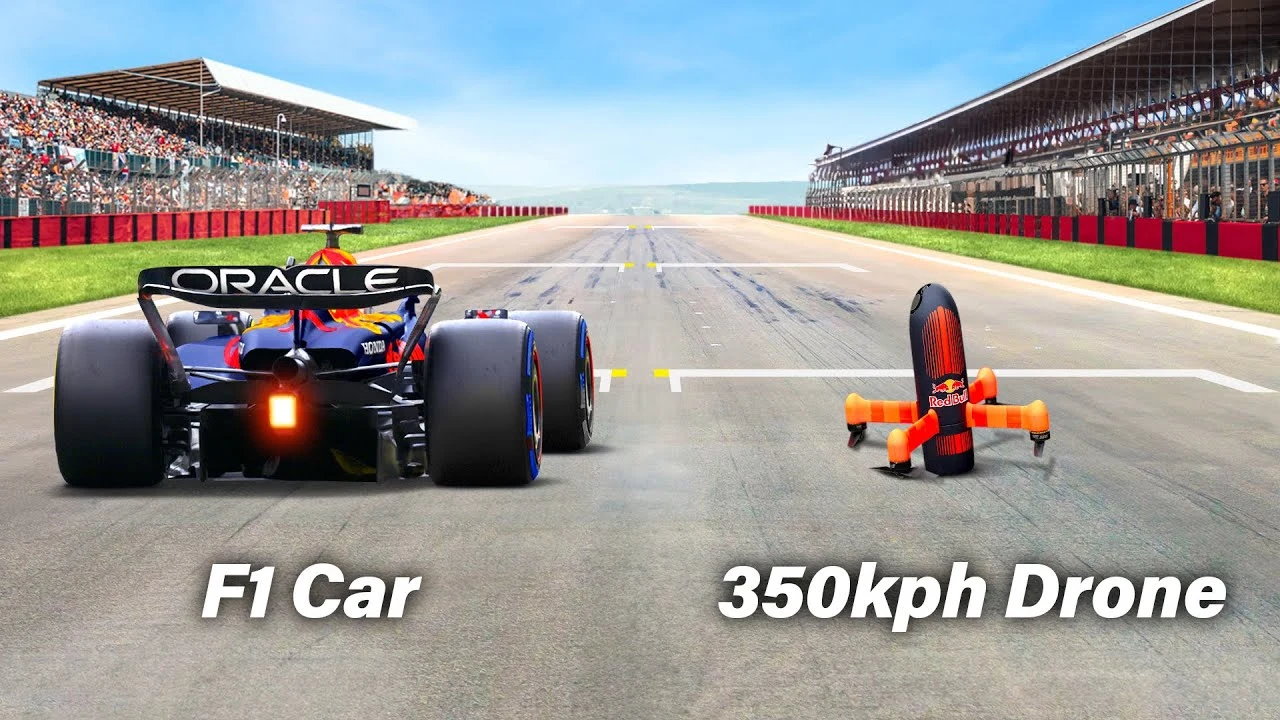
In a remarkable feat of engineering, the world’s fastest camera drone has gone head-to-head with the incredible speed of a Formula 1 car. This drone, designed to capture high-speed footage, had the daunting task of keeping up with Max Verstappen, a three-time world champion, as he raced his RB20 F1 car around the iconic Silverstone circuit.
Picture a drone, which we usually see hovering for scenic shots, racing alongside an F1 car, a machine synonymous with speed, power, and cutting-edge aerodynamics. To make this possible, the drone underwent a rigorous design and testing phase to push its limits. It needed to be swift, nimble, and sturdy enough to provide a stable video feed without succumbing to the heat of the chase.
The creation of this drone was a team effort, involving aerodynamics experts who fine-tuned its shape for the best airflow. Material scientists chose high-tech composites to ensure the drone was both tough and light. Every component, from the propellers to the body, was put through extensive testing to guarantee the drone could withstand the high-speed chase.
Camera Drone vs Formula One Car

Here are some other articles you may find of interest on the subject of drone technology :
- How to build a drone tracking radar
- Unique modular Dragon Drone created by University of Tokyo
- BW-Space 4K Underwater Drone
A key aspect of this mission was the drone’s video transmission system. To give viewers a flawless live feed, the drone was fitted with the latest technology that could cope with the high speeds and maintain a strong signal over the distance from the receiver.
However, the drone had significant hurdles to overcome. Keeping up with the RB20, which can exceed speeds of 200 mph, is a huge challenge for any drone, as they are generally built for slower speeds. The drone’s battery, motor longevity, and cooling systems were all pushed to their limits.
The pinnacle of this technological achievement was a stunning display of velocity and precision. As Verstappen skillfully took on Silverstone’s twists and turns, the drone was right there with him, providing a dynamic, aerial perspective of the action. The footage captured was a clear indication of the drone’s capability to handle the complex aerodynamics of the circuit in real-time.
This groundbreaking event has not only highlighted the progress in camera drone technology but has also introduced new opportunities for sports broadcasting. The world’s fastest camera drone has set a new standard, offering an engaging experience that brings spectators even closer to the thrilling realm of Formula 1 racing.
High-Speed Camera Drone
The engineering behind the world’s fastest camera drone is a marvel of modern technology. To match the pace of a Formula 1 car, which is the epitome of high-speed performance, the drone had to be meticulously designed. Formula 1 cars are engineered to reach speeds over 200 mph, with acceleration and handling that push the boundaries of physics. The drone, therefore, required a level of agility and speed that is atypical for conventional drones, which are often optimized for stability and endurance rather than outright speed.
The design process involved a multidisciplinary approach, incorporating insights from aerodynamics, materials science, and electronics. Aerodynamics experts worked on optimizing the drone’s shape to reduce drag and increase maneuverability, ensuring it could slice through the air with minimal resistance. The materials chosen for the drone’s construction had to strike a delicate balance between strength and weight, as any unnecessary mass could reduce its top speed and agility.
Advanced Video Transmission and Drone Durability
The video transmission system of the drone is a critical component that required advanced technology. High-speed footage demands a system that can transmit data quickly and reliably, even when the drone is moving at breakneck speeds. The technology had to ensure a stable and high-quality video feed that could be broadcast live, capturing every thrilling moment of the race without lag or interruption. This is a challenging feat, given that high speeds can introduce signal noise and reduce the quality of the transmission.
Durability was another significant challenge. The drone’s battery and motors had to endure the high demands of rapid acceleration and sustained high-speed flight. Additionally, cooling systems were crucial to prevent overheating, which could lead to failure of electronic components. These systems had to be efficient yet lightweight, adding to the complexity of the drone’s design. Engineers had to ensure that every part of the drone, from the propellers to the onboard electronics, could withstand the intense conditions of racing alongside an F1 car.
Revolutionizing Sports Broadcasting with Drone Technology
The successful flight of the drone alongside Max Verstappen’s RB20 F1 car at Silverstone was a demonstration of velocity and precision. The drone’s ability to keep up with the car and provide stable, high-speed footage showcased the potential of this technology to revolutionize sports broadcasting. The dynamic aerial perspective offered by the drone adds a new dimension to the viewing experience, allowing fans to witness the race from angles previously unattainable.
This achievement in camera drone technology opens up new possibilities for how sporting events are filmed and viewed. The immersive experience provided by such high-speed drones can bring audiences closer to the action, offering a sense of speed and excitement that complements traditional camera angles. As technology continues to advance, we can expect drones to play an increasingly significant role in sports broadcasting, offering unique and captivating views that enhance the spectator experience.
Image Credit : Red Bull
Disclosure: Some of our articles include affiliate links. If you buy something through one of these links, Geeky Gadgets may earn an affiliate commission. Learn about our Disclosure Policy.
